By Marcellus Roberts
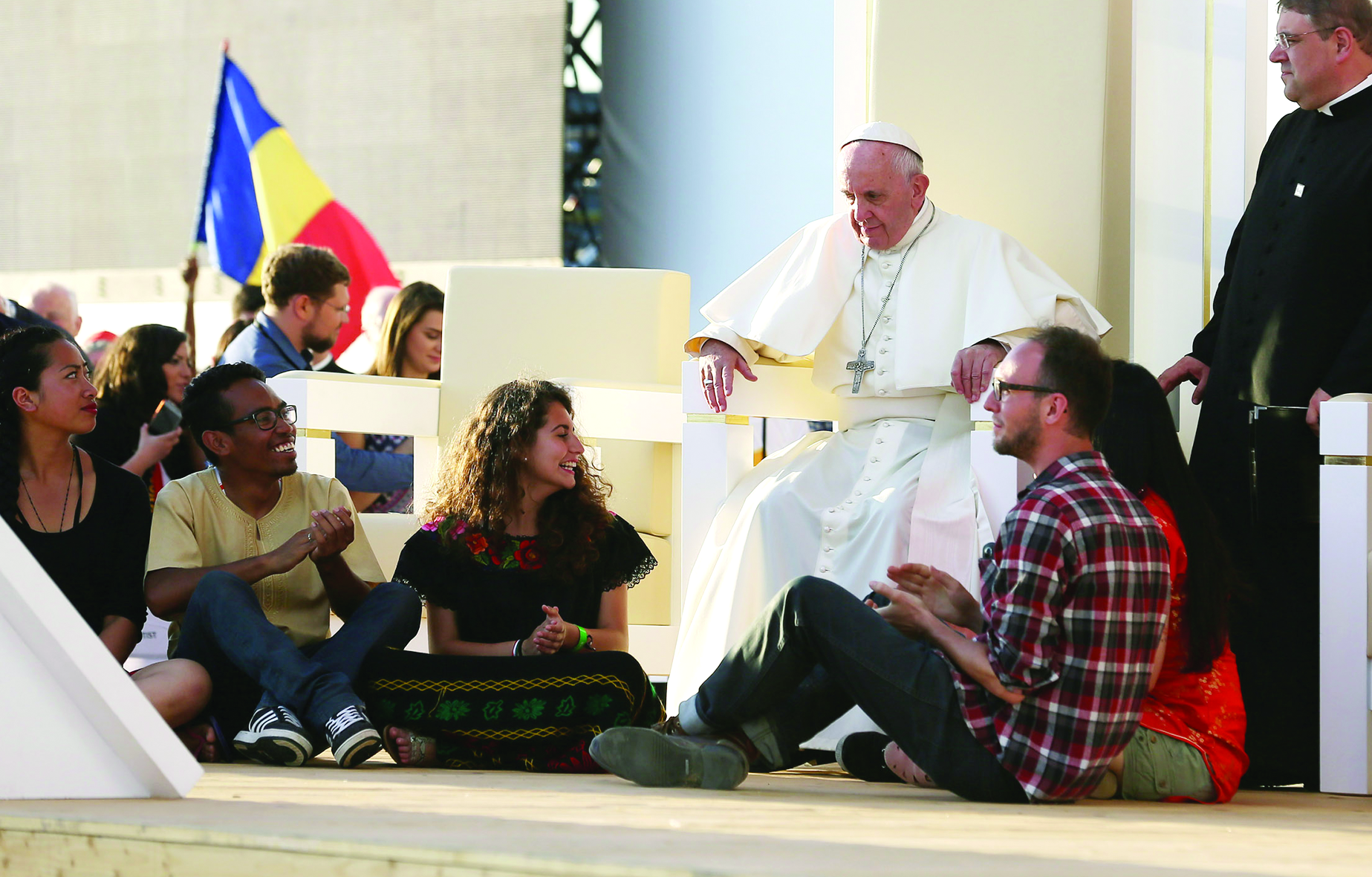
Pope Francis with World Youth Day pilgrims before a prayer vigil in Krakow, Poland, in 2016. (Photo – Grzegorz Galazka)
Fearlessness and patience. They are two qualities that occupy opposite ends of the spectrum for those who define fearlessness as being rash or impulsive, while interpreting patience as a slow passivity.
Yet, human beings are complex and carry a mixed bag of qualities that make for unique personalities — and result in each one’s distinctive contribution to history.
In Pope Francis, these two features, fearlessness and patience, wrestled in the womb like Esau and Jacob, resulting in a pontificate that was able to communicate a far-reaching message of invitation that stimulated the very edges of society — what Pope Francis liked to refer to as the “periphery.”
The message, wrapped in ambiguity at times and clouded by a media storm which followed the Argentinian over land and sea, shook sluggish Catholics into a vigilant alertness of discernment.
It also perked the ears of those who lie just outside of the Church’s usual line of sight, giving glimmers of hope that some might seriously consider being reconciled to Holy Mother Church.
This Pope had turned and met the outcast eye to eye.
Looking back, now that the Holy Father, Pope Francis, has fought his final battle, committing his spirit to the hands of our Eternal Father, my perspective of his pontificate, which in the fray seemed askew and disorienting, appears logical, methodical and hyper-real.
Keys fer interpretation
Upon reviewing his early Apostolic Exhortation, Evangelii Gaudium, I found a couple of keys that are helpful for interpreting the actions and choices Pope Francis made.
These keys are the abiding lessons I have learned from Pope Francis and his reign from the chair of St. Peter.
The first of these keys comes from line 129 of Evangelii Gaudium, which reads, “The ultimate aim should be that the Gospel, as preached in categories proper to each culture, will create a new synthesis with that particular culture. This is always a slow process and at times we can be overly fearful.”
I’m sure the kids loved the young Father Bergoglio most of all because he wasn’t afraid of getting his dress shoes dirty or sweating out his clerical collar by stepping onto the soccer field and kicking the ball around a bit, his mind never drifting far from the ultimate aim of getting the ball past the goalie and into the net.
As a pontiff, he brought that same deliberate focus to his leadership style with the intention of delivering the Gospel, “…proper to each culture..,” and creating a “… new synthesis with that particular culture.”
Sacred Scripture provides an example of preaching proper to the culture in its account of St. Paul’s address to the Areopagus: the way he recognized God working within the native culture of Athens as “an unknown god,” and cooperated with what God was already doing.
Pope Francis believed that we also encounter God hidden but active in the cultures around us. His pontificate was his own personal effort to collaborate with God’s grace by communicating to the culture in a language understood by the culture.
If you were invited (and you are) to enter into the walls of this prison and deliver the Gospel to its inhabitants, how would you do it? With the same words you’d use up the street at Sacred Heart Parish? Using the same analogies that would make sense at a national bishops’ conference?
Of course, you come as you are. But my advice is that you also come to learn. Learn the nuances of prison culture. Immerse yourself, as much as possible, into the unique day-to-day of the inmate experience. Pay attention, tear down your walls, use that material to make bridges, and only then should you be expected to facilitate lasting conversion of souls.
Pope Francis uses the word “synthesis.” His use of this word probably meant one of two things according to Merriam-Webster’s Collegiate Dictionary: “… the composing or combination of parts or elements so as to form a whole…”, or, the better-suited definition, “… the dialectic combination of thesis and antithesis into a higher stage of truth.”
The synthesis he sought to encourage can only come about by instigating dialogue between two parties holding opposing points of view: the Church and the culture. And instigate, he did.
I came to the conclusion that Pope Francis was an instigator of dialogue when I was confronted one morning by a Protestant about the allowance for the blessing of same-sex couples.
My concealed, knee-jerk response was frustration and defensiveness. Many times throughout Pope Francis’ pontificate I’d been approached before work at 4:30am about something Pope Francis had supposedly said on TV or in some news report. (And my patience is shortest early in the morning.)
After taking time to thoughtfully consider my response, I was able to see Pope Francis’ invitation in its proper light and explain it in a way my Protestant brother could understand. It was not a blessing of same-sex marriage; there is no such thing. Neither was it a blessing of the relationship itself, but of the individuals.
At any Mass there may be those who refrain from receiving the Holy Eucharist because of an attachment to some unconfessed mortal sin, yet the Church encourages these unrepentant Catholics, along with non-Catholic visitors, and anyone in attendance, to approach the altar and receive a blessing from the presiding priest during the liturgy of the Eucharist.
Pope Francis was extending a priestly blessing to a particular segment of an unconverted culture on the peripheries, in a way that they could understand.
He instigated the dialogue between a Protestant and me, a Protestant who is now attending R.C.I.A. classes. Together, we were elevated to a higher stage of truth.
Prioritizing time over place
The second key to unlocking the fruitfulness of the reign of Pope Francis is his principle of prioritizing time over place.
In this, Pope Francis echoes Benedictine spirituality, the vow of stability and its virtues.
Simply put, prioritizing time over place or space means committing to the process of transforming the culture around you. Transformation is a process over time, not a moment in time.
An evangelistic effort is like the life cycle of a fig tree. There is a considerable amount of time between sowing, germination, sprouting leafing, budding, fruiting and reaping.
Line 223 of Evangelii Gaudium says, “This principle enables us to work slowly but surely, without being obsessed with immediate results. It helps us patiently endure difficult and adverse situations, or inevitable changes in our plans.”
Not going anywhere for a while? I often imagine what the last ten years of my life would look like from the screen of a GPS tracker. A small speck swirling in place like a rotifer under the lens of a microscope, spinning its revolving wheels of cilia from one boundary of its petri dish to the other.
Not once, in the last ten years, have I left the hundred and fifty yard radius that surrounds the bunk upon which I sleep.
In February I was denied my first parole and my next interview was scheduled for five years from now. It is providential that I have been exhorted to prioritize time over place or space.
I hope to harvest an abundance of fruit, from seemingly bare shoots, once what’s above ground finally reflects the depth and breadth of its roots.
I will always remember Pope Francis as a fearless instigator of dialogue and a patient pioneer of the new evangelization, who benefitted from the fervent prayers of a righteous man, Pope Emeritus Benedict XVI.
Under that protective covering, he inspired the next generation of Catholics to be unafraid to venture to the peripheries and invite all to the kingdom of God.
Let us hold fast to the lessons that he taught us by word and deed.
“It must involve a process of inculturation if the Gospel is to take flesh in each people’s culture. There will be times of defeat. With regard to individuals, groups, and peoples it is only by degrees that [ the Church] touches and penetrates them, and so receives them into a fullness which is Catholic.”
Eternal rest grant unto them, O Lord, and let perpetual light shine upon them. May they rest in peace.