More than a century ago, Monsignor Robert Hugh Benson foresaw the rise of secular humanism, the contraction of the Catholic Church, and the coming of the Antichrist
By ITV Staff
 Editor’s Note: The passage below is from the novel Lord of the World, written by the English Catholic convert Monsignor Robert Hugh Benson (the son of the Anglican Archbishop of Canterbury) in 1907. He attempts a vision of the world more than a century in the future — in the early 21st century… our own time… predicting the rise of Communism, the fall of faith in many places, the advance of technology (he foresees helicopters) and so forth up until… the Second Coming of the Lord, with which his vision ends. For this reason, and also because Pope Benedict and Pope Francis have repeatedly cited the book, saying its clarification of the danger of a type of humanitarianism without God is a true danger that we do face, we print a selection from it in ITV, now and in the months ahead.
Lord of the World
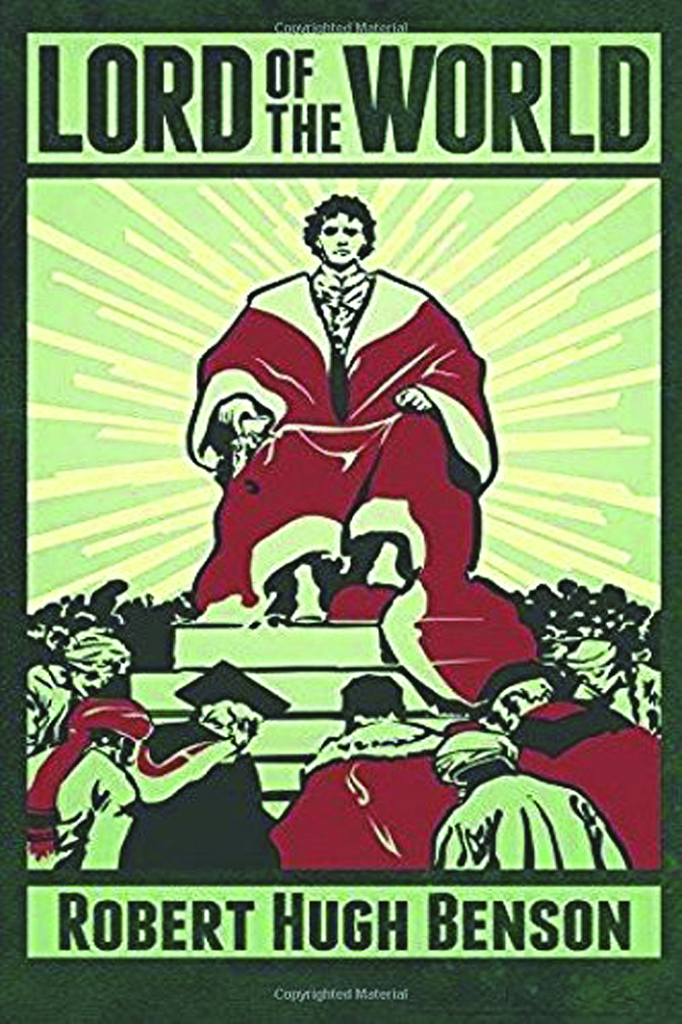
By Robert Hugh Benson (1907)
Book II, The Encounter, Chapter VIII, Section I
(Note: After the fall of Rome to the forces of the President of Europe, Julian Felsenburgh, and violence against Christians in the London streets, crowds gather at Westminster Abbey in anticipation of Felsenburgh’s personal appearance. Mabel, in the crowd, tells herself that “God was man, and Felsenburgh his Incarnation!”)
At about a quarter to ten the crowd at the west end of Victoria Street began to raise its voice in a song, and by the time that was over, and the bells had burst out from the Abbey towers, a rumour had somehow made its entrance that Felsenburgh was to be present at the ceremony. There was no assignable reason for this, neither then nor afterwards; in fact, the Evening Star declared that it was one more instance of the astonishing instinct of human beings en masse; for it was not until an hour later that even the Government were made aware of the facts. Yet the truth remained that at half-past ten one continuous roar went up, drowning even the brazen clamour of the bells, reaching round to Whitehall and the crowded pavements of Westminster Bridge, demanding Julian Felsenburgh. Yet there had been absolutely no news of the President of Europe for the last fortnight, beyond an entirely unsupported report that he was somewhere in the East.
And all the while the motors poured from all directions towards the Abbey and disappeared under the arch into Dean’s Yard, bearing those fortunate persons whose tickets actually admitted them to the church itself. Cheers ran and rippled along the lines as the great men were recognised—Lord Pemberton, Oliver Brand and his wife, Mr. Caldecott, Maxwell, Snowford, with the European delegates—even melancholy-faced Mr. Francis himself, the Government ceremoniarius, received a greeting. But by a quarter to eleven, when the pealing bells paused, the stream had stopped, the barriers issued out to stop the roads, the wire palisadings vanished, and the crowd for an instant, ceasing its roaring, sighed with relief at the relaxed pressure, and surged out into the roadways. Then once more the roaring began for Julian Felsenburgh.
The sun was now high, still a copper disc, above the Victoria Tower, but paler than an hour ago; the whiteness of the Abbey, the heavy greys of Parliament House, the ten thousand tints of house-roofs, heads, streamers, placards began to disclose themselves.
A single bell tolled five minutes to the hour, and the moments slipped by, until once more the bell stopped, and to the ears of those within hearing of the great west doors came the first blare of the huge organ, reinforced by trumpets. And then, as sudden and profound as the hush of death, there fell an enormous silence.
II
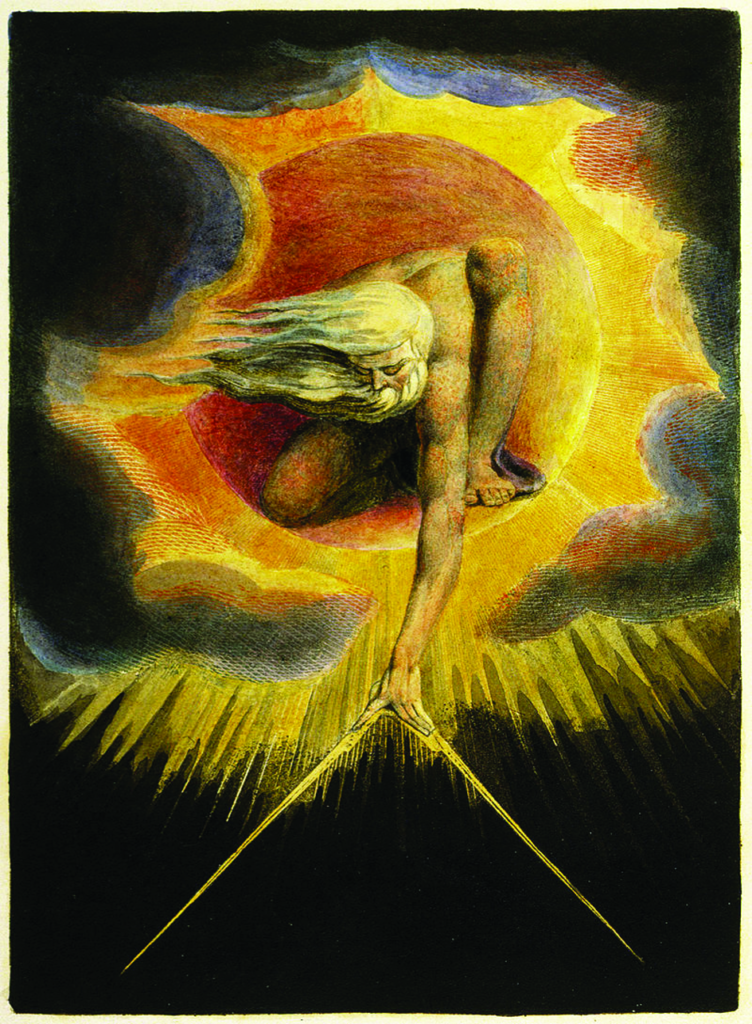
God as depicted by British poet William Blake as the “architect of creation,” the “Ancient of Days,” now in the British Museum, London
As the five-minutes bell began, sounding like a continuous wind-note in the great vaults overhead, solemn and persistent, Mabel drew a long breath and leaned back in her seat from the rigid position in which for the last half-hour she had been staring out at the wonderful sight. She seemed to herself to have assimilated it at last, to be herself once more, to have drunk her fill of the triumph and the beauty. She was as one who looks upon a summer sea on the morning after a storm. And now the climax was at hand.
From end to end and side to side the interior of the Abbey presented a great broken mosaic of human faces; living slopes, walls, sections and curves. The south transept directly opposite to her, from pavement to rose window, was one sheet of heads; the floor was paved with them, cut in two by the scarlet of the gangway leading from the chapel of St. Faith—on the right, the choir beyond the open space before the sanctuary was a mass of white figures, scarved and surpliced; the high organ gallery, beneath which the screen had been removed, was crowded with them, and, far down beneath, the dim nave stretched the same endless pale living pavement to the shadow beneath the west window. Between every group of columns behind the choir-stalls, before her, to right, left, and behind, were platforms contrived in the masonry; and the exquisite roof, fan-tracery and soaring capital, alone gave the eye an escape from humanity. The whole vast space was full, it seemed, of delicate sunlight that streamed in from the artificial light set outside each window, and poured the ruby and the purple and the blue from the old glass in long shafts of colour across the dusty air, and in broken patches on the faces and dresses behind. The murmur of ten thousand voices filled the place, supplying, it seemed, a solemn accompaniment to that melodious note that now pulsed above it. And finally, more significant than all, was the empty carpeted sanctuary at her feet, the enormous altar with its flight of steps, the gorgeous curtain and the great untenanted sedilia.
* * * *
Mabel needed some such reassurance, for last night, until the coming of Oliver, had passed for her as a kind of appalling waking dream. From the first shock of what she had seen outside the church, through those hours of waiting, with the knowledge that this was the way in which the Spirit of Peace asserted its superiority, up to that last moment when, in her husband’s arms, she had learned of the Fall of Rome, it had appeared to her as if her new world had suddenly corrupted about her. It was incredible, she told herself, that this ravening monster, dripping blood from claws and teeth, that had arisen roaring in the night, could be the Humanity that had become her God. She had thought revenge and cruelty and slaughter to be the brood of Christian superstition, dead and buried under the new-born angel of light, and now it seemed that the monsters yet stirred and lived. All the evening she had sat, walked, lain about her quiet house with the horror heavy about her, flinging open a window now and again in the icy air to listen with clenched hands to the cries and the roarings of the mob that raged in the streets beneath, the clanks, the yells and the hoots of the motor-trains that tore up from the country to swell the frenzy of the city—to watch the red glow of fire, the volumes of smoke that heaved up from the burning chapels and convents.
She had questioned, doubted, resisted her doubts, flung out frantic acts of faith, attempted to renew the confidence that she attained in her meditation, told herself that traditions died slowly; she had knelt, crying out to the spirit of peace that lay, as she knew so well, at the heart of man, though overwhelmed for the moment by evil passion. A line or two ran in her head from one of the old Victorian poets:
You doubt If any one Could think or bid it? How could it come about?… Who did it? Not men! Not here! Oh! not beneath the sun…. The torch that smouldered till the cup o’er-ran The wrath of God which is the wrath of Man!
She had even contemplated death, as she had told her husband — the taking of her own life, in a great despair with the world. Seriously she had thought of it; it was an escape perfectly in accord with her morality. The useless and agonising were put out of the world by common consent; the Euthanasia houses witnessed to it. Then why not she?… For she could not bear it!… Then Oliver had come, she had fought her way back to sanity and confidence; and the phantom had gone again.
How sensible and quiet he had been, she was beginning to tell herself now, as the quiet influence of this huge throng in this glorious place of worship possessed her once more—how reasonable in his explanation that man was even now only convalescent and therefore liable to relapse. She had told herself that again and again during the night, but it had been different when he had said so. His personality had once more prevailed; and the name of Felsenburgh had finished the work.
“If He were but here!” she sighed. But she knew He was far away.
* * * *
It was not until a quarter to eleven that she understood that the crowds outside were clamouring for Him too, and that knowledge reassured her yet further. They knew, then, these wild tigers, where their redemption lay; they understood what was their ideal, even if they had not attained to it. Ah! if He were but here, there would be no more question: the sullen waves would sink beneath His call of peace, the hazy clouds lift, the rumble die to silence. But He was away—away on some strange business. Well; He knew His work. He would surely come soon again to His children who needed Him so terribly.
She had the good fortune to be alone in a crowd. Her neighbour, a grizzled old man with his daughters beyond, was her only neighbour, and a stranger. At her left rose up the red-covered barricade over which she could see the sanctuary and the curtain; and her seat in the tribune, raised some eight feet above the floor, removed her from any possibility of conversation. She was thankful for that: she did not want to talk; she wanted only to control her faculties in silence, to reassert her faith, to look out over this enormous throng gathered to pay homage to the great Spirit whom they had betrayed, to renew her own courage and faithfulness. She wondered what the preacher would say, whether there would be any note of penitence. Maternity was his subject—that benign aspect of universal life—tenderness, love, quiet, receptive, protective passion, the spirit that soothes rather than inspires, that busies itself with peaceful tasks, that kindles the lights and fires of home, that gives sleep, food and welcome….
The bell stopped, and in the instant before the music began she heard, clear above the murmur within, the roar of the crowds outside, who still demanded their God. Then, with a crash, the huge organ awoke, pierced by the cry of the trumpets and the maddening throb of drums. There was no delicate prelude here, no slow stirring of life rising through labyrinths of mystery to the climax of sight—here rather was full-orbed day, the high noon of knowledge and power, the dayspring from on high, dawning in mid-heaven. Her heart quickened to meet it, and her reviving confidence, still convalescent, stirred and smiled, as the tremendous chords blared overhead, telling of triumph full-armed. God was man, then, after all — a God who last night had faltered for an hour, but who rose again on this morning of a new year, scattering mists, dominant over his own passion, all-compelling and all-beloved. God was man, and Felsenburgh his Incarnation! Yes, she must believe that! She did believe that! (to be continued)