North America, again, is largely snubbed in favor of the second and third worlds
By Christina Deardurff

(Photo Grzegorz Galazka)
Pope Francis has once again named a group of 21 new cardinals from around the world, to be installed at a December 8 consistory, bringing the number of cardinal-electors in the College of Cardinals to 142 — far exceeding the limit of 120 set by Pope Paul VI in the 1970s.
And once again, Francis remains true to his desire to include the “Church of the peripheries” by choosing men from the second and third worlds in larger proportion than those from the first world. Representation from North America, especially, is absent from the list, with a lone exception: the 53-year-old Archbishop of Toronto, Canada, Francis Leo.
Europe is represented by a Serb, a Lithuanian, an Englishman and five Italians.
The Serb is Archbishop László Nemet, SVD, metropolitan archbishop of Belgrade; the Lithuanian is Archbishop Rolandas Makrickas, currently coadjutor archpriest of the Basilica of St. Mary Major in Rome.
The Englishman is the former Master of the worldwide Order of Preachers — the Dominicans — Father Timothy Radcliffe. Recently, Pope Francis tapped Fr. Radcliffe as retreat master for the preparatory retreats, in 2023 and 2024, for the two sessions of the Synod on Synodality.
Of the five Italians, three of them are diocesan bishops — Archbishop Roberto Repole of Turin, Bishop Baldassare Reina, vicar of the Rome diocese, and Archbishop Domenico Battaglia of Naples — and two work or did work for the Vatican — Father Fabio Baggio, CS, a current undersecretary of the Dicastery for Human Development, and Archbishop Angelo Acerbi, a retired apostolic nuncio with several foreign postings in his history. (Unusually, Naples’ Archbishop Battaglia is an 11th-hour replacement for Indonesian Bishop Paskalis Bruno Syukur, OFM, a former Franciscan provincial and a leader in the Indonesian Bishops’ Conference, who declined the Pope’s appointment as cardinal in late October. Bishop Syukur pled that he wished to instead “continue to grow in priestly life and in service to the Church and the People of God.” The Indonesian press also notes his reportedly poor handling of a sexual abuse case in his Diocese of Bogor.)
Another European, but one whose work is in Australia, is Ukrainian-born Bishop Mykola Bycok, CSsR, who heads the Ukrainian Catholic Eparchy, centered in Melbourne but covering Australia, New Zealand and Oceania.
Another significant chunk of the new cardinals — five — come from the Pope’s home continent of South America. They are the archbishop of Santiago del Estero, Argentina, Vicente Bokalic Iglic; the archbishop of Porto Alegre, Brazil, Jaime Spengler; the archbishop of Santiago, Chile, Fernando Natalio Chomali Garib; the archbishop of Guayaquil, Ecuador, Luis Gerardo Cabrera Herrera; and the archbishop of Lima, Peru, Carlos Gustavo Castillo Mattasoglio. (As an aside, we note that the Pope’s home country of Argentina, with the latest appointments, now has eight cardinals — a higher proportion relative to population than most countries.)
Asia, where the Catholic Church has seen a steady growth rate of around 1.8% per year, now has two new cardinals: Tarcisio Isao Kikuchi, the archbishop of Tokyo, and Pablo Virgilio Sinogco David, the bishop of Kalookan, Philippines.
Also from Asia, but working as a Vatican Curial official, is Monsignor George Jacob Koovakad, official of the Secretariat of State and organizer of papal trips.
And the new cardinal who shepherds the tiny Catholic Church in Iran, also in Asia, is Archbishop Dominique Joseph Mathieu, OFM Conv, a Belgian missionary bishop of the Tehran-Ispahan diocese, which was first established in Ispahan in 1629.
The continent of Africa, which has shown the Church’s largest growth (approximately 2.1% per year) has two new cardinals: the archbishop of Abidjan, Ivory Coast, Ignace Bessi Dogbo, and the bishop of Algiers, Algeria, Jean-Paul Vesco.
Analyzing their significance
Pundits began to analyze the significance of the Pope’s new appointments the moment they were announced.
The theories ranged from world politics (anti-war Francis, it was argued, chose the Ukrainian Eparchy head in Australia for the red hat rather than Ukraine’s Primate, Sviatoslav Shevchuk, a supporter of Ukraine’s prosecution of the war with Russia) to Church politics (Francis chose Fr. Timothy Radcliffe, one of the current Synod’s public faces, to emphasize his commitment to synodality despite criticism from more traditional quarters in the Church).
Another point of comment has been the fact that 11 of the 21 new cardinals, so more than half, are members of religious orders. That means that these men have not been primarily formed in the context of a local diocese, but rather in religious orders which by their nature transcend physical borders and have a more collegial style of governance.
In other words, they may tend to have a more “global” perspective, which may dovetail better with Francis’ vision of a “synodal” Church having a more “horizontal,” rather than vertical, structure and leadership culture.
Certainly, the face of what we once called “Christendom” is changing rapidly. The nations that were once the pillars holding up the Catholic Church are now facing demographic winter, internal strife, loss of identity and, most tragic of all, loss of faith.
In fact, it has been repeatedly pointed out that the very “peripheries” of the Church are changing; the historical “center” of Catholicism is in Europe, but the vitality — and the numbers — of the body of the Church are increasingly located elsewhere.
Soon Europe itself will be the new “peripheries.”

 Francis Leo
Archbishop of Toronto, Canada
Archbishop Francis Leo, 53, was born in Montreal to Italian immigrant parents. He earned both a licentiate and a doctorate in theology at the International Marian Research Institute, and was ordained a priest in Montreal in 1996. After training for the Vatican diplomatic corps in Rome, he was posted to the apostolic nunciature in Australia (2008-11) and then to the Holy See Study Mission in Hong Kong (2011-12).
In 2012 he returned to Montreal to become director at the Major Seminary. In 2022, Pope Francis appointed him auxiliary bishop of Montreal, and in 2023, as Metropolitan Archbishop of Toronto.
In a 2023 interview with America magazine’s Gerald O’Connor, Archbishop Leo explained that he founded the Canadian Mariological Society after he returned to Montreal from overseas posts in 2012 because “I find there’s a great need to get to know the Mother of Christ, for our own personal journey of faith and for the good of the church.”
He is a member of the third order of the Dominicans, founded by the saint who first received the rosary from Our Lady. And in true Dominican spirit, he says he also likes “Thomas Aquinas and his reasonableness.”
“Faith and reason, they are not enemies, they work together,” he said.

 László (Ladislav) Német
Archbishop of Belgrade, Serbia
Another priest of the Divine Word Missionaries, Archbishop László Német, was born in Odžaci, in then-Yugoslavia, now Serbia, and completed his theological studies in Poland. He was ordained a priest there in 1983.
After missionary work in the Philippines, he moved to Austria and held parish and teaching positions as well as collaborating with the Holy See’s Mission to the UN in Vienna. Subsequently, he was named provincial of the Hungarian Province of his order, then Secretary-General of the Hungarian Bishops’ Conference.
In 2008, Pope Benedict XVI named him Bishop of Zrenjanin. In 2022, Pope Francis made him Archbishop of Belgrade.
Archbishop Német has been the President of the International Episcopal Conference of Saints Cyril and Methodius, which comprises Kosovo, North Macedonia, Montenegro, and Serbia, since 2016. It is a difficult job: in Kosovo, 96% are Muslim. In Macedonia, Montenegro and Serbia, the vast majority are Orthodox, and the Catholic Church is poor in these nations. “Only in Serbia,” said the Archbishop of Belgrade, “do we even have the right to teach religion in schools.”

 Rolandas Makrickas
Archbishop, Lithuania
Archbishop Rolandas Makrickas, 52, was born in Biržai, Lithuania, the youngest of five children. Because of Soviet restriction of religion, his early religious education was private and undertaken in a hostile environment. The end of the Soviet era, in 1990, allowed him to pursue his faith more freely, and though he briefly considered a career in aviation, he entered the Kauna Priest Seminary in 1990, only its second year of operation.
After studies in Rome, he was ordained in 1996, and became undersecretary of the Lithuanian Bishops’ Conference.
Subsequent to training in the Vatican diplomatic service from 2003-06, he was sent to several countries around the globe, including a stint in the U.S. that included the 2013 papal visit. In 2019, he joined the Section for General Affairs of the Secretariat of State in Rome as head of administration, the first non-Italian to hold that position.
In 2021, Pope Francis appointed him extraordinary commissioner to manage the assets of the Basilica of Santa Maria Maggiore (St. Mary Major), making him an archbishop two years later. “It is first of all a shrine,” he says of the basilica, “and the first Marian shrine in Europe.”
On March 20, 2024, Pope Francis named him coadjutor archpriest of Santa Maria Maggiore.

 Timothy Radcliffe
Friar, Order of Friars Preachers, England
Fr. Timothy Radcliffe, OP, 79, was born in London. He was educated at Oxford, entered the Dominican order in 1965 and was ordained in 1971. During the 1970s and 1980s, he taught scriptures at Oxford and was elected provincial of England in 1988. In 1992, he was elected master of the Dominican Order, holding that office until 2001.
After his retirement from heading the worldwide Dominican order, Fr. Radcliffe led the Las Casas Institute, dealing with governance and social justice, at Blackfriars, Oxford. He now preaches internationally.
Some of his views on theology and ethics, especially on topics of sexuality, are criticized by traditionalists as departing from Catholic morality.
Somewhat controversially, Pope Francis tapped Fr. Radcliffe to lead the preparatory retreats before both the 2023 and 2024 sessions of the Synod on Synodality.
In one of his 2023 reflections, he spoke about the concept of “home,” telling the Synod Fathers, “For others, the present Church does not seem to be a safe home. It is experienced as exclusive, marginalizing many people: women, the divorced and remarried. For some it is too Western, too Eurocentric. The IL [Instrumentum Laboris] mentions also gay people and people in polygamous marriages. They long for a renewed Church in which they will feel fully at home, recognized, affirmed and safe.”

 Roberto Repole
Archbishop of Turin, Italy
Archbishop Roberto Repole, 57, was born in Turin, Italy; his father was a municipal government official. He was educated in Turin and received his doctorate in theology from the Pontifical Gregorian University in Rome. He was ordained in 1992. After parish work and then teaching theology at the university level in Turin, he became president of the Italian Theological Association.
In 2022, Pope Francis appointed Fr. Repole both archbishop of Turin and bishop of Susa — a surprise, as he was not then a bishop and his name had not been mentioned in press speculations.
Some commentators have called Archbishop Repole a “Boarinian,” that is, a member of a group of theologically and politically liberal clerics influenced by Sergio Boarino, rector of the Turin seminary in the 1980s and 1990s.
In an article on the appointment of Fr. Repole to the see of Turin, Italian magazine La Rupubblica said that Repole “has expressed his own hope for greater synodality, a recurring theme in Francis’ teaching… ‘Already in the ancient Church,’ he recently wrote, ‘different models of ministry coexisted that seem to go well with a perspective of better synodality, which allows us to think of the bishop as a principle of unity with and in his priests, rather than outside of it.’”
 Baldassare Reina
Bishop, vicar of the Rome diocese, Italy
Bishop Baldassare Reina, 53, known as “Baldo,” was born in San Giovanni Gemini, in the province of Agrigento, in Italy. He was educated in Agrigento and at the Pontifical Gregorian University in Rome, earning a doctorate in theology. He was ordained in 1995.
From 1998 to 2001, he was a diocesan assistant of Catholic Action and a parish priest, later becoming a professor and then rector at the major seminary, and taking on progressively larger roles in diocesan administration.
In 2022, Pope Francis made him a member of the Dicastery for the Clergy.
In January 2023, Reina was appointed vice-regent of the Diocese of Rome — the Pope’s diocese — and on October 6 of this year, when Francis announced the creation of new cardinals, he simultaneously announced the appointment of Bishop Reina as Vicar General for the Diocese of Rome.
In an October 7 letter to Catholics in Rome, Reina wrote that Pope Francis’ “dedication to the universal Church and the prophecy he has given us in these years of pontificate urge me to work for a transparent and poor Church, capable of releasing and spreading the fragrance of the Gospel.”
 Fabio Baggio
Friar, Scalabrian Missionaries, Italy
Fr. Fabio Baggio, CS, 59, was born in Bassano del Grappa in the Italian province of Vicenza. He joined the Scalabrian Missionaries in 1986 and took his perpetual vows in 1991. He was ordained in 1992.
Since the 1990s, Fr. Baggio has been active in various diocesan and university capacities dealing with migration, and in 2013 became dean of the Scalabrini International Migration Institute within the Faculty of Theology of the Pontifical Urbaniana University. A member of the Dicastery for Promoting Integral Human Development since 2017, he was named one of three members of the Vatican’s COVID-19 commission in 2021.
In 2019 he described his section’s message: “So many people who arrive from outside, from cultures different from our own, from expressions of Christian or Catholic life different from ours, are a source of enrichment, and not of impoverishment, for us. Thus, instead of creating the fear of an invasion, which one hears many speak about, the facts should make us want to encounter them.
“If it was truly my brother or sister, would I close the door?”
 Angelo Acerbi
Archbishop, Italy
Archbishop Angelo Acerbi, at 99 the only cardinal-elect ineligible to vote in the next conclave, was born in 1925 in Sesta Godano, in the Italian region of Liguria. After earning a degree in canon law and a licensure in theology, he was trained for and entered the Vatican’s diplomatic service.
He worked as nuncio in Columbia, Brazil, Japan, France, New Zealand, and Fiji, and was made Bishop of Zella, Tunisia, as well.
In 1978 Pope John Paul II appointed him nuncio to Colombia, where the next year he was taken hostage, along with more than 50 diplomats and others, by communist guerillas. He was one of the last released in Havana two months later. Acerbi was allowed to celebrate Mass daily in captivity.
In 1990, he was appointed the first apostolic nuncio to Hungary to be named after the establishment of Communism in that country. During his diplomatic assignment there, the Holy See concluded an agreement with the Republic of Hungary on religious assistance to the Armed Forces and prepared another relating to the financing of public and other purely religious activities carried out by the Catholic Church, in particular the financing of educational activities.

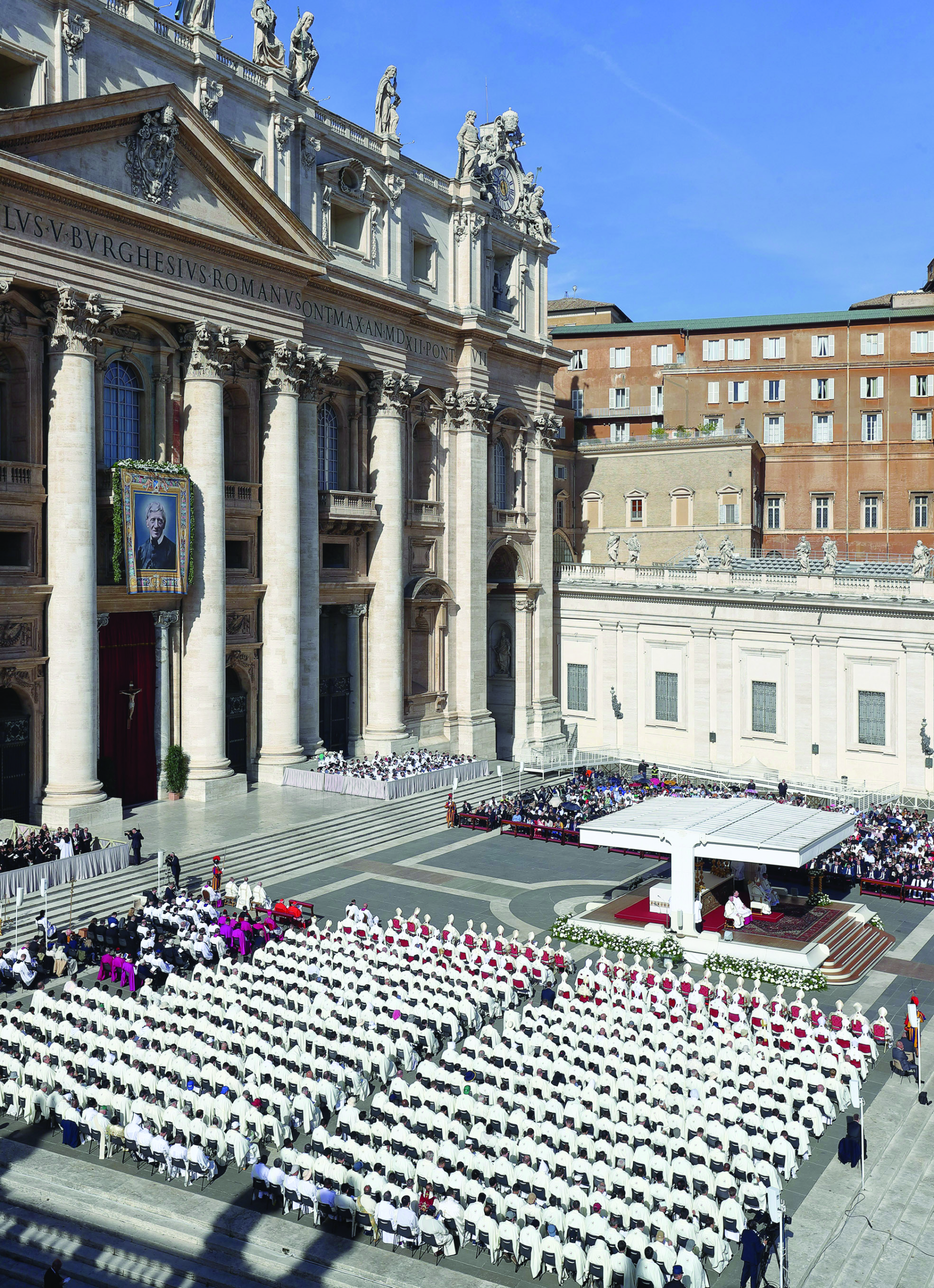
September 30, 2023, St. Peter’s Square. Ordinary Public Consistory for the creation of new Cardinals (Photo Grzegorz Galazka)
 Mykola Bycok
Bishop, Ukrainian Catholic Eparchy, Australia
Bishop Mykola Bychok was born in 1980 in Ternopil, Ukraine. In 1997, he entered the Congregation of the Most Holy Redeemer (Redemptorists). After religious, philosophical, and theological formation in Ukraine and Poland, he obtained a master and then a licensure in pastoral theology. He made his perpetual vows and was ordained priest in 2005.
He was a parish priest in Prokopievsk, Russia, and a superior and parish priest in Ivano-Frankivsk, Ukraine. From 2015 to 2020, he worked at St. John the Baptist parish in Newark, New Jersey, USA.
He was then elected Ordinary of the Ukrainian Catholic Eparchy of Saints Peter and Paul in Melbourne, which was established in 1982 and covers Australia, New Zealand and Oceania.
Bishop Bycok sees his appointment as cardinal in terms of both Australia and the world, telling reporters it is “a great responsibility to the Catholic Church in Australia, where faith is gradually being lost and secularization is spreading.”
“This appointment gives me responsibility for the life and future of our entire Church,” he also noted. “Knowing what difficult times our Ukrainian people are going through because of the war, I will continue to inform the Catholic world about what is happening on our land…”
 Vicente Bokalic Iglic
Archbishop of Santiago del Estero, Argentina
Archbishop Vicente Bokalic Iglic, CM, 72, was born in Lanús, Buenos Aires Province, Argentina, in 1952. He entered the Congregation of the Mission (Vincentians or Lazarists) in 1970. He studied philosophy at Jesuit Maximo College in San Miguel and theology at the Seminary of Buenos Aires. He took his final vows in 1976, and was ordained in 1978.
He worked in various capacities for the Archdiocese of Buenos Aires and at the Shrine of Our Lady of the Miraculous medal there, as well as holding posts in his order. He was a missionary in the Territorial Prelature of Deán Funes from 1994 to 1997 and then superior of his order’s seminary in San Miguel from 1997 to 2000.
In 2003, he was made provincial superior of the Vincentians. Pope Benedict XVI appointed him auxiliary bishop of Buenos Aires in 2012, and Iglic received his episcopal consecration from then-archbishop of Buenos Aires, Jorge Mario Bergoglio.
In 2013, Pope Francis appointed him bishop of Santiago del Estero, which he elevated in 2024 to the rank of archdiocese, making Iglic its first archbishop, while also giving him the title “Primate of Argentina.”
 Fernando Natalio Chomali Garib
Archbishop of Santiago, Chile
Fernando Natalio Chomali Garib, 67, was born in Santiago de Chile, one of five children; he has described himself as “a descendant of a Palestinian.” After earning a degree in civil engineering from the Pontifical University in Santiago, he entered the seminary and was ordained a priest in 1991.
Garib has a licentiate in moral theology, a doctorate in theology and a master’s degree in bioethics from the John Paul II Pontifical Theological Institute for Marriage and Family Sciences. A professor of both theology and bioethics in Santiago, Pope Benedict made him auxiliary bishop of Santiago, then archbishop of Concepción.
In 2014, Pope Francis named him as apostolic administrator of the Diocese of Osorno, during which assignment he met with Pope Francis to dissuade him, unsuccessfully, from appointing Juan Barros as Osorno’s new bishop. Chomalí Garib was a friend of Juan Carlos Cruz, who charged Barros with failure to protect him from sexual abuse.
In a 2018 pastoral letter he wrote that due to the abuse crisis, the Church had lost its reputation as “a voice for the voiceless.” He decried clericalism and proposed a separate office to handle abuse cases, with new rules for transparency. Pope Francis appointed him Archbishop in 2023.

 Jaime Spengler
Archbishop of Porto Alegre, Brazil
Jaime Spengler, OFM, 64, was born on September 6, 1960, in the city of Gaspar, Brazil. He later joined the Order of Friars Minor and was ordained a Catholic priest. He has a doctorate in philosophy from the Pontifical University Antonianum in Rome.
On November 10, 2010, he was appointed by Pope Benedict XVI as auxiliary of the Archdiocese of Porto Alegre, then named archbishop there by Pope Francis in 2013.
In 2023, he was elected President of the Episcopal Conference of Brazil (CNBB) for the 2023–2027 term.
At an October 8 briefing on the Synod on Synodality, the archbishop said that his archdiocese is “investing in permanent deacons: Maybe in the future these married men could also be ordained as priests for a specific community.”
“I don’t know if it could be the best solution to the shortage of priests, but…. we can and must face the issue with courage, keeping in mind theology but also grasping the signs of the times.”
Spengler has also supported an Amazonian rite of the Mass, something that has been under study since the 2019 Amazon Synod.

 Luis Gerardo Cabrera Herrera
Archbishop of Guayaquil, Ecuador
Archbishop Luis Gerardo Cabrera Herrera, OFM, 69, was born in the Ecuadorian city of Azogues.
He earned a bachelor’s degree and a doctorate in Philosophy from the Pontifical Antonianum University. In 1975, he entered the novitiate of the Order of Friars Minor in Quito, and made his solemn profession in 1982. His priestly ordination was in 1983. He held various leadership positions in the Franciscan order, most notably Provincial Minister of the Franciscans in Ecuador (2000-2003) and General Councilor of the Order of Friars Minor in Rome, and responsibility for the Franciscan provinces of Latin America and the Caribbean (2004-2009).
In 2015, Pope Francis appointed him Archbishop of Guayaquil, Ecuador. As vice president of the Ecuadorian Episcopal Conference (2017-2020), he played a crucial role in promoting dialogue and peace, especially in the 2019 demonstrations against the economic measures of President Lenìn Moreno. He has acted as mediator in two national strikes.
In 2020 and again in 2023, he was elected president of the bishops’ conference.

 Carlos Castillo Mattasoglio
Archbishop of Lima, Peru
Archbishop Carlos Castillo Mattasoglio, 74, was born in Lima, Peru. He earned a bachelor’s degree in social sciences from the University of San Marcos. At San Marcos, he joined the National Union of Catholic Students, led by Father Gustavo Gutiérrez, one of the principal voices in the Liberation Theology movement.
At the Pontifical Gregorian University in Rome he earned bachelor’s degrees in philosophy and theology.
He was ordained a priest for the Archdiocese of Lima in 1984.
He obtained a licentiate in 1985 and a doctorate in dogmatic theology in 1987 at the Gregorian University.
He returned to Peru and began teaching, but he was suspended by Cardinal Cipriani Thorne in 2013 amid allegations of heterodoxy and “attacks on the ecclesiastical hierarchy.” He was given a pastoral assignment but refused it and continued teaching at the university.
Pope Francis named him to succeed Juan Luis Cipriani Thorne — the archbishop who once suspended him — as Archbishop of Lima in 2019. Cardinal Pedro Barreto said Castillo’s appointment “brings the Peruvian conference of bishops much closer to the reality of the church of which we all dream, a church that is poor and for the poor, a church that reaches out, a church that is closer to those who are suffering now.”
 Domenico Battaglia
Bishop of Naples, Italy
Archbishop Domenico Battaglia, 61, nicknamed “Mimmo,” was chosen by Pope Francis in the 11th hour to replace another cardinal-designate who had declined the appointment. Replacing Indonesian Bishop Paskalis Bruno Syukur, OFM, on the Pope’s list of 21 new cardinals, Archbishop Battaglia’s name was announced November 7. He has headed the Naples diocese since 2020.
Ordained in 1988, he was a rector at a seminary, a parish priest, a member of the diocesan Peace and Justice Committee, and later became very involved in running Catholic drug addiction rehabilitation and residential care centers.
Pope Francis named him Bishop of Cerreto Sannita-Telese-Sant’Agata de ‘Goti in 2016. He was the first priest of the diocese to become a bishop since 1960.
Even after becoming a bishop, Battaglia was known as a “street priest,” — even being called a “Bergoglio of the South” — and is coauthor of a 2010 book titled, The Poor Are Always Right: Stories of Street Priests. In a pastoral letter in April 2020, he said that the COVID-19 pandemic had “exposed the fragility of this world of ours… the weakness of that economy which, both locally and globally, was considered the single goal, and was seen and applauded as the only route, without any restraints, to human happiness on earth.”

 Tarcisio Isao Kikuchi
Archbishop of Tokyo, Japan
Archbishop Tarcisio Isao Kikuchi, SVD, 65, was born in Iwate, Japan. He became a priest of the Divine Word Missionaries in 1986.
After six years as a missionary in Ghana, he returned to Japan and took on several positions of responsibility in his order, finally being elected provincial of his order’s Japanese province in 1999 and again in 2002.
He served as executive director of Caritas Japan from 1999 to 2004, after first gaining experience as a volunteer in the refugee camp in Bukavu, Zaire (now in the Democratic Republic of the Congo).
He was appointed Bishop of Niigata in 2004 by Pope John Paul II, taking as his motto, Vatietate Unitas (Unity in Diversity). Pope Francis made him Archbishop of Tokyo in 2017.
Kukuchi attended the beatification for 16th-century samurai and Catholic convert Takayama Ukon in Osaka in 2017 and proposed the samurai “Blessed” as “a model for all.”
“Takayama Ukon showed his faith left no room for compromises,” he said. “In Japan today, we live a life full of compromises. We are easily attracted by easy money and the kind of lifestyles that lead us to forget about God… Anyone who gives up their comfortable lifestyle and wealth for the faith, is an example to everyone.”
 Pablo Virgilio David
Bishop of Kalookan, Philippines
Bishop Pablo Virgilio David, 65, was born in Betis, Philippines, in 1959, the 10th of 13 children. He earned his bachelor’s degree in Pre-Divinity from Ateneo de Manila University, his master’s degree in Theology from the Loyola School of Theology, and both his licentiate and doctorate (summa cum laude) in Sacred Theology from the KU Leuven in Belgium.
He also trained at the École Biblique et Archeologique Française de Jerusalem, and is now considered one of the country’s leading Bible experts. David was ordained a priest in 1983, and in 2006 was appointed by Pope Benedict XVI as auxiliary bishop of San Fernando. He became Bishop of Kalookan in January 2016. He was elected President of the Catholic Bishops’ Conference of the Philippines in 2021. In 2023, David was chosen as the Asian representative to the Synod on Synodality.
David was a noted critic of former President Rodrigo Duterte’s “war on drugs.” On July 19, 2019, Duterte’s government filed charges against David, two fellow bishops and members of the opposition for “sedition, cyber libel, libel, estafa, harboring a criminal, and obstruction of justice.” The charges were dropped in 2020.

 George Jacob Koovakad
Friar, staff Secretariat of State, India
Fr. George Jacob Koovakad, 51, is an Indian priest of the Syro-Malabar Catholic Church who since 2020 has worked in the offices of the Holy See’s Secretariat of State where he has been responsible for organizing Pope Francis’ overseas trips. He was born in Changanacherry, Kerala state, India, and educated at St Thomas Minor Seminary, Kurichy, and St Joseph Pontifical Seminary, Aluva.
He was ordained a priest of the Syro-Malabar Catholic Archeparchy of Chan ganacherry in 2004.
Moving to Rome, he obtained a doctorate in canon law in 2006 from the Pontifical University of the Holy Cross with a thesis on “The Obligation of Poverty for Secular Clerics in the Codes of Canon Law.”
After completing the preparatory program at the Pontifical Ecclesiastical Academy, he joined the diplomatic service of the Holy See in 2006. He worked in the nunciatures of Algeria, South Korea, Iran, Costa Rica and Venezuela. In 2014 he was given the title Chaplain of His Holiness, and in 2019 that of Prelate of Honor of His Holiness.
In July 2020 he joined the staff of the Secretariat of State and since 2021 has organized several papal trips.
 Dominique Mathieu
Archbishop of Tehran-Isfahan, Iran
Archbishop Dominique Mathieu, OFM Conv., 61, was born in Arlon, Belgium. He joined the Order of Friars Minor Conventual at 21, professed his solemn vows in 1987 and was ordained in 1989.
In 2013 he was incardinated in the Provincial Custody of the East and of the Holy Land. Within his Franciscan order he has held various positions, including rector of the national shrine of Saint Anthony of Padua in Brussels. He also served as president of the Central Europe Federation of the Friars Minor Conventual.
He moved to Lebanon in 2013 and served in several roles in the provincial Custody of the East and of the Holy Land.
Pope Francis appointed him Archbishop of Tehran-Isfahan in 2021; Mathieu told an interviewer that from the time he entered religious life he “almost always felt affinity with the Islamic world.” According to Vatican statistics, there are only 9,000 baptized Catholics in Iran.
Though Christian proselytism is outlawed, the Vatican has had uninterrupted diplomatic relations with Iran since 1954.

 Ignace Bessi Dogbo
Archbishop of Abidjan, Ivory Coast
Archbishop Ignace Bessi Dogbo, 63, was born in Niangon-Adjamé, a village in the District of Abidjan, Ivory Coast. He was ordained in 1987; after study in Rome, he returned to work in Yopougon diocese and was a professor of biblical languages at Saint Paul major seminary.
In 2004, Pope John Paul II named him bishop of Katiola. In 2015, he represented the Ivorian bishops in the Synod of Bishops at the Vatican.
Pope Francis appointed him Archbishop of Korhogo in 2020, and Archbishop of Abidjan in 2024. He was president of the Conference of Catholic Bishops of the Ivory Coast 2017-23.
Earlier this year Archbishop Dogbo explained that the Ivorian culture itself reflects the kind of synodality the Church proposes: “In this culture… the moderator launches the debate and it circulates according to an order; the youngest members are listened to first… The leader speaks only at the end when all members of the generational strata have expressed themselves freely.
“When the leader finally speaks, he is wise enough to move towards a consensus,” he said.

 Jean-Paul Vesco
Archbishop of Algiers, Algeria
Archbishop Jean-Paul Vesco was born in Lyon, France. Educated in law, he practiced in Lyon for seven years before joining the Dominicans in 1995, taking his vows in 1996. He was ordained a priest of the Dominican order in 2001, following in the footsteps of his uncle, Jean-Luc Vesco (1934–2018), a noted Dominican biblical scholar and provincial leader.
After studies at the École Biblique in Jerusalem, he moved in 2002 to Tlemcen, Algeria, in the Diocese of Oran, reestablishing the Dominican presence in that diocese six years after the assassination of its Dominican bishop, Pierre Claverie. He was elected head of the Dominicans in Tlemcen in 2007.
In 2010, Vasco was elected Prior Provincial of the Dominicans in France and took up his duties in Paris. In 2012, Pope Benedict XVI appointed him bishop of Oran.
In 2021, Pope Francis appointed Vesco archbishop of Algiers; in 2023, President Abdelmadjid Tebboune granted Vesco Algerian citizenship by presidential decree.
In 2015, he called for the Church to reevaluate its treatment of divorced Catholics who remarry, writing: “The Church’s discipline regarding divorced and remarried couples has long troubled me, even revolted me, because of the unnecessary suffering it inflicts on individuals without consideration for their unique situations.”