By Matthew Trojacek
Pope Francis meets Middle East Catholic bishops amid fears of all-out war in region
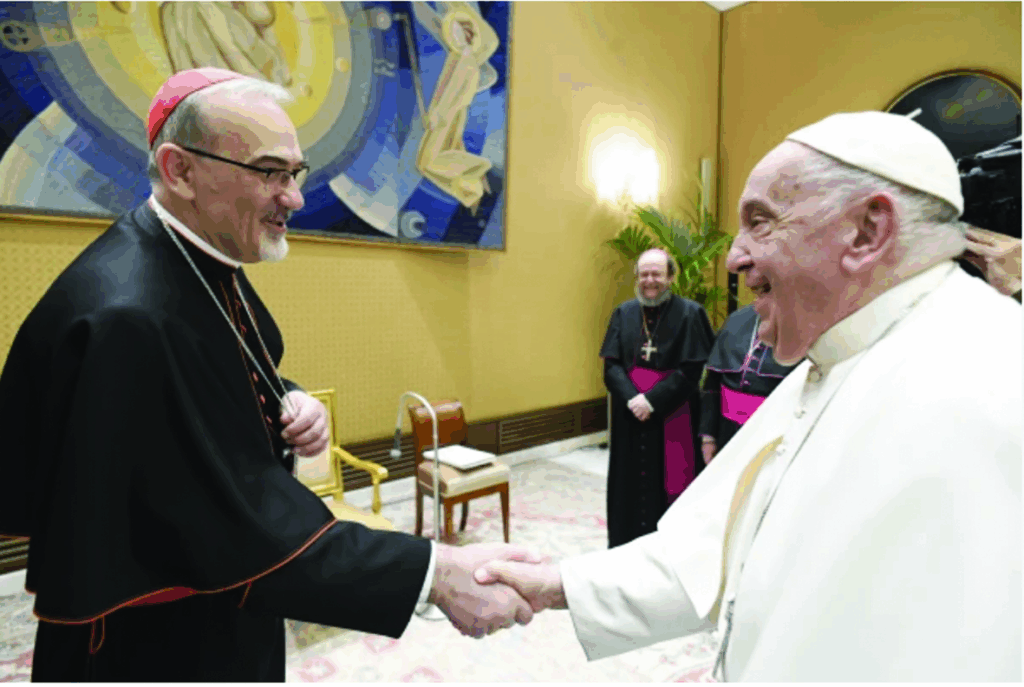
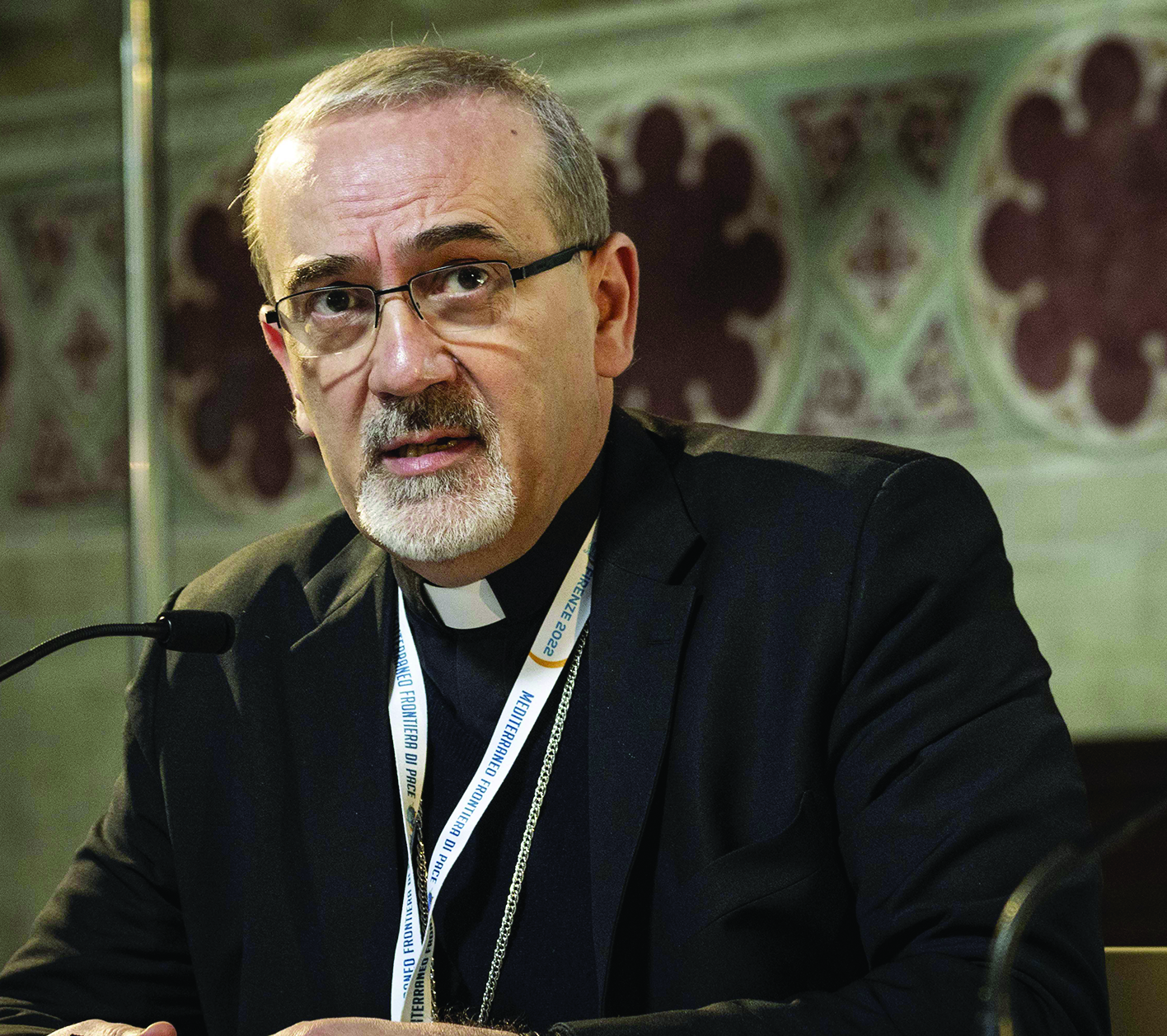
August 28, 2024. Vatican. Led by Cardinal Pierbattista Pizzaballa (above left), Pope Francis met with the Latin rite Catholic leaders of several Middle Eastern and Arabic-speaking countries
Pope Francis met August 28 with the Latin-rite Catholic leaders of some of the Middle Eastern and Arabic-speaking countries amid fears of an escalation of the Israel-Hamas war.
He encouraged the bishops to “bear witness to faith in [the Lord], also through respectful and sincere dialogue with everyone.”
The meeting took place as part of the plenary assembly of the Conference of the Latin Bishops of the Arab Regions (CELRA), which covers Israel, Palestine, Jordan, Lebanon, Iraq, Syria, Egypt, Cyprus, Djibouti, Somalia, and the countries of the Arabian Peninsula.
“This situation has caused thousands and thousands of deaths, enormous destruction, immense suffering, and the spread of feelings of hatred and resentment, which prepare the ground for new tragedies,” he said.
“May you keep hope alight,” Francis added. “Be yourselves… a presence that, in itself, invites reason, reconciliation, overcoming with goodwill the divisions and enmities stratified and hardened over time, which are becoming increasingly inextricable.” (CNA)
Pope agrees to appointments of two bishops chosen by Syro-Malabar Church for India
The Synod of Bishops of the Syro-Malabar Church, an Eastern Catholic rite in full communion with Rome, appointed two new bishops for Changanacherry and Shamshabad in India on August 30.
The appointments come after years of internal tensions among Syro-Malabar Church leaders regarding a unified liturgy.
In May, Pope Francis warned the Church’s leaders that division is the work of “the devil, the divider” and that unity with Rome is essential. “Apart from Peter, apart from the major archbishop, there is no Church,” he said.
On the July 3 feast day of St. Thomas the Apostle, the patron of the Syro-Malabar Church, a compromise was reached to resolve the liturgical feud.
“The Holy Qurbana [Mass] should not be the reason for division in the Church,” Syro-Malabar Church spokesman Father Antony Vadakkekara told CNA in July. “That is why the synod made the compromise proposal to say at least one synodal Mass in each of the parishes [in India].” (CNA)
Iraqi Cardinal urges Christians to give “testimony of life”
“Today, Christians do not need martyrdom, but what they need is the testimony of [a] life that positively affects society,” said Cardinal Louis Raphael Sako, the patriarch of the Chaldean Catholic Church during a Mass on September 28, the anniversary of St. Meskenta’s martyrdom, at the Saint Hannah Monastery for Chaldean nuns in Karada, Baghdad.
According to tradition, St. Meskinta was martyred along with her two children by the Persians during the anti-Christian persecution by the Sassanian king Yazdgerd II (438-457).
Sako urged the faithful to endure pain to produce work of human, spiritual, and social value despite being small in numbers.
Iraq’s Christian population has drastically declined since the 2003 US-led invasion, dropping from more than 1.5 million people to around 400,000 today. (UCANews)
Young Russian Catholics gather to celebrate “hope”
“Hope is not just the expectation of something longed for and far away: it is a foretaste in which we can already find what we want,” said Father Denis Malov, CMF, to the participants of the youth meeting of the Archdiocese of the Mother of God in Moscow, which took place in early August in Kaliningrad, a Russian exclave between Poland, Lithuania and the Baltic Sea.
The event was attended by about a hundred young people, mostly between the ages of 14 and 30, including seven faithful of the Russian Orthodox Church and three catechumens. During these intense days they were accompanied not only by several priests, but also by the auxiliary bishop of the archdiocese, Nikolai Dubinin. The participants, who came from 23 cities in the territory of the Catholic archdiocese, stayed as guests of the Catholics of Kaliningrad.
The event was entitled “Rejoice in Hope” (Romans 12:12) after the letter that Pope Francis sent to the youth of the world for the XXXVIII World Youth Day in Lisbon in 2023.
The event in Kaliningrad, conceived as an intermediate stage between WYD 2023 and the Holy Year 2025, took place one year after the Russian Catholic Youth Meeting, held in St. Petersburg two weeks after WYD in Lisbon (see Fides, 6/7/2023), and precedes the Holy Year of Youth 2025, also under the theme of hope.
The Ecclesiastical Province of the Catholic Church in Russia consists of the Archdiocese of the Mother of God in Moscow and its three suffragan dioceses: the Diocese of St. Clement in Saratov, the Diocese of St. Joseph in Irkutsk and the Diocese of the Transfiguration in Novosibirsk. Since Catholics in the Russian Federation represent less than 1% of the total population, communities are usually small and scattered over a wide area, so the presence of a priest is sometimes quite rare during the year.
Obituary: Orthodox Mystic Vassula Rydén
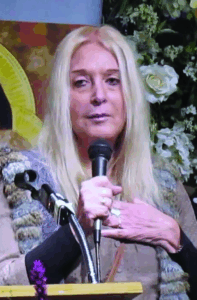
The controversial Greek Orthodox self-proclaimed mystic and alleged conduit of messages from the Persons of the Trinity, the Virgin Mary and her guardian angel, Vassula Rydén, 82, died in Switzerland on September 24 of complications after surgery. Her funeral was on October 1 on the Greek island of Rhodes.
Vassula, as she was commonly known, was born Vassiliki Claudia Pendakis on January 18, 1942, in Heliopolis on the outskirts of Cairo, Egypt, the daughter of Greek Orthodox parents.
When she was 15, her family emigrated to Europe. During her childhood and teens, she said that she experienced waking nightmares attributed to Satan trying to kill her, dreams of a “spiritual marriage” between her and Jesus, and the cries of dead people asking for her help. Nevertheless, she remained indifferent to religion through her youth and earlier adulthood. She married a Lutheran man in a Greek Orthodox church 1966, had two sons, and was divorced in 1980. In 1981, she married another Lutheran, did some modeling, painted in oils and played competitive tennis.
Then in 1985, while living in Bangladesh, while writing a shopping list for a cocktail party, she suddenly experienced “an invisible force” that “pushed my hand.” She added: “ I was not afraid, I do not know why.” She later said the force was her guardian angel, Daniel.
After three months of preparation by “Daniel,” she said she started receiving messages from Jesus Christ, from God the Father, from the Holy Spirit, and from the Virgin Mary, all written in the manner of her hand being guided, she said, by her interlocutors.
The messages were centered on repentance, love of God, and unity of the Churches, and were in English.
Some of the messages she changed slightly — often making them more doctrinally correct — after their initial publication, claiming God had authorized her to do so.
In 1995, the Catholic Church’s Congregation for the Doctrine of the Faith (CDF), under Cardinal Joseph Ratzinger, issued a “Notification” on the writings of Rydén. The CDF said an “attentive examination” had found “several doctrinal errors.” It questioned the “suspect nature of the ways in which these alleged revelations have occurred” and called the subsequent editing of these errors “a sign that the alleged heavenly messages are merely the result of private meditations.”
On March 16, 2011, the Greek Orthodox Church and synod of the Ecumenical Patriarchate of Constantinople issued a disapproval of her teachings and instructed all Orthodox Christians not to associate with her and her organization, “True Life in God.”
Rydén continued to produce new volumes of messages in the series True Life in God up until her 12th in 2003.
In 2013, Rydén published Heaven Is Real, But So Is Hell.
Several priests, including Fathers Rene Laurentin, Robert Faricy, and Michael O’Carroll as well as Archbishop Frane Franić, who are major promoters of Our Lady of Međugorje, also actively support Rydén.
In 2005 Bishop Felix Toppo, S.J., D.D., granted the Nihil Obstat and Archbishop Ramon C. Arguelles, STL, DD, granted the Imprimatur to the “True Life in God” books.
In 2014, Cardinal Prosper Grech called Heaven Is Real But So Is Hell an autobiography and apologia in the apocalyptic genre. Grech said that he does not know the origin of Rydén’s visions but that if they bring more people to God then “there is no reason to reject them outright.” (ITV staff)