From ancient aqueducts to “nasoni“
By Lucy Gordan

The Trevi Fountain is the largest and most spectacular of Rome’s fountains, designed to glorify the three Popes who commissioned it: Clement XII (r. 1730-40), Benedict XIV (r. 1740-58), and Clement XIII (r. 1758-74)
Rome is nicknamed “The Eternal City” thanks to her monuments from all periods of her history: from the legendary kings to the present. They begin with the 7th-century BC Temple of Vesta in the Forum and go up to MAXXI, her Museum of Contemporary Art, designed by the Iranian-born, naturalized British architect Zaha Hadid (1950-2016) and opened in 2010. However, Rome could also be nicknamed “The City of Water” thanks to her 11 ancient aqueducts, which, in the first century AD, fed 39 monumental fountains and 591 public basins, down to the latest three “nasoni” (“big noses,” that is, nose-shaped drinking fountains), installed near the Colosseum in 2024 to commemorate the 150th birthday of the very first nasoni.
After the fall of the Western Roman Empire in 476 AD, the aqueducts fell into disrepair or were demolished, and so many of the fountains stopped working.
The Fountain in Piazza Santa Maria in Trastevere is believed to be Rome’s oldest fountain, dating, according to some sources, to the 8th century AD and built on the site of an ancient fountain. Its first design was based on an ancient model: a circular vasque on a pedestal pouring water into a basin below (between 1499 and 1659 it underwent reconstructions and embellishments).
Today Rome is home to more than 2,000 fountains — more than any other city in the world. Some 50 are “monumental” and were commissioned by Popes.

A view of Piazza Navona, which houses the fountains of Neptune, of the Four Rivers and of the Moor
The earliest of these Popes was Nicholas V (r. 1447-55), who decided to embellish the city and make it a worthy capital of the Christian world. So, in 1453, almost 1000 years after the fall of the Western Roman Empire, he began to rebuild the Acqua Vergine, the ruined Roman aqueduct, inaugurated in 19 BC by Agrippa, the Emperor Augustus’ son-in-law. Although he didn’t commission a “monumental fountain” himself, Nicholas V had the idea. He proposed reviving the ancient Roman custom of marking the arrival point of an aqueduct with a mostra or grand commemorative fountain.
The first Pope to build “commemorative” fountains was Gregory XIII (r. 1572-85), best known as the namesake of the Gregorian calendar, which remains the internationally accepted civil calendar today. He commissioned the Fountain of Neptune (1574) and the Fountain of the Moor (1575), both in Piazza Navona; the fountain in Piazza della Rotonda outside the Pantheon (1575); and the fountain in Piazza Colonna (1577).
Gregory XIII’s successor was the Franciscan Sixtus V (r.1585-1590), a significant figure of the Counter-Reformation and untiring city planner who, with his trusted architect-engineer Domenico Fontana, immediately built a new aqueduct, the Acqua Felice, which fed 27 new fountains. The first, the Fontana dell’Acqua Felice (1585), designed by Fontana with a large statue of Moses in its central arch, was named for this aqueduct. Others were the Fontana di Piazza d’Aracoeli (1589) at the bottom of the Capitoline Hill and the Fontana dei Monti (1589). He also turned the axis of Rome from the ancient forums to St. Peter’s and laid out new arteries to connect the four main basilicas.

Barcaccia Fountain in Piazza di Spagna designed by Gian Lorenzo Bernini’s father, Pietro, in 1627
However, it was during the 17th and 18th centuries that the Popes reconstructed other ruined ancient aqueducts and built elaborate fountains to mark their termini. These two centuries were the golden age of Rome’s fountains, which, not surprisingly, are those most admired still today. They were expressions of a new style: Baroque art. Crowded with allegorical figures and filled with emotion and movement, their sculptures, not their water, became their most important element. Water was used to animate and decorate the sculptures.

Maderno’s fountain in Piazza San Pietro
The first such fountains, yet still classical, were completed or commissioned by Paul V Borghese (r. 1605-21). The first fountain, completed during Paul V’s papacy, was the one outside the Basilica of St. John Lateran, financed by the Lateran Canons under Pope Clement VIII (r. 1592-1605) for the Jubilee in 1600, but not finished until 1607. Supposedly, the Romans used to bathe their hands in this fountain on the night of the Feast Day of St. John (June 23) to keep away witches and the evil eye.
In 1610, Paul V restored the ancient Roman aqueduct, acqua traiana, built by the Emperor Trajan, bringing water to the right bank of the Tiber, and built the majestic fountain Acqua Paola, named for him, on the Janiculum Hill. Two years later, he commissioned from the architect Carlo Maderno a new façade for St. Peter’s Basilica, a new plan to replace Michelangelo’s design for its interior, and the fountain (1614), made to complement the lavish Baroque façade, in the Piazza. That same year he also commissioned Maderno to build a magnificent fountain outside the Basilica of St. Mary Major.
During this same period Paul V had the Tiber’s water near the modern neighborhood Parioli analyzed because of its metallic taste. It turned out that the water was not only drinkable but curative for diseases of the kidney, stomach, spleen and liver, so he commissioned La Fontana dell’Acqua Acetosa (meaning “vinegary”) there, later restored by Pope Innocent X (r. 1644-55) and rebuilt by Pope Alexander VII (r. 1655-67).
Like his predecessor, Pope Urban VIII Barberini (r. 1623-1644) commissioned several fountains, all from the sculptor/painter/architect Gian Lorenzo Bernini. To be fair, he commissioned the first, known as La Barcaccia, because of its boat-shape, from Gian Lorenzo’s father, Pietro, in 1627. The other two, The Triton Fountain (1642), representing a Triton — half-man and half-fish — blowing his horn to calm the waters, inspired by a text in Ovid’s poem Metamorphoses, and the Fountain of the Bees (1644), the Barberini family’s crest, are located in Piazza Barberini near the Palazzo Barberini.
Bernini was the sculptor of two other important Roman fountains, the twin of Maderno’s fountain in St. Peter’s Square (1677), and earlier (1648-51), the highly theatrical Fontana dei Quattro Fiumi (“The Fountain of the Four Rivers”) with its statues representing the four continents known at the time: the Nile, the Danube, the Rio de le Plata, and the Ganges. At the center of Piazza Navona and topped with a 54-foot ancient Egyptian obelisk, it was commissioned by Pope Innocent X, near the Pope’s family palazzo.
The Trevi Fountain is the largest and most spectacular of Rome’s fountains, designed to glorify the three Popes who commissioned it: Clement XII (r. 1730-40), Benedict XIV (r. 1740-58), and Clement XIII (r. 1758-74). Designed by the architect Nicola Salvi, it was built at the terminus of the Acqua Vergine, the ancient aqueduct reconstructed by Pope Sixtus V, on the site of a Renaissance fountain by Leon Battista Alberti. Its central figure is Oceanus, the personification of all the seas and oceans, in an oyster-shell chariot, surrounded by tritons and sea nymphs. Pilgrims for this year’s Jubilee will undoubtedly admire many, if not all, of these papally-commissioned “monumental” fountains, but will also be thankful to the some 200 nasoni (fountains with nose-like spigots) in the city center for quenching their thirst. Another some 2,500 nasoni are located in parks, the EUR (the major business district), and outlying residential neighborhoods.
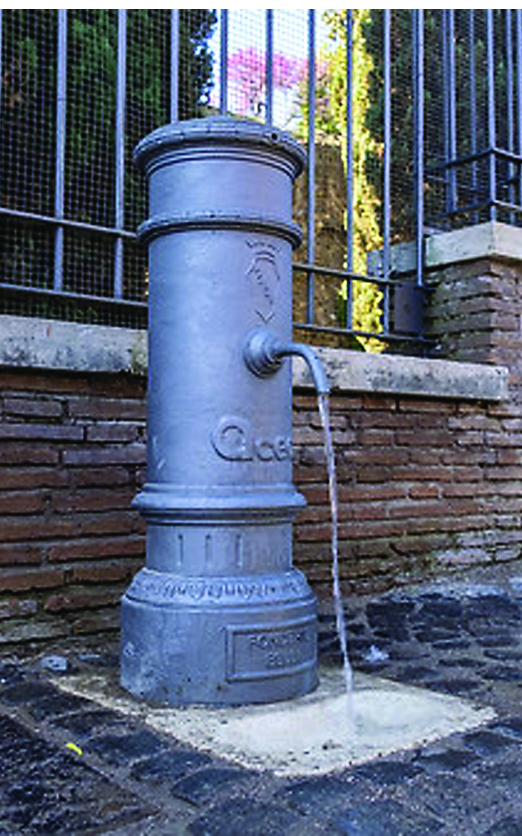
Nasoni were the idea of Freemason and anticlerical Luigi Pianciani, the first mayor of Rome after the Unification of Italy, and his alderman Rinazzi (first name unknown), to provide free, continuously flowing water to his fellow citizens. The first 20 were installed between 1872 and 1874. They were made of cast iron, weighed around 200 pounds, and were just over a meter tall. Three of these still exist today, in Piazza della Rotonda outside the Pantheon, in Via San Teodoro between the Forum and Circus Maximus, and in Via delle Tre Cannelli, in the neighborhood called Monti. They were then called “dragoni,” not “nasoni,” because they had three lion-headed spouts at their top, resembling a dragon.
Before long, brass replaced cast iron and the three spouts became only one — long, curved, and nose-shaped: hence the name “nasoni” (“big noses”). Each spout has a small hole. If you cover the mouth of the spout with your hand, water will flow upwards through the hole and reach your thirsty mouth. In addition to the “nasoni,” during Fascism (1922-1945) drinking fountains, called “the Imperial she-wolf,” were made using marble, and their water flowed from the head of a brass she-wolf. Some 70 of these still exist.

IMG_20210421_190548-1536×2048 x
A historical drinking fountain with a wolf’s head spout in the garden of the Orange Trees on the Aventine Hill.
53597768848_ff900758f8 x
A typical example of a “nasone” (“big nose”) today
During the 1980s, the city government, to limit the amount of wasted water, added a faucet at the top of each nasone to turn the water on and off, but vandals stole many of the faucets. Some 35 years later, Virginia Raggi, the first female mayor of Rome from 2016-2021, tried to close down nearly all the nasoni, leaving only 85 functional, but the Romans rebelled and she had to abandon her plan. Actually, according to ACEA, the acronym for Azienda Comunale Elettricità e Acque (Electricity and Water Municipal Utility), Raggi’s plan wouldn’t have saved much water, only some 2% of all that the city uses. Let’s hope the Romans will continue to conserve this precious natural resource: fresh, free drinking water.