I acknowledge one baptism for the forgiveness of sins
By Robert Wiesner
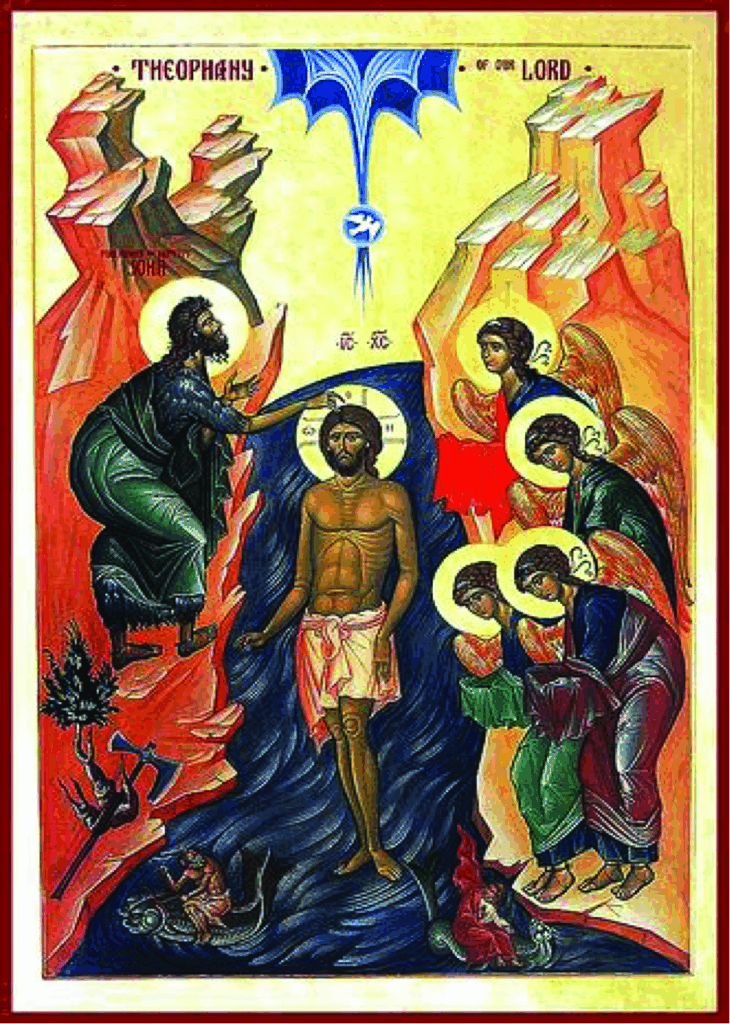
The history of water, beginning with Creation itself, provides a sort of unifying theme throughout salvation history. At the very beginning, we find the Holy Spirit brooding over the primordial waters, already prefiguring the vital role water is to play for humanity: water is destined to be foundational to both natural and supernatural life.
Water is seen to engulf sin in the Great Flood and in the Great Escape from Egypt; in those two same instances, God’s people are found to be held apart from the ruin, being spared contact with water at its most destructive. Being a desert people, the Hebrews practiced a careful respect for water. They never became a great sea-faring people (though some dared to become fishermen!), but rather mostly limited their contact with the fluid to hygienic and ritual cleanliness. Both literal and moral grime then were deposited in water.
The Baptism of John the Forerunner served to bring the moral function of water to its fruition in the Old Covenant. The repentance preached by John brought thousands to rid themselves of sin in Jordan’s waters, adding further pollution to an already quite murky element.
Then came Jesus. Obviously He had no need of repentance; His purpose in entering the river was quite different. St. Gregory of Nyssa bluntly states of Jesus’ Baptism: “He descended into the filth.” In that first stunning act of His public ministry, Jesus completely reversed the supernatural function of water. The great cleansing of water is heralded in one of the antiphons for the Feast of Theophany: “The sea beheld this and fled, the Jordan turned back on its course. Why was it, O sea, that you fled, that you, O Jordan, turned back on your course?”
Eastern tradition holds that the Jordan River indeed reversed its flow as a sign that water’s function as a depository for moral misdoing was changed in an instant. Jesus sucked out every blot of sin collected in the waters, all to be put to death on the cross. The contact of the sin-filled waters with the absolute purity of Jesus imparted His purity to the Jordan River. Indeed, to this very day, the Great Blessing of Water on Theophany indicates that ordinary water used in the ceremony is actually transformed into the very water cleansed by Jesus; it is in fact Jordan Water! One of the more powerful aspects of Baptism consists of the utter destruction of sin, not a mere forgiveness. Water has become a potent moral medicine, healing the soul completely of sin.
Many Eastern Churches actually make use of a nearby river or stream for the blessing to drive home the point more forcibly. Even beyond the moral aspects of the blessing, an outdoor ceremony reinforces another aspect of the Blessing. Nature itself, also wounded by the sin of Adam, begins its great regeneration, fulfilled at the end of time with the “New Earth” promised in Revelation.
Baptism in the Eastern Churches is most properly accomplished as a public ceremony at the beginning of the Divine Liturgy. Beginning at the doors of the church, certain preliminary prayers precede the entrance of the catechumen: the renunciation of Satan, the exorcism and the formal acceptance of a life in Christ.
The entrance into the church is accompanied by the recitation of the Nicene Creed. Chrismation (Confirmation) and First Communion are also administered, as the newly baptized has become a full member of the Church with full rights and privileges. Often, Roman Catholics attending Divine Liturgy are startled by the sight of infants and very small children receiving the Eucharist!