The Holy Father visited Christian-minority Turkey, site of the COuncil of Nicaea 1700 years ago, and Lebanon, where he became the first Pope to pray at the tomb of St. Charbel
By Robert Moynihan and Anna Artymiak
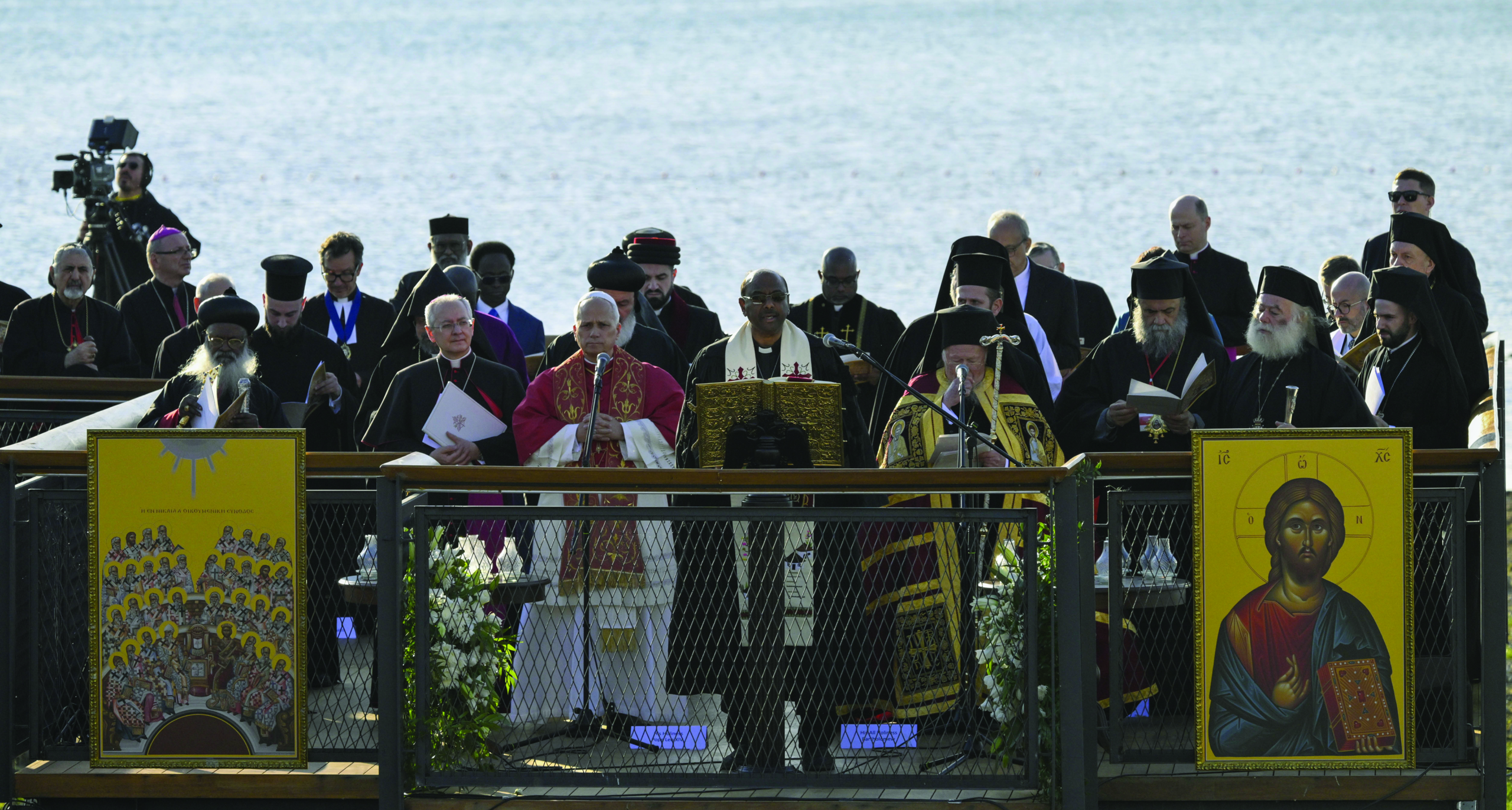
Iznik, Turkey, November 28, 2025, Ecumenical Prayer Meeting near the archaeological excavations of the ancient Basilica of Saint Neophytos, where the Council of Nicaea was held in 325 A.D. (Vatican Media/Agenzia Romano Siciliani)
Leo XIV started his first Apostolic Journey in the early morning of Thursday, November 27, arriving at Terminal 5 of Rome’s Fiumicino Airport at 7:25 am. He was leaving Italy to visit Turkey and Lebanon, marking the 1700th anniversary of the Council of Nicaea. As the Vatican Secretary of State, Italian Cardinal Pietro Parolin told journalists, the Pope was traveling as a “messenger of harmony, dialogue, peace.”
It is significant that Leo XIV, who has often said that he seeks unity within the Church and between all Christians, was making his first Apostolic Journey as an ecumenical one.
So the visit was seen as a test of several decades of modern ecumenical dialogue.
“It’s so important today that the message be transmitted in a way that really reveals the truth and the harmony that the world needs,” Leo said to the journalists present on board the plane at the beginning of the trip.
“In a special way, this particular trip to Turkey and Lebanon has, first of all, the very meaning of unity, celebrating 1700 years from the Council of Nicaea.” —RM
Pope Leo Leaves Rome

Here, Pope Leo XIV at Rome’s Fiumicino Airport during his first apostolic journey to Turkey and Lebanon. November 27, 2025 (Photo — Grzegorz Galazka)
It was a beautiful, colorful morning as the sunlight in the winter months is the most spectacular of the whole year in Rome.
More than 80 journalists were traveling with Leo on a so-called “papal flight.”
Among them: representatives of Turkish and Lebanese media, and many American media.
As he left Italy, the Holy Father was greeted by more than the usual group of people.
At the stairs were two carabinieri in full dress uniform, paying honor to the departing pontiff.
Also, for the first time, to salute the Holy Father in the name of the Vatican was new vice-regent of the Papal Household, the Nigerian priest Fr. Edward Daniang Daleng, OSA, appointed by Pope Leo on November 10. It is a tradition that a representative of the Prefecture of the Papal Household goes to salute the Pope before the trip and welcomes him back on his return.
Traditionally, the Pope travels to the destination country on board the Italian national airline, formerly Alitalia, now ITA Airways.
The blue “Shepherd One” was decorated with Leo’s coat-of-arms painted on the jet next to the main entrance door to the plane (see photo).
There were also little flags of the Vatican and Italy hung in the windows of the plane.
On this day, in the United States, Thanksgiving Day is celebrated, and the Pope, himself an American, wished “Happy Thanksgiving!” to the American journalists present.
Two American colleagues, Cindy Wooden and Elise Allen, made a traditional dessert for the Pope for Thanksgiving Day: pumpkin pie.
The Pope also received white socks, white slippers, a NY Knicks cap, and a baseball bat that used to belong to the legendary 1950 White Sox second baser Nellie Fox. The Pope asked, with a smile, if the bat had passed the pre-flight security control.
His remarks on the plane included:
“Buongiorno a tutti! [“Good day to all!”]
“To the Americans here: Happy Thanksgiving!
“It’s a wonderful day to celebrate. And I want to begin by saying thank you to each and every one of you for the service that you offer to the Vatican, to the Holy See, to my person, but to the whole world.
“It’s so important today that the message be transmitted in a way that really reveals the truth and the harmony that the world needs, and in a special way, this particular trip to Turkey and to Lebanon has, as you know, first of all, the very meaning of unity, celebrating 1700 years from the Council of Nicaea.
“And I very much have been looking forward to this trip because of what it means for all Christians.
“But it’s also a great message to the whole world and in a special way, with the presence of myself, of the Church, of believers in both Turkey and in Lebanon, we hope to also announce, transmit and proclaim how important peace is throughout the world.”
 Since Paul VI (1963-1978), who was the first to start the tradition of international papal trips, every Pope has visited Turkey, and Pope Leo wished to continue that tradition. And it is significant that the trip always occurs at the beginning of a pontificate.
Present-day Turkey is called “the Holy Land of New Testament” as so many early Christian Church communities were in Asia Minor. As the Holy Father said at the start of his first speech to the authorities and the diplomatic corps after he landed in Ankara, Turkey is a land which “is inextricably linked to the origins of Christianity.”
Upon landing in Turkey, Pope Leo began his meetings with Turkish dignitaries by praising the beauty of Turkey, and spoke of a new bridge, opened in March 2022 over the Dardanelles Strait (and chosen for the trip’s logo), terming Turkey “the bridge between East and West.” (The bridge, the 1915 Çanakkale Bridge, is the world’s longest suspension bridge, joining the European and Asian sides of Turkey.)
In this context, the Pope assured that “Christians desire to contribute positively to the unity of your country,” recalling the figure of Pope John XXIII (1958-1963), who, though Italian, is remembered in Turkey as the “Turkish Pope” because he was the Vatican’s Apos tolic Delegate to Turkey and Greece in the years 1935-1945.
Speaking about the authentic criteria of development which are “compassion and solidarity,” Pope Leo emphasized that “it is essential to honor the dignity and freedom of all God’s children, both men and women, fellow nationals and foreigners, poor and rich. We are all children of God, and this has personal, social and political implications.”
And he again mentioned artificial intelligence. It is a “great challenge” for Turkey’s leaders to “reshape local policies and international relations, especially in the face of technological developments that could otherwise exacerbate injustice instead of helping to overcome it,” he said. “Even artificial intelligence simply reproduces our own preferences and accelerates processes that, on closer inspection, are not the work of machines, but of humanity itself.”
The Holy Father spoke also about another bridge “between our common destiny and the experiences of each individual” remembering the great importance of the family in Turkish culture. — Anna Artymiak
Pope: Nicaea Invites Christians to Unity in Face of Violence, Conflict
Pope Leo XIV prayed with leaders of various Christian Churches in Nicaea, modern-day Iznik, Turkey, and invited all Christians to follow the paths of fraternal encounter, dialogue, and cooperation
By Devin Watkins (Vatican News)

Friday, November 28: Pope Leo XIV and Greek Orthodox Ecumenical Patriarch Bartholomew, with other Christian Church leaders, walk to a platform overlooking the site of the Council of Nicaea (Vatican Media)
At the site of ancient Nicaea, Pope Leo XIV joined around 27 other leaders of Christian Churches to commemorate the 1,700th anniversary of the First Ecumenical Council in the Church’s history.
The ecumenical prayer service took place on the second day of the Pope’s Apostolic Journey to Turkey.
In his address, the Pope thanked Patriarch Bartholomew I, Ecumenical Patriarch of Constantinople, for his “great wisdom and foresight” in calling for Church leaders to celebrate this important anniversary together. He also expressed appreciation to the Heads of Churches and Representatives of Christian World Communions for attending the event.
Pope Leo recalled that the Council of Nicaea was held in 325, saying it invites all Christians, even today, to ask ourselves who is Jesus Christ for us personally.
“This question is especially important for Christians,” he said, “who risk reducing Jesus Christ to a kind of charismatic leader or superman, a misrepresentation that ultimately leads to sadness and confusion.”
The Council was held to respond to the Alexandrian priest Arius’ claim that Jesus was only an intermediary between God and humanity, saying He was not fully divine and ignoring the reality of the Incarnation.
“But if God did not become man, how can mortal creatures participate in His immortal life?” asked Pope Leo. “What was at stake at Nicaea, and is at stake today, is our faith in the God who, in Jesus Christ, became like us to make us ‘partakers of the divine nature.’”
The Council of Nicaea, he said, agreed upon the Christological confession we now call the Nicene Creed, which is professed by all Christian Churches and Communities.
The Symbol of Faith, as it is known, was of “fundamental importance in the journey that Christians are making towards full communion.”
“Faith ‘in one Lord Jesus Christ, the Only Begotten Son of God, born of the Father before all ages… consubstantial with the Father’ (Nicene Creed),” he said, “is a profound bond already uniting all Christians.”
The Pope invited Christians to embrace that existing bond of unity and journey ever deeper in “adherence to the Word of God revealed in Jesus Christ, under the guidance of the Holy Spirit, in mutual love and dialogue.”
By overcoming divisions and reconciling with one another, Christians can bear more credible witness to Jesus Christ and His proclamation of hope for all, he said. He upheld the role of religions in serving truth and encouraging individuals to seek dialogue and respect.
“We must strongly reject the use of religion for justifying war, violence, or any form of fundamentalism or fanaticism,” the Pope said.
“Instead, the paths to follow are those of fraternal encounter, dialogue and cooperation.”
Finally, Pope Leo prayed that God the Father may help the commemoration of the 1,700th anniversary of the Council of Nicaea bear “the abundant fruits of reconciliation, unity and peace.”
As the prayer service concluded, the leaders of Christian Churches and Communions prayed the Nicene-Constantinopolitan Creed together, omitting the “Filioque,” which has been a main source of contention between the Eastern and Western Churches for centuries.
The Addition, and Omission, of the “Filioque“
The Latin word “filioque,” meaning “and from the Son” (in reference to the sending of the Holy Spirit) was added to the Creed in the West, first in Spain (in the late 500s) and later throughout the West (in the early 1000s) to emphasize the divinity of Christ against the Arians, who argued that Jesus was not fully divine. Professing that the Holy Spirit proceeded “from the Father and from the Son” emphasized the unity of the Son with the Father. The word was never added to the Creed in the eastern Roman Empire; so the use of the word by Catholics, now for more than 1,000 years, and the non-use of the word by the Orthodox, has become one barrier to the eventual reunion of the two great branches of Christianity, which ought to recite a common Creed if they profess a common faith.
“If God did not become man, how can we participate in His immortal life?” Pope Leo on the 1700th Anniversary of the Council of Nicaea
Pope Leo’s November 28 address near the archaeological excavations of the Ancient Basilica of St. Neophytos, Iznik (Nicaea), Turkey, on Day #2 of his trip

A depiction of the bishops who were summoned by the Roman Emperor Constantine I (272-337 A.D.) to come to Nicaea in 325 A.D. The Nicene Council’s most important achievement was the formulation of the Nicene Creed, which emphasized the full divinity of Jesus Christ
Dear brothers and sisters,
At a period of history marked by many tragic signs, in which people are subjected to countless threats to their very dignity, the 1700th anniversary of the First Council of Nicaea is a precious opportunity to ask ourselves who Jesus Christ is in the lives of men and women today, and who he is for each one of us personally.
This question is especially important for Christians, who risk reducing Jesus Christ to a kind of charismatic leader or superman, a misrepresentation that ultimately leads to sadness and confusion (cf. Leo XIV, Homily, Holy Mass Pro Ecclesia, May 9, 2025).
By denying the divinity of Christ, Arius reduced Him to a mere intermediary between God and humanity, ignoring the reality of the Incarnation such that the divine and the human remained irremediably separated.
But if God did not become man, how can mortal creatures participate in his immortal life?
What was at stake at Nicaea, and is at stake today, is our faith in the God who, in Jesus Christ, became like us to make us “partakers of the divine nature” (2 Pet 1:4; cf. Saint Irenaeus, Adversus Haereses, 3, 19; Saint Athanasius, De Incarnatione, 54, 3).
This Christological confession of faith is of fundamental importance in the journey that Christians are making towards full communion. For it is shared by all Christian Churches and Communities throughout the world, including those which, for various reasons, do not use the Nicene-Constantinopolitan Creed in their liturgies.
Indeed, faith “in one Lord Jesus Christ, the Only Begotten Son of God, born of the Father before all ages… consubstantial with the Father” (Nicene Creed) is a profound bond already uniting all Christians.
In this sense, to quote Saint Augustine, in the ecumenical context we can also say that, “although we Christians are many, in the one Christ we are one” (Exposition on Psalm 127). Consequently, with an awareness that we are already linked by such a profound bond, we can continue our journey of ever deeper adherence to the Word of God revealed in Jesus Christ, under the guidance of the Holy Spirit, in mutual love and dialogue.
In this way, we are all invited to overcome the scandal of the divisions that unfortunately still exist and to nurture the desire for unity for which the Lord Jesus prayed and gave his life.
The more we are reconciled, the more we Christians can bear credible witness to the Gospel of Jesus Christ, which is a proclamation of hope for all.
Moreover, it is a message of peace and universal fraternity that transcends the boundaries of our communities and nations (cf. Francis, Address to participants in the Plenary Session of the Pontifical Council for Promoting Christian Unity, 6 May 2022).
Today, the whole of humanity afflicted by violence and conflict is crying out for reconciliation.
The desire for full communion among all believers in Jesus Christ is always accompanied by the search for fraternity among all human beings. In the Nicene Creed, we profess our faith “in one God, the Father.”
Yet, it would not be possible to invoke God as Father if we refused to recognize as brothers and sisters all other men and women, who are created in the image of God (cf. Second Vatican Ecumenical Council, Declaration Nostra Aetate, 5).
There is a universal fraternity of men and women regardless of ethnicity, nationality, religion or personal perspectives.
Religions, by their very nature, are repositories of this truth and should encourage individuals, groups and peoples to recognize this and put it into practice (cf. Leo XIV, Address at the conclusion of the Meeting for Prayer for Peace, 28 October 2025).
Furthermore, we must strongly reject the use of religion for justifying war, violence, or any form of fundamentalism or fanaticism. Instead, the paths to follow are those of fraternal encounter, dialogue and cooperation.
I am deeply grateful to His All Holiness Bartholomew, for it was with great wisdom and foresight that he decided to commemorate together the 1700th anniversary of the Council of Nicaea in the very place where it was held.
I likewise warmly thank the Heads of Churches and Representatives of Christian World Communions who have accepted the invitation to participate in this event.
May God the Father, almighty and merciful, hear the fervent prayers we offer him today, and grant that this important anniversary may bear the abundant fruits of reconciliation, unity and peace. —Pope Leo XIV
The Blue Mosque… and a Joint Declaration of Faith

On Saturday, November 29, Pope Leo, on the 3rd day of his trip to Turkey and Lebanon, visited the “Blue Mosque,” but did not pause to pray in the mosque
Pope Leo today spent his third day in Turkey, after visiting yesterday the site of the Council of Nicaea, held 1,700 years ago in 325 A.D., in Istanbul, the ancient Constantinople, the capital city of the Eastern Roman Empire, founded by Constantine and dedicated in 330 A.D.
On the Pope’s itinerary — as it was when both Pope Benedict XVI and Pope Francis made their visits to Turkey — was a visit to the city’s famous “Blue Mosque.”
The visit to the mosque prompted a certain interest because Leo did not stop his tour of the mosque for a moment of prayer, as had been expected
On the morning of the 3rd day of his visit to Turkey, Pope Leo XIV — like his two predecessors, Benedict XVI and Francis — made a visit to the Sultan Ahmed Mosque in Istanbul, known the “Blue Mosque” for its strikingly blue ceramic tiles.
A silent prayer had been scheduled during the visit, as had been a welcome address by the President of Turkey’s Directorate of Religious Affairs, Safi Arpagus.
But neither took place.
The Pope was accompanied by President of the Turkish Directorate of Religious Affairs, Safi Arpagus, and he was guided by the Muezzin, Asign Musa Tunca.
The Vatican confirmed in its second bulletin today that there was no moment of silent prayer during the visit to the Mosque.
The Holy Father, in a sign of respect, removed his shoes at the entrance, walking in white socks, but did not pray.
Asign Musa Tunca, who, as the Muezzin, calls the faithful to prayer, told the journalists present outside the Blue Mosque after the visit that he asked the Pope if he would like to pray, but that Leo had replied that he preferred to just visit the mosque instead.
The atmosphere of the 20-minute visit was very good and relaxed.
The Pope listened attentively to the Muezzin’s explanations and the two exchanged friendly words.
So what really happened?
Here is how American Vaticanist Nicole Winfield of the Associated Press explained what happened:
“Even the Vatican seemed caught off guard by his (Pope Leo’s) decision not to pray. The Holy See had to correct the official record of the visit after it originally kept the planned reference to him pausing for a moment of prayer. Speaking to reporters after the visit, the imam Tunca said he had told the Pope: ‘It’s not my house, not your house, (it’s the) house of Allah. If you want, you can worship here.’
Tunca, Winfield reported, continued:
“But he (the Pope) said, ‘That’s OK.’
“‘He wanted to see the mosque, wanted to feel (the) atmosphere of the mosque, I think. And (he) was very pleased.’”
From this, it seems that Leo may indeed have intended to take a moment of silence or prayer — as the Vatican originally said was scheduled — but had heard “It’s not my house, not your house, (it’s the) house of Allah.”
That is when Pope Leo said, “That’s OK,” and gave his host to understand that he wished to simply tour the mosque, not stop to pray in it. The second significant moment of the day was the private meeting with the leaders of the local Churches and Christian communities at the Syriac Orthodox Church of Mor Ephem.


Leo XIV two predecessors, Benedict XVI and Francis, made a visit to the Sultan Ahmed Mosque in Istanbul, known the “Blue Mosque”
The Holy Father was welcomed by the Syriac Orthodox Patriarch and the Metropolitan of the Syriac Orthodox Church of Antioch for the dioceses of Istanbul, Ankara and Izmir, Metropolitan Mor Philoxenus Yusuf Cetin, and received a bouquet of white flowers.
At the end of the visit, Pope Leo wrote in the church guest book:
“On the historic occasion in which we celebrate 1700 years since the Ecumenical Council of Nicaea, we gather to renew our faith in Jesus Christ, true God and true man, celebrating the faith we share together.
“I wish many blessings on all who have gathered here and on all the communities they represent.”
“We Reject Any Use of Religion to Justify Violence”
Common Declaration by Pope Leo and Patriarch Bartholomew
“O give thanks to the Lord, for he is good, for his steadfast love endures for ever” —Psalm 106 (105):1

On the eve of the feast of Saint Andrew the First-called Apostle, brother of the Apostle Peter and patron of the Ecumenical Patriarchate, we, Pope Leo XIV and Ecumenical Patriarch Bartholomew, give heartfelt thanks to God, our merciful Father, for the gift of this fraternal meeting. Following the example of our venerable predecessors, and heeding the will of our Lord Jesus Christ, we continue to walk with firm determination on the path of dialogue, in love and truth (cf. Eph 4:15), towards the hoped-for restoration of full communion between our sister Churches. Aware that Christian unity is not merely the result of human efforts, but a gift that comes from on high, we invite all the members of our Churches – clergy, monastics, consecrated persons, and the lay faithful – earnestly to seek the fulfilment of the prayer that Jesus Christ addressed to the Father: “that they may all be one, even as you, Father, are in me, and I in you… so that the world may believe” (Jn 17:21).
The commemoration of the 1700th anniversary of the First Ecumenical Council of Nicaea, celebrated on the eve of our meeting, was an extraordinary moment of grace. The Council of Nicaea held in 325 AD was a providential event of unity.
The purpose for commemorating this event, however, is not simply to call to mind the historical importance of the Council, but to spur us on to be continuously open to the same Holy Spirit who spoke through Nicaea, as we wrestle with the many challenges of our time.
We are deeply grateful to all the leaders and delegates of other Churches and ecclesial communities who were willing to participate in this event. In addition to acknowledging the obstacles that prevent the restoration of full communion among all Christians – obstacles which we seek to address through the path of theological dialogue – we must also recognize that what binds us together is the faith expressed in the creed of Nicaea.
This is the saving faith in the person of the Son of God, true God from true God, homoousios with the Father, who for us and our salvation was incarnate and dwelt among us, was crucified, died and was buried, arose on the third day, ascended into heaven, and will come again to judge the living and the dead.
Through the coming of the Son of God, we are initiated into the mystery of the Holy Trinity – Father, Son, and Holy Spirit – and are invited to become, in and through the person of Christ, children of the Father and coheirs with Christ by the grace of the Holy Spirit.
Endowed with this common confession, we can face our shared challenges in bearing witness to the faith expressed at Nicaea with mutual respect, and work together towards concrete solutions with genuine hope.
We are convinced that the commemoration of this significant anniversary can inspire new and courageous steps on the path towards unity.
Among its decisions, the First Council of Nicaea also provided the criteria for determining the date of Easter, common for all Christians.
We are grateful to divine providence that this year the whole Christian world celebrated Easter on the same day.
It is our shared desire to continue the process of exploring a possible solution for celebrating together the Feast of Feasts every year.
We hope and pray that all Christians will, “in all wisdom and spiritual understanding” (Col 1:9), commit themselves to the process of arriving at a common celebration of the glorious resurrection of our Lord Jesus Christ.

This year we also commemorate the 60th anniversary of the historic Joint Declaration of our venerable predecessors, Pope Paul VI and Ecumenical Patriarch Athenagoras, which extinguished the exchange of excommunications of 1054.
We give thanks to God that this prophetic gesture prompted our Churches to pursue “in a spirit of trust, esteem and mutual charity the dialogue which, with God’s help, will lead to living together again, for the greater good of souls and the coming of the kingdom of God, in that full communion of faith, fraternal accord and sacramental life which existed among them during the first thousand years of the life of the Church” (Joint Declaration of Pope Paul VI and Ecumenical Patriarch Athenagoras, 7 December 1965).
At the same time, we exhort those who are still hesitant to any form of dialogue, to listen to what the Spirit says to the Churches (cf. Rev 2:29), who in the current circumstances of history urges us to present to the world a renewed witness of peace, reconciliation and unity.
Convinced of the importance of dialogue, we express our continued support for the work of the Joint International Commission for the Theological Dialogue between the Roman Catholic Church and the Orthodox Church, which in its current phase is examining issues that have historically been considered divisive.
Together with the irreplaceable role that theological dialogue plays in the process of rapprochement between our Churches, we also commend the other necessary elements of this process, including fraternal contacts, prayer, and joint work in all those areas where cooperation is already possible.
We strongly urge all the faithful of our Churches, and especially the clergy and theologians, to embrace joyously the fruits that have been achieved thus far, and to labor for their continued increase.
The goal of Christian unity includes the objective of contributing in a fundamental and life-giving manner to peace among all peoples.
Together we fervently raise our voices in invoking God’s gift of peace upon our world. Tragically, in many regions of our world, conflict and violence continue to destroy the lives of so many.
We appeal to those who have civil and political responsibilities to do everything possible to ensure that the tragedy of war ceases immediately, and we ask all people of good will to support our entreaty.
In particular, we reject any use of religion and the name of God to justify violence.
We believe that authentic interreligious dialogue, far from being a cause of syncretism and confusion, is essential for the coexistence of peoples of different traditions and cultures.
Mindful of the 60th anniversary of the declaration Nostra Aetate, we exhort all men and women of good will to work together to build a more just and supportive world, and to care for creation, which is entrusted to us by God.
Only in this way can the human family overcome indifference, desire for domination, greed for profit and xenophobia.
While we are deeply alarmed by the current international situation, we do not lose hope. God will not abandon humanity.
The Father sent his Only-Begotten Son to save us, and the Son of God, our Lord Jesus Christ, bestowed upon us the Holy Spirit, to make us sharers in his divine life, preserving and protecting the sacredness of the human person.
By the Holy Spirit we know and experience that God is with us.
For this reason, in our prayer we entrust to God every human being, especially those in need, those who experience hunger, loneliness or illness.
We invoke upon each member of the human family every grace and blessing so that “their hearts may be encouraged, as they are knit together in love, to have all the riches of assured understanding and the knowledge of God’s mystery,” who is our Lord Jesus Christ (Col 2:2)
—From the Phanar, 29 November 2025
Feast of St. Andrew, Brother of St. Peter
“We must draw from this shared apostolic faith”

Pope Leo XIV made a historic visit to Annaya, Lebanon, on December 1, 2025, on the second day of his Apostolic. becoming the first Pope to pray at the tomb of St. Charbel Makhlouf at the Monastery of St. Maroun. It was a deeply symbolic moment honoring the Lebanese saint who is also a symbol of Christian-Muslim coexistence in Lebanon. Both Christians and Muslims revere him. Pope Leo prayed silently at the tomb, emphasizing divine hope beyond political struggles.
The focus in this photograph is on the image of the saint (@Vatican Media)
Day #4 of Pope Leo’s first foreign trip as Pope was marked by mention of support for a Palestinian state during the papal flight press conference.
Pope Leo said today that the only solution in the decades-long conflict between Israel and the Palestinian people must include a Palestinian state, reaffirming the Vatican’s long-held position.
“We all know that at this time Israel still does not accept that solution, but we see it as the only solution,” Leo, the first American Pope, told journalists on a flight from Turkey to Lebanon, as he held his first in-flight press conference as Pope.
Leo quickly added: “We are also friends of Israel, and we try with the two sides to be a mediating voice that can help draw closer to a solution with justice for all.”
And Leo also emphasized something that he first mentioned yesterday: that he hopes to visit Jerusalem in the Holy Land, along with other Christian leaders, on the 2,000th anniversary of the Crucifixion and Resurrection of Christ in 2033 A.D.
Most political figures in Israel — including Prime Minister Benjamin Netanyahu — are vehemently opposed to the creation of a Palestinian state. Leo’s eight-minute press conference was brief and focused primarily on his visit to Turkey.
Still, the press conference did touch on the difficult situation in Lebanon, where the papal plane was about to land, and in neighboring Israel, where a bloody war between Israel and the Palestinians in Gaza, and to a lesser degree in the West Bank, has been fought since October 7, 2023, more than two years ago, leaving tens of thousands dead.
And so, the most important “takeaway” from the press conference was what Leo said about Palestine: that the Vatican has supported, and still does support, the idea of a separate state for the Palestinian people as “the only solution” viable to bring peace to the region.
—RM
From Istanbul to Beirut
Pope Leo Leaves Istanbul and Travels to Lebanon, Country of St. Charbel…

The 4th and last day of Leo’s Apostolic trip to Turkey started with the visit to the Armenian Apostolic Cathedral for a prayer meeting. Before it, His Beatitude Sahak II Mashalian, the Armenian Patriarch of Constantinople, welcomed him with a gift of bread.
Sahak II Mashalian gave his address in English. He said that the First Council of Nicaea “was a spiritual turning point in Christian history, reminding us that unity is essential, that truth must be spoken with courage, and that our shared faith in Christ transcends nation, ethnicity and time.”
Speaking of the commemoration of 1700th anniversary of Nicaea, Leo spoke about unity and restoring full communion.
“We must draw from this shared apostolic faith in order to recover the unity that existed in the early centuries between the Church of Rome and the ancient Oriental Churches,” Leo said.
“We must also take inspiration from the experience of the early Church in order to restore full communion, a communion which does not imply absorption or domination, but rather an exchange of the gifts received by our Churches from the Holy Spirit for the glory of God the Father and the edification of the body of Christ (cf. Eph 4:12).”
Leo XIV expressed his hope that “the Joint International Commission for Theological Dialogue between the Catholic Church and the Oriental Orthodox Churches will be able to resume promptly its fruitful work, seeking a model of full communion ‘together, of course,’ as Pope John Paul II wished in his 1995 Encyclical Ut unum sint (no. 95).”
The Holy Father at the end of the meeting received from the Patriarch a chalice and gave him his own gift, a mosaic picture of the Greek Cross created by the Vatican Mosaic Studio.
The Divine Liturgy
For the fourth time in history, the Ecumenical Patriarchate hosted the Holy Father for the celebration of the liturgical solemnity of St. Andrew’s feast day.
Leo XIV arrived at the Patriarchal Church of Saint George amid Orthodox chants. He lit a candle and entered the Patriarchal Church to participate in the Divine Liturgy. He was wearing a richly calligraphed and gemmed stole adorned with 11 crosses, which he received the day before from the Ecumenical Patriarch as a gift.
Leo recalled that ancient tradition tell us St. Andrew brought the Gospel to Istanbul. “His faith is the same as our faith, namely that which was defined by the Ecumenical Councils and is professed by the Church today.”
In his speech, given in English, the Holy Father spoke about the dialogue of reconciliation between the Catholic and the Orthodox Churches and the need of them to be peacemakers in today’s world.
“In the past, there have been many misunderstandings and even conflicts between Christians of different Churches, and there are still obstacles preventing us from achieving full communion,” Pope Leo said.
“Nevertheless, we must not relent in striving towards unity,” he continued. “We must continue to consider each other as brothers and sisters in Christ and to love one another accordingly.”
The Holy Father stressed, then, two other further challenges of our times: “the threatening ecological crisis” and “the use of new technologies, especially in the filed of communications.” He called Catholics and Orthodox to “cooperate in promoting their responsible use.”
At the end of the solemn two-hour Divine Liturgy, both Leo XIV and Bartholomew I imparted together a traditional joint ecumenical blessing from the balcony of the Patriarchate, as did his predecessors. The gesture was received with applause by those gathered in front of the Patriarchate.
Arriving in Lebanon
In the afternoon, Leo boarded Shepherd One and flew to Beirut for a three-day visit to Lebanon, biblical Land of Cedars.
Leo XIV is the fourth Pope to visit the country since Paul VI, who had only a short layover in 1964.
John Paul II visited in 1997 and Benedict XVI in 2012, making his last Apostolic Journey before his resignation in February 2013.
Pope Francis also wished to visit this country but was never able to do it.
At Beirut International Airport the pontiff was welcomed by the President of the Republic of Lebanon, Joseph Aoun. A couple of children welcomed the Pope with flowers, and again with bread and salt. (Leo XIV had a bite.)
The Pope was warmly welcomed by large crowds of people who gathered along the streets, shouting “Viva il Papa!” and dancing and making music with joy, despite a heavy rain. Ships exhibited a water salvo of honor and 21-gun salute.
The last part of the route in Beirut Leo XVI made in his popemobile.
Meeting with Civil Authorities
As his last meeting of a long Sunday, Leo XIV had a meeting with the Lebanese Authorities, Civil Society and the Diplomatic Corps.
In his speech, given in English, Leo XIV called Lebanon a “land where ‘peace’ is much more than just a word,” but “is a desire and a vocation,” and “a gift and a work in progress.”
The Pope praised the beauty of nature in Lebanon, and expressed his appreciation of the rich culture of the Lebanese nation.
“You are a people,” he said, “who do not give up, but in the face of trials, always know how to rise again with courage. Your resilience is an essential characteristic of authentic peacemakers, for the work of peace is indeed a continuous starting anew.
“Moreover, the commitment and love for peace know no fear in the face of apparent defeat, are not daunted by disappointment, but look ahead, welcoming and embracing all situations with hope.
“It takes tenacity to build peace; it takes perseverance to protect and nurture life.”
The Holy Father gave his hosts a cast of a commemorative medal. In the center were depicted the Maronite Saint, Charbel Makhlouf, and Saint Andrew the Apostle.
— Anna Artymiak
St. Charbel and Our Lady of Lebanon
“O Saint Charbel, absorbed in God, intercede for me”
Pope Leo today prayed at the tomb of St. Charbel.
We know what he prayed for — the unity of the Church and peace in the world, among other things, as Leo made clear later.
The Pope also asked for the grace of conversion, saying: “There is no peace without conversion of hearts.”
We know that many who have turned in prayer to St. Charbel (1828-1898) for his intercession have testified that they received miracles of healing and consolation. A record of these miracles is kept in a little room in the monastery where he once lived, and they now number more than 29,700.
“And I too have received a miracle through the intercession of St. Charbel,” the keeper of the records told me when I visited the monastery in 2023.
Father Louis Matar told me that he had had a heart attack and collapsed while celebrating Mass some years ago.
His heart stopped beating. The doctor called in to attend to him pronounced him dead.
Then his brothers pleaded to be able to pray one last time for the intercession of St. Charbel for his life, and they were permitted to do so. Then… Father Louis awoke, and, after a few moments, was strong enough to get out of bed and walk.
This is a prayer to St. Charbel:
“O Saint Charbel, absorbed in God, intercede for me. O Jesus, the most peaceful, you who have raised your beloved Charbel to biblical perfection, I solemnly ask you to grant me the grace to spend the rest of my life according to your demand. I love you, O God, my savior. Amen.”
—RM
The Monastery of St. Maroun
“There is no peace without conversion of hearts”

Pope Leo XIV prays before the tomb of St. Charbel in Lebanon on December 1, 2025
Pope Leo started the second day of his trip to Lebanon with a visit to the tomb of St. Charbel at the Monastery of St. Maroun situated on a picturesque hill in Annaya.
As Leo himself said, he came “as a pilgrim to the tomb of St. Charbel.”
Thousands gathered along the route of the popemobile. Enthusiasm was huge although the weather was harsh. But even a heavy rain could not deter the Lebanese from coming see the Pope.
Reaching the hill, the Holy Father changed his car for the popemobile to allow more chances for the pilgrims to see and greet him.
When the Holy Father reached the monastery, he went first to the tomb of St. Charbel, kneeling in front of the cedar coffin of the saint for about five minutes in a dark chapel.
Then Leo, the first Pope to visit this shrine, lit a candle.
There was present also the President of the country, Joseph Aoun, with his wife. According to the Lebanese Constitution, which protects power-sharing among the country’s different ethnic and religious groups, the president of the country must always be a Maronite Christian.
After his silent prayer, the Holy Father, in a short reflection, pronounced in impressively fluent French, presented a summary of St. Charbel’s spiritual legacy.
St. Charbel’s “counter-cultural” witness and immense prayerfulness “could teach those who live without God how to pray, those who live immersed in noise how to be silent, those who live ostentatiously how to be modest, and those who seek riches how to be poor.”
He said that he was entrusting to St. Charbel’s intercession “the needs of the Church, Lebanon and the world” — unity for the Church, and peace for Lebanon and the world.
The Pope also asked for the grace of conversion, saying: “There is no peace without conversion of hearts.”
As a gift for the monastery, the Pope brought a lamp.
Shrine of Our Lady of Lebanon
The second event of the morning was a meeting with bishops, priests, consecrated persons and pastoral workers at the Shrine of Our Lady of Lebanon in Harissa, which is visited also by Muslims.
Thus, the figure of Our Lady is uniting Christians and Muslims in the country.
The Holy Father answered the long ovation greeting him with a warm and surprising “thank you” in Arabic, the common language of Lebanon.
The Holy Father was welcomed by Raphaël Bedros XXI, Catholicos-Patriarch of Cilicia for the Catholic Armenians, who called the Shrine a place where “the peoples are united and the religionsmeet and reconcile.” The Pope quoted words of St. John Paul II who, in his Message to the Citizens of Lebanon in 1984, called the Lebanese “the ones responsible for hope.”
Leo XIV said that the Shrine of Harissa is “a symbol of unity for the entire Lebanese people” where prayer “gives us the strength to continue to hope and work, even when surrounded by the sound of weapons and when the very necessities of daily life become a challenge.”
Speaking about building peace, he said that “we must anchor ourselves to heaven” and asked to “love without being afraid of losing those things which pass away and let us give without measure.”
These roots are strong like those of cedars, which are a symbol of Lebanon, present on its flag.
He recalled the words of Pope Benedict XVI, who spoke about “the unifying power of love even in the moments of trial.”
After his speech, the Pope offered a golden rose at a smaller, wooden statue of Our Lady, and prayed for a few moments. Then, the faithful sang the Magnificat in Arabic and the Our Father in French.
The Shrine of Our Lady of Lebanon was built in 1904, for the 50th anniversary of the proclamation of the dogma of the Immaculate Conception by Pope Pius IX. It was inaugurated on the first Sunday of May, 1908, which became the annual feast day of Our Lady of Lebanon. The white bronze statue, cast in Lyon, France, is 8.50 meters high and weighs about 15 tons.
Beirut Ecumenical and Interreligious Meeting
In the afternoon, the Holy Father, back in Beirut, held an interreligious meeting in Martyrs’ Square, then met with young people in the Square of the Maronite Patriarchate of Antioch in Bkerké, outside of Beirut.
The sky in the afternoon cleared, and sunset bathed the city in gold.
The Martyrs’ Square is near the port where the tragic explosion took place in 2020, aggravating an already difficult situation in Beirut caused by the 1975-1990 civil war. Pope Francis wanted to visit Lebanon for that reason, and today Leo XIV realized that dream.
In his address, given in English, Leo XIV underlined the uniqueness of Lebanon, a land “where minarets and church bell towers stand side by side, yet both reach skyward, [testifying] to the enduring faith of this Land and the steadfast devotion of its people to the one God.”
“Here, the land itself becomes more than a mere site of encounter between Jesus and a pleading mother; it becomes a place where humility, trust, and perseverance overcome all barriers and meet God’s boundless love that embraces every human heart,” said the Pope recalling that Jesus, in the region of the Decapolis, encountered the Syro-Phoenician woman.
At the end of his address, Leo XIV also spoke about the timeless symbolism of olive trees as trees of reconciliation and peace.
“From this tree flows oil that heals — a balm for physical and spiritual wounds — manifesting the boundless compassion of God for all who suffer,” he said.
“Its oil also provides light, serving as a reminder of the call to illuminate our hearts through faith, charity and humility.”
At the very end, Leo XIV entrusted the whole country to Our Lady of Lebanon, who is venerated on March 25, a day which is a holiday in the country.
Visit and Prayer at the Tomb of Saint Charbel Maklūf
Greeting of the Holy Father
Monastery of Saint Maroun (Annaya) – Monday, 1st December 2025
Dear brothers and sisters!
I would like to thank the Superior General for his kind words and for welcoming us to this beautiful monastery in Annaya. The natural enviroment around this house of prayer also draws us in with its austere beauty.
I give thanks to God for allowing me to come as a pilgrim to the tomb of Saint Charbel. I think that my predecessors – especially Saint Paul VI, who beatified and canonized him – would have greatly desired to do the same.
Dear friends, what does Saint Charbel teach us today? What is the legacy of this man who wrote nothing, who lived a hidden and silent life, yet whose fame spread throughout the world?
I would like to offer the following summary of his legacy. The Holy Spirit formed him so that he could teach those who live without God how to pray, those who live immersed in noise how to be silent, those who live ostentatiously how to be modest, and those who seek riches how to be poor. All of these behaviors are counter-cultural, yet, that is precisely why they attract us, just like fresh, pure water draws those walking in the desert.
In particular, Saint Charbel reminds us, bishops and ordained ministers, of the evangelical demands of our vocation. At the same time, his steadfastness, as radical as it was humble, is a message for all Christians.
There is another crucial aspect of his legacy. Saint Charbel has never ceased to intercede for us before our Heavenly Father, the source of every good and grace. Even during his earthly life, many went to him to receive comfort, forgiveness and advice from the Lord. After Saint Charbel’s death, his work multiplied and became like a river of mercy. For this reason, on the twenty-second of every month, thousands of pilgrims from different countries come here to spend a day in prayer and to renew their souls and bodies.
Sisters and brothers, today we entrust to Saint Charbel’s intercession the needs of the Church, Lebanon and the world. For the Church, we ask for communion and unity, beginning with families who are small domestic churches, then parish and diocesan communities, and finally for the universal Church. Communion and unity. For the world, we ask for peace. We especially implore it for Lebanon and for the entire Levant. But we know well – and the saints remind us – that there is no peace without conversion of hearts.
May Saint Charbel, therefore, help us to turn to God and ask for the gift of conversion for all of us.
Dear friends, as a symbol of the light that God has enkindled here through Saint Charbel, I have brought a lamp as a gift. In offering this lamp, I entrust Lebanon and its people to the protection of Saint Charbel, so that they may always walk in the light of Christ.
We give thanks to God for the gift of Saint Charbel! I also thank all of you for preserving his memory. Keep walking in the light of the Lord!
Leo’s Final Day In Lebanon
“I pray that this land of the Levant may always be illuminated by faith in Jesus Christ”

Pope Leo addresses journalists traveling with him on his airplane, “Shepherd One,” at the end of the first Apostolic Journey of his pontificate
Pope Leo XIV concluded his first international journey on Tuesday, December 2, spending the final day of his visit to Lebanon under clear, sunny skies.
For three days, Lebanon seemed able to set aside its suffering and recover a sense of hope.
Leo’s words throughout the trip were marked by the tenderness that has become a hallmark of his pontificate.
The Holy Father left the apostolic nunciature in Beirut at 8 a.m. by white Toyota to Jal el Dib, about 5.6 miles north of the capital, for a visit to the staff and patients of the “De la Croix” (“Of the Cross”) Psychiatric Hospital.
There he met with the Franciscan Sisters of the Holy Cross and the people they serve — an encounter that proved to be the most moving moment of his 1st apostolic journey.
At the hospital, the joy seemed endless. The mother superior, speaking in Arabic, was visibly moved and struggled to deliver her prepared remarks.
She emphasized that the hospital is “a place that does not choose its patients, but lovingly embraces those no one else has chosen.” She asked Pope Leo to consider the canonization of the hospital’s founder, Blessed Father Jacques, beatified in 2008 by Benedict XVI.
“I wanted to come because Jesus dwells in this place: in you who are ill, and in you who care for the ailing — the Sisters, the doctors, all the healthcare workers and staff,” Leo XIV said, assuring them of his daily prayers.
Silent Prayer at Explosion Site
After meeting the patients and staff, Leo XIV traveled to the site of the August 4, 2020 Beirut port explosion for another deeply emotional moment.
He prayed silently at the monument to the victims, laid red roses and met families who held photographs of loved ones killed on that terrible day. More than 200 people died, 7,000 were injured, and an estimated 300,000 lost their homes. Families of the victims continue to await answers from authorities.
“Lebanon, stand up! Be a home of justice and fraternity! Be a prophetic sign of peace for the whole of the Levant!” Pope Leo XIV used these words during his homily at a Mass celebrated this morning at the Beirut Waterfront, the final major event of his visit. With the Catholic Church having begun the Advent season, the liturgical vestments were violet.
In his homily, Leo XIV spoke with compassion about the heavy burdens carried by the Lebanese people. Yet the Pope encouraged the people to “find the small shining lights in the heart of the night,” opening themselves to gratitude as a way of renewing commitment to one another and to the country.
But gratitude alone is not enough, he warned. “It must lead to a transformation of the heart, a conversion of life,” he said, calling all to “live in the light of faith” and not be discouraged by financial hardship, violence, the idolatry of money or the spread of evil.
At the end of the Mass, the Pope gifted a chalice and then delivered a surprise appeal in English — a message directed to the entire Middle East.
“I wanted to come as a pilgrim of hope to the Middle East, imploring God for peace for this beloved land, marked by instability, wars and suffering,” he said, urging people to reject despair and to commit themselves to coexistence and fraternity. “Be artisans of peace, heralds of peace, witnesses of peace!”
The last day of Leo XIV’s visit closed a trip marked by joy, gratitude and clarity from the Holy See. For many around the world, the visit offered a glimpse of Lebanon’s cultural and spiritual richness — a side often overshadowed by crisis. The Pope’s presence reshaped global headlines, placing Lebanon back in the news for hopeful reasons.
During the farewell ceremony, President Joseph Aoun thanked the pontiff for his message. “In your words and encounters with the sons and daughters of this country, we felt your love for Lebanon,” he said. “While arriving in your country meant gently entering into your culture, leaving this land means carrying you in my heart,” he said.
As he approached Shepherd One — an ITA Airways A32neo — people waited on the tarmac under a bright Lebanese sun. As Leo boarded, they called out in English, “We love you, Pope!”
—Anna Artymiak