More than a century ago, Monsignor Robert Hugh Benson foresaw the rise of secular humanism, the contraction of the Catholic Church, and the coming of the Antichrist
By ITV Staff
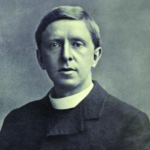 Editor’s Note: The passage below is from the novel Lord of the World, written by the English Catholic convert Monsignor Robert Hugh Benson (the son of the Anglican Archbishop of Canterbury) in 1907. He attempts a vision of the world more than a century in the future — in the early 21st century… our own time… predicting the rise of Communism, the fall of faith in many places, the advance of technology (he foresees helicopters) and so forth up until… the Second Coming of the Lord, with which his vision ends. For this reason, and also because Pope Benedict and Pope Francis have repeatedly cited the book, saying its clarification of the danger of a type of humanitarianism without God is a true danger that we do face, we print a selection from it in ITV, now and in the months ahead.
Lord of the World
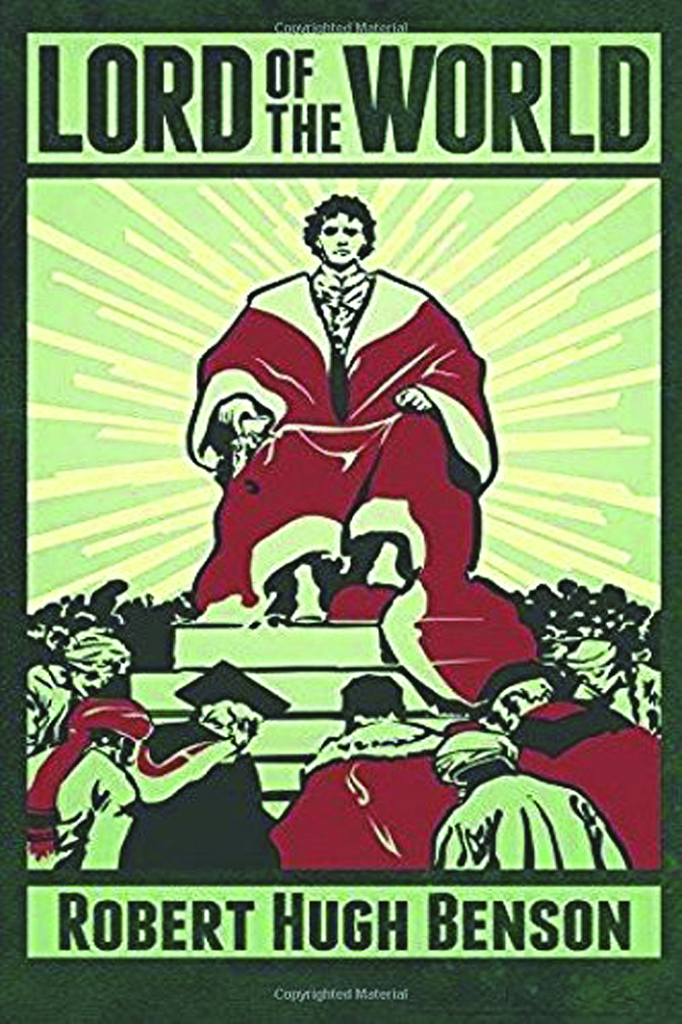
By Robert Hugh Benson (1907)
Book II, The Encounter, Chapter VIII, Section III, and Book III, The Victory, Chapter I, Section I
(Julian Felsenburg is hailed as “Lord and God”; a woman is offered as his “mother.” The Pope, in exile, reads Felsenberg’s official biography, contemplating its “sublime egotism” which alone is “capable of confronting the Christian spirit.”)
A great panting as of some monstrous life began to fill the air as the mob swayed behind Him, and the torrential voice poured on. Waves of emotion swept up and down; there were cries and sobs, the yelping of a man beside himself at last, from somewhere among the crowded seats, the crash of a bench, and another and another, and the gangways were full, for He no longer held them passive to listen; He was rousing them to some supreme act.
The tide crawled nearer, and the faces stared no longer at the Son but the Mother; the girl in the gallery tore at the heavy railing, and sank down sobbing upon her knees. And above all the voice pealed on — and the thin hands blanched to whiteness strained from the wide and sumptuous sleeves as if to reach across the sanctuary itself.
It was a new tale He was telling now, and all to her glory. He was from the East, now they knew, come from some triumph. He had been hailed as King, adored as Divine, as was meet and right — He, the humble superhuman son of a Human Mother — who bore not a sword but peace, not a cross but a crown. So it seemed He was saying; yet no man there knew whether He said it or not — whether the voice proclaimed it, or their hearts asserted it.
He was on the steps of the sanctuary now, still with outstretched hands and pouring words, and the mob rolled after him to the rumble of ten thousand feet and the sighing of ten thousand hearts…. He was at the altar; He was upon it. Again in one last cry, as the crowd broke against the steps beneath, He hailed her Queen and Mother.
The end came in a moment, swift and inevitable. And for an instant, before the girl in the gallery sank down, blind with tears, she saw the tiny figure poised there at the knees of the huge image, beneath the expectant hands, silent and transfigured in the blaze of light. The Mother, it seemed, had found her Son at last.
For an instant she saw it, the soaring columns, the gilding and the colours, the swaying heads, the tossing hands. It was a sea that heaved before her, lights went up and down, the rose window whirled overhead, presences filled the air, heaven flashed away, and the earth shook it ecstasy. Then in the heavenly light, to the crash of drums, above the screaming of the women and the battering of feet, in one thunder-peal of worship ten thousand voices hailed Him Lord and God.
BOOK III – THE VICTORY, CHAPTER I, SECTION I
The little room where the new Pope sat reading was a model of simplicity. Its walls were whitewashed, its roof unpolished rafters, and its floor beaten mud. A square table stood in the centre, with a chair beside it; a cold brazier laid for lighting, stood in the wide hearth; a bookshelf against the wall held a dozen volumes. There were three doors, one leading to the private oratory, one to the ante-room, and the third to the little paved court.
The south windows were shuttered, but through the ill-fitting hinges streamed knife-blades of fiery light from the hot Eastern day outside. It was the time of the mid-day siesta, and except for the brisk scything of the cicade from the hill-slope behind the house, all was in deep silence.
* * * * *
The Pope, who had dined an hour before, had hardly shifted His attitude in all that time, so intent was He upon His reading.
For the while, all was put away, His own memory of those last three months, the bitter anxiety, the intolerable load of responsibility. The book He held was a cheap reprint of the famous biography of Julian Felsenburgh, issued a month before, and he was now drawing to an end. It was a terse, well-written book, composed by an unknown hand, and some even suspected it to be the disguised work of Felsenburgh himself. More, however, considered that it was written at least with Felsenburgh’s consent by one of that small body of intimates whom he had admitted to his society — that body which under him now conducted the affairs of West and East. From certain indications in the book it had been argued that its actual writer was a Westerner.
The main body of the work dealt with his life, or rather with those two or three years known to the world, from his rapid rise in American politics and his mediation in the East down to the event of five months ago, when in swift succession he had been hailed Messiah in Damascus, had been formally adored in London, and finally elected by an extraordinary majority to the Tribuniciate of the two Americas.
The Pope had read rapidly through these objective facts, for He knew them well enough already, and was now studying with close attention the summary of his character, or rather, as the author rather sententiously explained, the summary of his self-manifestation to the world. He read the description of his two main characteristics, his grasp upon words and facts; “words, the daughters of earth, were wedded in this man to facts, the sons of heaven, and Superman was their offspring.”
His minor characteristics, too, were noticed, his appetite for literature, his astonishing memory, his linguistic powers. He possessed, it appeared, both the telescopic and the microscopic eye — he discerned world-wide tendencies and movements on the one hand; he had a passionate capacity for detail on the other.
Various anecdotes illustrated these remarks, and a number of terse aphorisms of his were recorded. “No man forgives,” he said; “he only understands.” “It needs supreme faith to renounce a transcendent God.” “A man who believes in himself is almost capable of believing in his neighbour.” Here was a sentence that to the Pope’s mind was significant of that sublime egotism that is alone capable of confronting the Christian spirit: and again, “To forgive a wrong is to condone a crime,” and “The strong man is accessible to no one, but all are accessible to him.”
There was a certain pompousness in this array of remarks, but it lay, as the Pope saw very well, not in the speaker but in the scribe. To him who had seen the speaker it was plain how they had been uttered — with no pontifical solemnity, but whirled out in a fiery stream of eloquence, or spoken with that strangely moving simplicity that had constituted his first assault on London.
It was possible to hate Felsenburgh, and to fear him; but never to be amused at him. But plainly the supreme pleasure of the writer was to trace the analogy between his hero and nature.
In both there was the same apparent contradictoriness — the combination of utter tenderness and utter ruthlessness. “The power that heals wounds also inflicts them: that clothes the dungheap with sweet growths and grasses, breaks, too, into fire and earthquake; that causes the partridge to die for her young, also makes the shrike with his living larder.”
So, too, with Felsenburgh; He who had wept over the Fall of Rome, a month later had spoken of extermination as an instrument that even now might be judicially used in the service of humanity.
Only it must be used with deliberation, not with passion.
The utterance had aroused extraordinary interest, since it seemed so paradoxical from one who preached peace and toleration; and argument had broken out all over the world.
But beyond enforcing the dispersal of the Irish Catholics, and the execution of a few individuals, so far that utterance had not been acted upon. Yet the world seemed as a whole to have accepted it, and even now to be waiting for its fulfilment.
As the biographer pointed out, the world enclosed in physical nature should welcome one who followed its precepts, one who was indeed the first to introduce deliberately and confessedly into human affairs such laws as those of the Survival of the Fittest and the immorality of forgiveness. If there was mystery in the one, there was mystery in the other, and both must be accepted if man was to develop.
And the secret of this, it seemed, lay in His personality. To see Him was to believe in Him, or rather to accept Him as inevitably true.
“We do not explain nature or escape from it by sentimental regrets: the bear cries like a child, the wounded stag weeps great tears, the robin kills his parents; life exists only on condition of death; and these things happen however we may weave theories that explain nothing. Life must be accepted on those terms; we cannot be wrong if we follow nature; rather to accept them is to find peace — our great mother only reveals her secrets to those who take her as she is.”
So, too, with Felsenburgh. “It is not for us to discriminate: His personality is of a kind that does not admit it. He is complete and sufficing for those who trust Him and are willing to suffer; an hostile and hateful enigma to those who are not. We must prepare ourselves for the logical outcome of this doctrine. Sentimentality must not be permitted to dominate reason.”
Finally, then, the writer showed how to this Man belonged properly all those titles hitherto lavished upon imagined Supreme Beings. It was in preparation for Him that these types came into the realms of thought and influenced men’s lives.
He was the Creator, for it was reserved for Him to bring into being the perfect life of union to which all the world had hitherto groaned in vain; it was in His own image and likeness that He had made man.
Yet He was the Redeemer too, for that likeness had in one sense always underlain the tumult of mistake and conflict. He had brought man out of darkness and the shadow of death, guiding their feet into the way of peace.
He was the Saviour for the same reason — the Son of Man, for He alone was perfectly human; He was the Absolute, for He was the content of Ideals; the Eternal, for He had lain always in nature’s potentiality and secured by His being the continuity of that order; the Infinite, for all finite things fell short of Him who was more than their sum.
He was Alpha, then, and Omega, the beginning and the end, the first and the last. He was Dominus et Deus noster [“Our Lord and Our God”] (as Domitian had been, the Pope reflected).
He was as simple and as complex as life itself — simple in its essence, complex in its activities.
(to be continued)