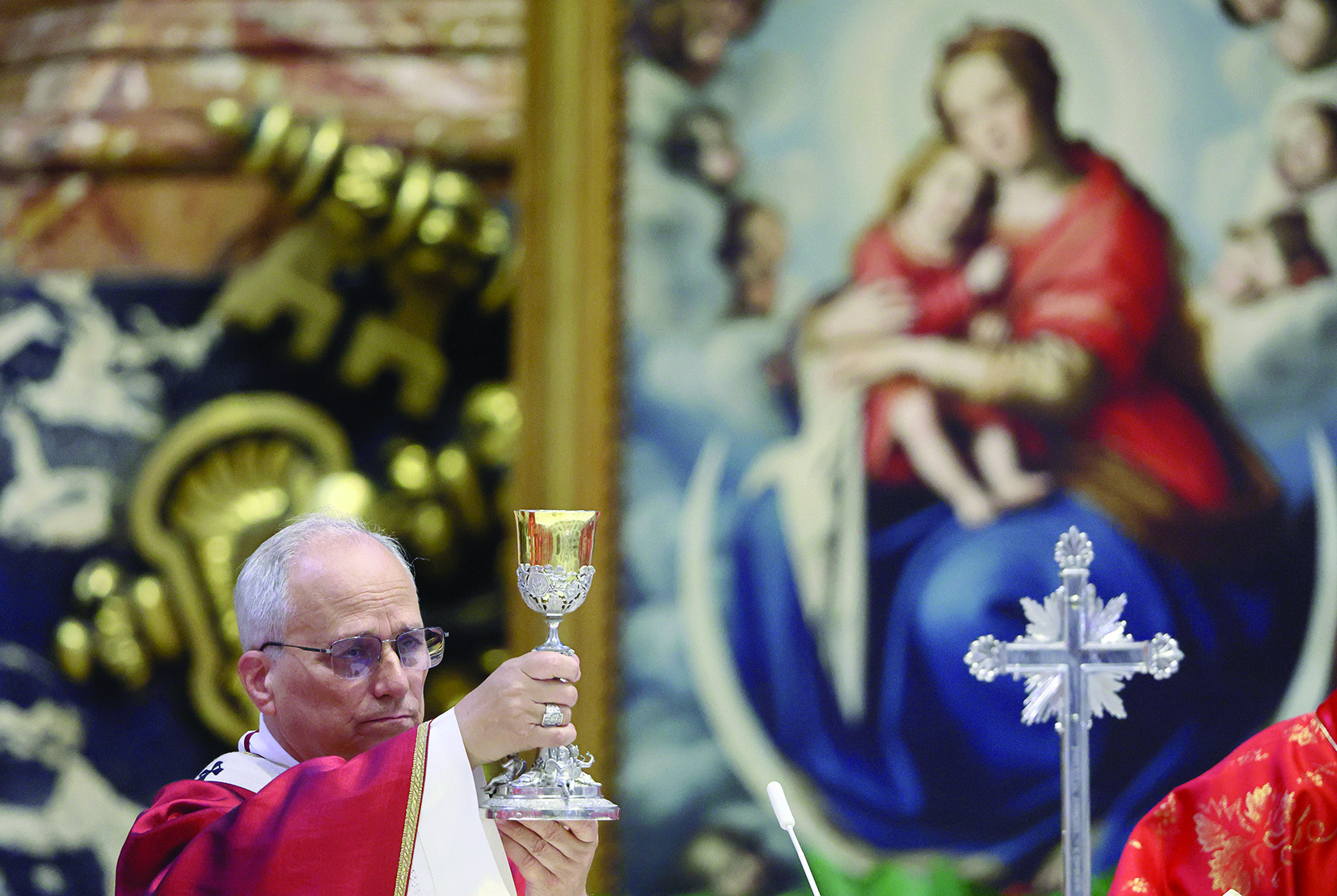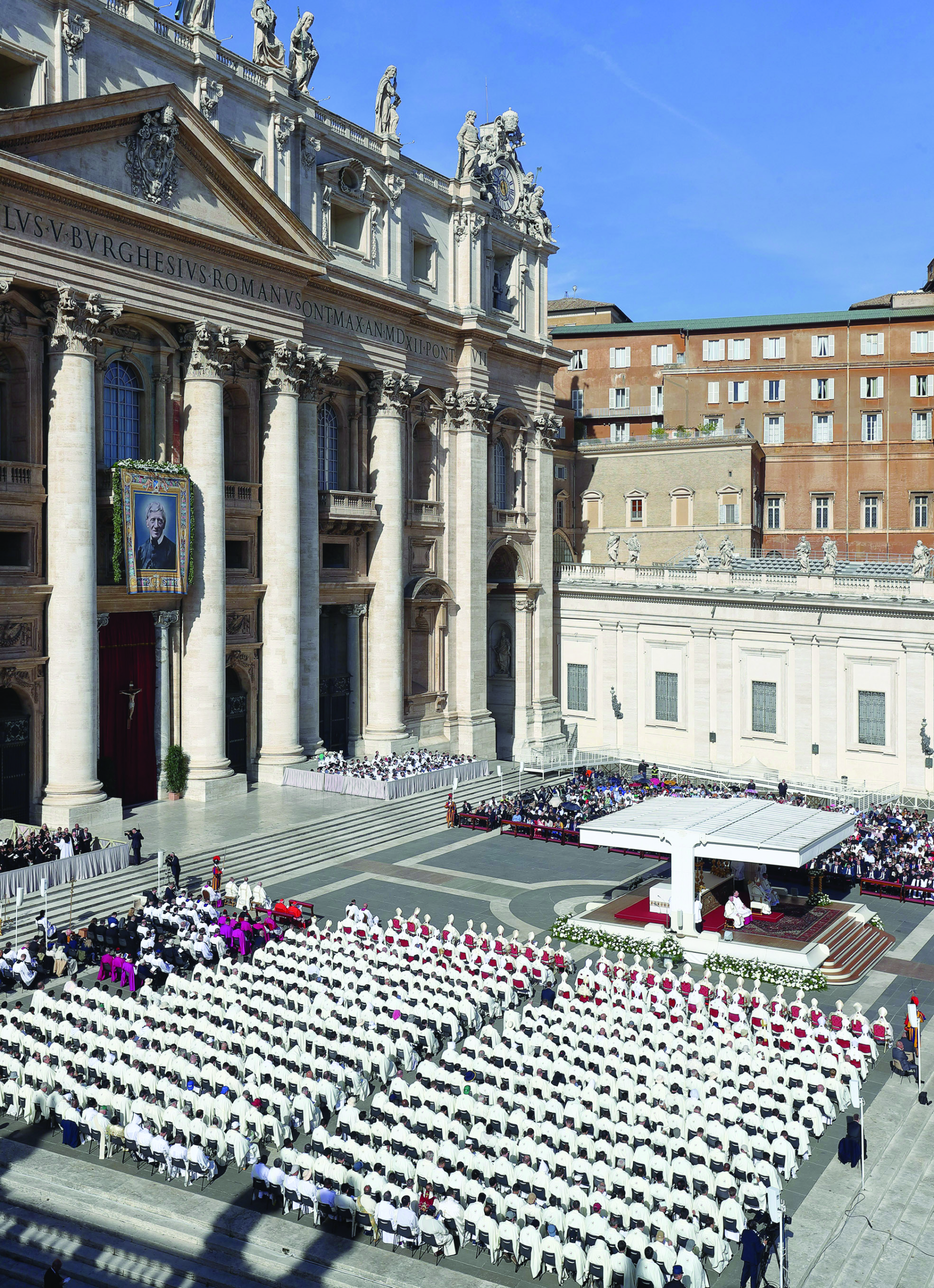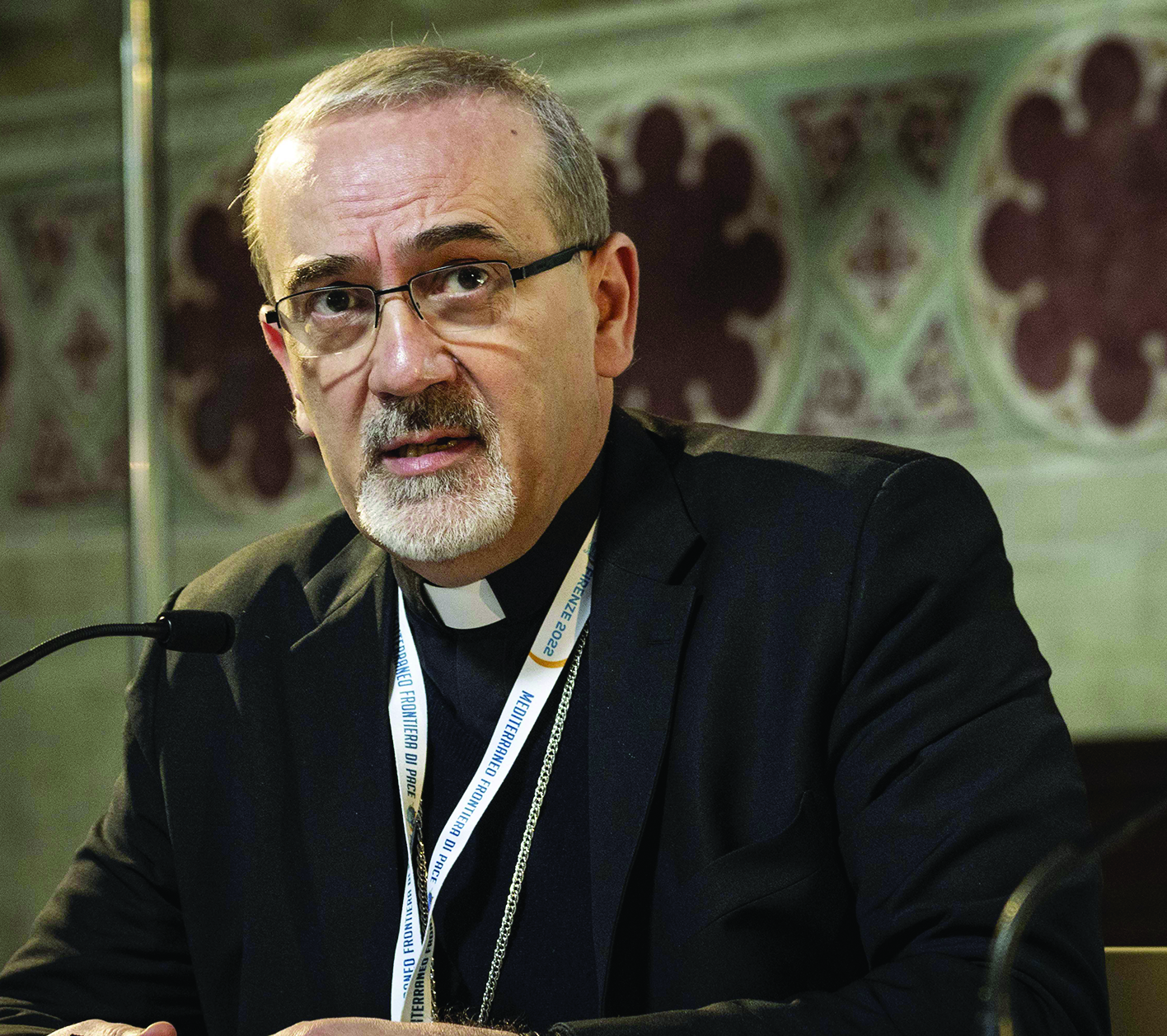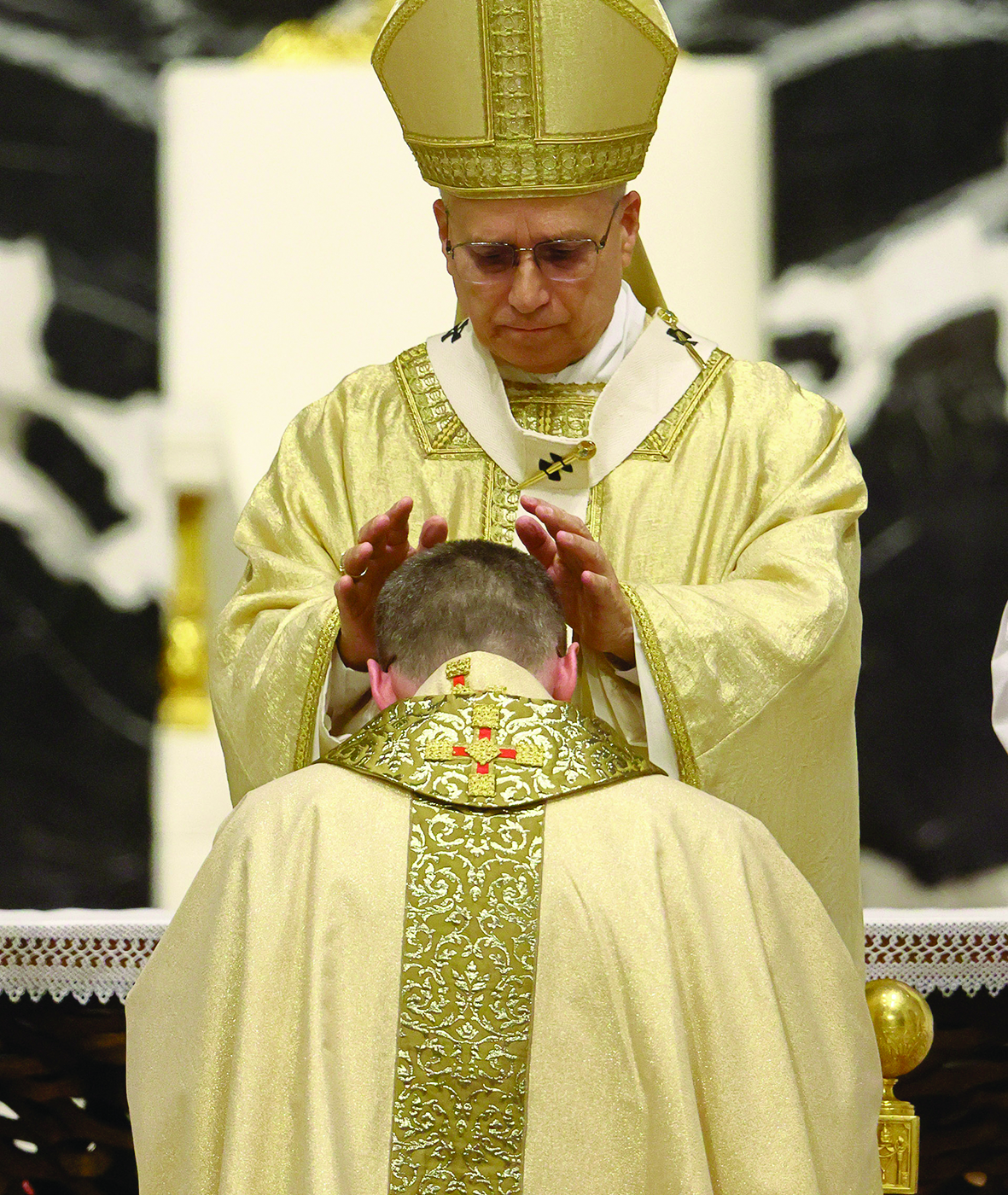
Every day, he says, a curtain opens on each of the thousands of characters that inhabit St. Peter’s
Text by Christina Deardurff – Photos by Grzegorz Galazka

Although St. Peter’s Basilica is the church most closely associated with the Pope (in his office as Pope, as well as geographically — he lives in its shadow), it is in fact not the church of which he is pastor. That honor belongs to St. John Lateran Basilica — the oldest basilica in the Western world and the “Mother Church” of Catholicism, which lies about two miles outside of Vatican City.
So, who is the pastor of St. Peter’s?
You might be surprised to learn he is not another dour veteran Curial official, but rather a jolly Franciscan from the south of Italy, who jokes about the fact that he, unlike most other pastors, does not have most of the keys to the buildings in his parish.
But Fra Agnello Stoia has a kind of “master key,” he told CNS in 2022 — the “affection of the ‘Sanpietrini,’” the workers at St. Peter’s, with whom he tries hard to form bonds of friendship.
For example, he said, “I ask for the keys, and I go down to the pallium niche” under the basilica’s main altar, which also is near St. Peter’s tomb. “But I go discreetly because other people cannot go down there, and I feel bad.”
Fra Agnello is a Conventual Franciscan who spent 19 years in the convent of San Francesco a Folloni, in Montella, in the south of Italy. In fact, it is Montella that he hopes to return to when his duties at St. Peter’s are completed.
But for now, he is concentrating on turning “tourists” into “pilgrims” at St. Peter’s, which is visited by between 10 and 20 million people a year. For Fra Agnello, St. Peter’s is not just a magnificent expression of a worldwide faith; it is also a parish.
Cardinal Mauro Gambetti, another Conventual Franciscan who heads the Fabric of St. Peter’s, oversees the care and conservation of the building.
But Fra Agnello conducts the dayto-day parish life of St. Peter’s. Marriages and baptisms, confirmations and confessions, all are celebrated at St. Peter’s, and Fra Agnello is the one, aided by Missionary Sisters of the Faith in the parish office, who oversees them all.
His demeanor is joyful, and he finds that joy in the daily pastor’s work he does among the mighty, the lowly and everyone in between.
Like the title character in George Bernanos’ magnificent novel Diary of a Country Priest, Fra Agnello’s ever-present smile seems to say: “Joy is the gift of the Church, whatever joy is possible for this sad world to share… What would it profit you even to create life itself, when you have lost all sense of what life really is?”
***
Below, Inside the Vatican asked Fra Agnello what it means to hold the unique job of the “parish priest” of St. Peter’s — and how he maintains his joy amid the human anxieties he sees every day.
ITV: How is St. Peter’s different from other parishes? Are your parishioners comprised of only the people who live in Vatican City? Or is it all the millions who visit? How can you care for both since they are so different?
Fra Agnello: Each parish is unique in its history and community, but San Pietro is a one-of-a-kind parish! I like to compare it to the heart which receives the blood to be oxygenated from the periphery of the body and, once this exchange has taken place, sends it back into the circulation without retaining even a drop. Thus, from every part of the world, believers come to Peter’s tomb to renew their faith and their love for the Holy Father, and then each return to their own lives and their communities of origin.
Therefore, at St. Peter’s we must welcome all pilgrims and help them have a significant experience of meeting with St. Peter and the Lord. The beauty of the basilica, of the songs, of the splendor of the liturgy — we must pay a lot of attention to this. Even Saint Francis — whose son I am — wanted decorum and splendid praise to shine in the Churches. It makes me think of Fra Cesareo da Spira, a German who became the greatest musician at the court of France — a rock star of his time! — who, once he became a friar, set the Mass of Saint Francis and Saint Anthony to music, composing hymns which — thanks to the missionary friars — went around the world…
Welcoming and the liturgy are two cornerstones of the work that, as a parish priest, I carry out in St. Peter’s Basilica. Obviously I am not alone; together with the Cardinal Archpriest Mauro Gambetti and the Vatican Chapter, we are a team continually engaged on this front.
In particular, the Fabric of St. Peter’s has equipped itself with a reception office for pilgrims. But particular applicants knock at the parish office, for baptisms, confirmations, first communions and weddings. For some time now, many have also been asking to renew their marriage vows on their 25th or 50th anniversary. The work is really a lot but we are not discouraged, which I say together with the Missionary Sisters of the Faith who work with me in the parish office. I love calling them “The Vatican dream team”!

Where were you born and raised and do you have any siblings? Did you imagine you would be a pastor at an early age?
I was born in Pagani, a town a few kilometers from the Sanctuary of Pompeii, where the presence and devotion to Saint Alfonso de’ Liguori is strong. I grew up in Nocera, in the shadow of the Convent of Sant’Antonio run by my brothers, the Conventual Friars Minor. Mine is a large family; we are six children, of which I am the eldest. The smallest one is male while in the middle there are four females. After the earthquake that hit Campania in 1980, my family moved to the north, to Lake Garda, and lives there. But I have always remained in the South, except for my training which I did in Rome, at the Seraphicum.
I was nine years old when I met a friar. It happened in front of my house: it was the feast of the Patron Saint — San Prisco -— and the procession stopped at number 80 in Via Origlia, where we lived.
I approached a man in the procession who wasn’t dressed like my parish priest and asked him: “Why are you dressed so strangely?” and he replied: “Why do you say ‘strange’? This is the dress of Saint Francis!”
“Where do you live?” I asked him, and he said to me: “At the convent of Sant’Antonio — come and visit us.”
And so I began to frequent what would one day become my religious family. When I was nine years old and I made my First Communion, on the souvenir that was distributed to everyone they wrote by mistake “Agnello” instead of “Aniello,” which is the name with which I am registered with the Municipality. But I only discovered this after, as a friar, I had chosen the name Fra Agnello.
But for everyone, in the family and among those who knew me in those years, I was Nello, Nellino… almost as if it were the name of a small seed!
Where have you managed to bring more sense of the sacred into the experience of visitors to St. Peter’s Basilica? Where was it difficult or frustrating?
I gained experience for eight years in the central Parish of Santi Apostoli in Piazza Venezia, in the heart of the historic center of Rome. And I understood that “going out” — as Pope Francis always invites us to do — for me meant “welcoming.” Here in St. Peter’s, since I arrived, I understood that the Fisherman of Galilee, Kefa (Aramaic for “Peter”), had to leave the Basilica and return to the streets of Rome — because the City had forgotten that its special mission in the world of being “universal” is not given by the reflected light of the Caesars, which set centuries and centuries ago, but is given by the testimony and blood of the apostles Peter and Paul.
So the video mapping that we created on the facade of the Basilica, together with the Fratelli Tutti Foundation, was a proclamation and a starting point. (This is a video projected onto the facade of St. Peter’s which tells the story of the first Pope. You can see the video in English at www.fondazionefratellitutti.org/video-mapping/#video-gallery-a32852d-2.)
All this work continues outside of St. Peter’s Basilica, in the places of the apostolic memories, trying to involve the religious and parish communities of Rome around these sites so that they return to the originating moment of this truly special Community which, having the Pope as Bishop, presides with him in Charity over all of the churches of the world.
Furthermore, in St. Peter’s Square we wanted to recover the Marian dimension of the face of the Church by presenting as an image the “Mother of the Church” which is the most emblematic Marian image we have in the Basilica, and proposing in the months of May and October, on Saturday evenings, the procession with her image and the recitation of the rosary aux flambeaux.
In the month of June, however, we dedicate St. Peter’s Square to the prayer of the “Via Petri,” a pious practice that traces the life of Peter in twelve stations. In other times of the year, the Basilica hosts a common prayer every Saturday evening, with Eucharistic adoration at the altar of the Confession: each time there is great participation, especially of young people. And the other liturgical moments in the life of the Basilica are underlined by its own liturgies, memorials and celebrations with displays of relics linked to the passion of Christ, or to the Popes and holy doctors who are buried there.
Furthermore, the celebrations tend to take over the space of the Basilica so that when you enter, especially on Sunday, you are necessarily catapulted into the prayers, the songs, the scents of the incense, the splendor of the lights of the celebrations — allowing the basilica to reveal its most beautiful aspect, also artistically speaking, as part of the praise that the whole Assembly raises to the Father.
It is a work in progress and we must have the patience to involve all those who are at the service of the basilica, clerics and lay people both. It’s not automatic: you need training, time, and tenacity in the face of normal resistance (“It’s always been done like this in the Basilica…” or “These things have never been done in the Basilica!”). But things of value convince over time and become a shared mentality and then, finally, a common feeling and action.

What was the most unexpected but joyful aspect of your coming to St. Peter’s in 2021?
When Cardinal Gambetti called me to talk to me about this proposal for me, I was really very surprised; it was St. Patrick’s Day 2021. But the thing that made me rejoice so much was the possibility of sharing this with the people who in all these years have accompanied me. The Lord gave me the opportunity to work with many people to build communities. And then my joy has always been a participation in this large group of people who have come from everywhere to rejoice with me, wherever the Lord has called me to serve.
And this joy was contagious, because even in the Vatican they immediately realized that something unusual was happening; this group of peaceful invaders brought a liveliness and happiness that belonged to everyone. The last occasion was last November, when I celebrated my 30th anniversary of priestly ordination: together with a nice group of families we also managed to organize a chestnut party inside the rectory, roasting a quintal of chestnuts for everyone, with the great joy of the Canon brothers, the Sanpietrini and all those who joined our spontaneous celebration.
How do you maintain your sense of humor about the difficulties of your job?
I have a healthy sense of humor, more Neapolitan than English. It is a heritage that I carry from my family and cultural background in Naples. And as happens in Naples, every day on the street you can see the spectacle of life, with its most tragic aspects and, at the most tragic point, it ends up becoming even more comical (Pirandello’s great lesson, which is visible in Edoardo De Filippo’s theater or in the comedy of Totò)…
So I too, in St. Peter’s, often see myself as if I were inside a kind of “nativity scene” tableau composed of such jagged humanity. Inside that magnificent setting of the Basilica, there is an important fact that is always remembered: God becoming man. In my heart, I have the notes of Saint Alphonsus de’ Liguori and contemplating this mystery gives me joy; it is a meditation that puts me in a good mood continuously, even in the face of the thousand curtains that open every day on the many characters that inhabit St. Peter’s — like a Neapolitan “nativity scene.”
Vatican News on Holy Week “snack” with the homeless
A “snack” with the poor of St. Peter’s: Fra Agnello Stoia and a moment of listening and friendship
The parish priest of the Vatican Basilica recounts the afternoon spent with the homeless who live in the area around the Vatican in the courtyard of the Santo Spirito in Sassia complex, shared with the almoner Cardinal Krajewski and many volunteers: “We listened to their stories, which were very incisive. We decided to do it outdoors because our friends live on the streets”

Fra Agnello Stoia with one of the “guests” in the Courtyard of the Friars inside the monumental complex of Santo Spirito in Sassia (photo: Vatican Media)
A pillow, a slice of tart and a cup of tea: many small “living rooms” to experience an afternoon of serenity and friendship and put aside, at least for a few moments, the weight of loneliness and indifference. This is the gift that on Monday, March 25, the beginning of Holy Week this year, the Apostolic Charity Office and the parish of St. Peter’s wanted to offer to the poor who gravitate around the Vatican Basilica every day. About a hundred invitations were made, and 75 or 80 people responded with their presence.
The location of this special “snack” was the “Courtyard of the Friars” inside the monumental complex of Santo Spirito in Sassia, which was possible to access thanks to the collaboration of the Extraordinary Commissioner of ASL Rome 1, Giuseppe Quintavalle. With the papal almoner, Cardinal Konrad Krajewski, and the parish priest of the Basilica, Fra Agnello Stoia, many volunteers sat together with the poor to talk and listen to their stories. In addition to the showers, health care services, and the provision of clothing and food by the Charities and various associations, it is occasions like these that make people for whom life is particularly hard feel part of a community.
To Vatican Media, Fra Agnello described the afternoon he experienced: “It was a moment placed in the context of Holy Week which begins with Jesus at his friends’ house. In fact, we titled it ‘With Jesus in Bethany, in the house of Lazarus.’ In Lazarus’ house, Jesus finds the warmth of friendship and above all he finds Martha and Mary, Mary who listens to him and Martha who serves him.
“And so we wanted to share all this with our poor friends. We welcomed them like Jesus in a beautiful place, recalling Lazarus’ house, and there were people who listened to their stories; therefore acting like Mary, and others served them, like Martha. It was a very beautiful moment, an embrace for our poor friends, wanting to enter Holy Week with them like this.
“Jesus, among other things, in yesterday’s Gospel, where the others reproached Judas for the outburst that he makes when he complains, in short, ‘All this perfume… is wasted; it could have been given to the poor…’ — Jesus says of Mary: ‘Leave her alone, because you will always have the poor with you…’”