By Robert Moynihan, drawing on a CNA report by Almudena Martínez-Bordiú
The “Synod on Synodality” ended on October 26 without calling for any radical changes in Church doctrine or practice. But the process of the Synod itself is turning out to be the “radical change” in how the Church governs herself. This change finds its roots in one interpretation of the ecclesiology of the Second Vatican Council (1962-65). So argues American Catholic writer Matt Gaspers, who says that this is “the key” to understanding the 2024 Synod. —RM

From the austere disposition of cardinals and bishops during Vatican II in the 1960s to the round tables (below) in the Paul VI Audience Hall at which the delegates of the 2024 Synod sat without any hierarchical distinction (Photo – G. Galazka).
The Second Session of the Synod on Synodality took place in October at the Vatican, the culmination of a three-year process initiated by Pope Francis in October 2021. Composed of 368 voting members from across the globe — 96 of whom were not bishops — this year’s assembly focused on the question, “How to be a synodal Church in mission?”
When the Synod concluded, on the evening of October 26, in a significant departure from previous synods, Francis adopted the final document, foregoing a traditional “apostolic exhortation” in favor of direct implementation of the assembly’s conclusions.
The 52-page document, approved by 355 synod members in attendance, outlines substantial proposals for Church renewal, including: (1) expanded women’s leadership roles; (2) greater lay participation in decision-making; and (3) significant structural reforms. The final document is organized into five main sections and calls for five forms of conversion: spiritual, relational, procedural, institutional, and missionary.
Among the most significant proposals is a call for strengthening pastoral councils at parish and diocesan levels.
The document advocates for regular ecclesiastical assemblies across all Church levels — including continental — and more ecumenical dialogue.
The text introduces the concept of “synodal authority” while acknowledging that in “a synodal Church, the authority of the Bishop, of the Episcopal College and of the Bishop of Rome in regard to decision-taking is inviolable.”
“Such an exercise of authority, however, is not without limits,” the document adds. The text calls for a revision in canon law, “clarifying the distinction and relation between consultation and deliberation and shedding light on the responsibilities of those who play different roles in the decision-making process.”
Women’s Leadership
The document explicitly states there is “no reason or impediment” to prevent women from assuming leadership roles in the Church. Furthermore, “the question of women’s access to diaconal ministry remains open,” and that discernment should continue.
The text advocates for increased female participation in clergy formation and broader involvement in Church decision-making processes.
The document significantly expands the role of lay faithful in Church governance. It calls for their increased presence in synodal assemblies and all phases of ecclesiastical decision-making. New procedures for selecting and
evaluating bishops and expanded lay participation in diocesan leadership and canonical processes are proposed.
Implementation Phase
While Pope Francis has declared the synodal path “completed,” the document emphasizes that a crucial implementation phase lies ahead. This next stage will focus on integrating synodality as a “constitutive dimension of the Church.”
The text also addresses accountability measures, calling for enhanced financial transparency and protocols for abuse prevention, declaring: “The need within the Church for healing, reconciliation and the rebuilding of trust has resounded at every stage of the synodal process.”
The document represents the culmination of one of the most extensive consultative processes in Church history, building on both the 2023 assembly’s work and the broader synodal journey initiated in 2021. The exercise aimed to balance “traditional Church teaching” with “contemporary pastoral needs” while promoting “greater inclusivity and transparency” in Church governance.
Back to the Beginning

Fr. Yves Congar (d. 1995), a Dominican theologian at the Second Vatican Council (1962-1965)
“If we want to speak of a synodal Church,” Pope Francis said three years ago, “we cannot remain satisfied with appearances alone; we need content, means and structures that can facilitate dialogue and interaction within the People of God, especially between priests and laity… This will require changing certain overly vertical, distorted and partial visions of the Church, the priestly ministry, the role of the laity, ecclesial responsibilities, roles of governance and so forth.”
As American Catholic writer Matt Gaspers notes in a report he forwarded to me, “During the same address, Francis also quoted Fr. Yves Congar (d. 1995), a progressive Dominican theologian at the Second Vatican Council (1962-1965), who once said: ‘There is no need to create another Church, but to create a different Church’ (Fr. Yves Congar, True and False Reform in the Church, 1950).”
“A Continuation of Vatican II”

October 2, 2024, Vatican City. Pope Francis during a session of the 16th Ordinary General Assembly of the Synod of Bishops in the Paul VI Audience Hall (Photo – G. Galazka)

Fr. Vimal Tirimanna, C.Ss.R., a Sri Lankan theologian and 2024 Synod delegate
Gaspers adds: “Arguably the best summation of the meaning of the Synodal process was given last year by Fr. Vimal Tirimanna, C.Ss.R., a Sri Lankan theologian and Synod delegate, who said during a press briefing: ‘This synodal process is not a private agenda of Pope Francis; it is a continuation of Vatican II. Of course, [the] Church had so many other things to face during the last five decades or so, but now, the Vatican II theology — rather, the ecclesiology of Vatican II [emphasis added] — is being revived.’”
Gaspers adds: “Commenting on the seating arrangement during the Synod, Fr. Tirimanna likewise observed that ‘the round tables themselves,’ at which delegates sat without distinction in the Paul VI Audience Hall, ‘are a symbol of the ecclesiology of Lumen Gentium,’ the Council’s Dogmatic Constitution on the Church.
“And interestingly, the phrase ‘ecclesiology of Vatican II’ is found in Synodality in the Life and Mission of the Church (SLMC), a document produced by the Vatican’s International Theological Commission in 2018. It has been a foundational text throughout the synodal process and is quoted multiple times in the final document just approved by delegates and issued by Pope Francis.”
The goal of creating “a different Church” based on the “ecclesiology of Vatican II,” Gaspers contends, has been the “overarching narrative promoted by Synod officials and documents over the past three years.”
The following paragraph from the Final Document is evidence for this thesis: “Rooted in the Tradition of the Church, the entire synodal journey took place in the light of the conciliar magisterium.
“The Second Vatican Council was indeed like a seed thrown onto the field of the world and the Church…The Synod 2021-2024 continues to draw upon the energy of that seed and develop its potential. The synodal journey is indeed putting into practice what the Council taught about the Church as Mystery and Church as People of God, called to holiness through continual conversion that comes from listening to the Gospel. In this sense, the synodal journey constitutes an authentic further act of reception of the Council, thus deepening its inspiration and reinvigorating its prophetic force for today’s world” (FD, 5).
Thus Gaspers concludes: “This is the key to understanding the Synod, which, in many ways, was a continuation of the battle between what Christopher Ferrara has called ‘the party of Catholic Tradition on the one hand, in continuity with all that the Church has handed down in her doctrine and practice through the centuries … and, on the other hand, the party of innovation, modernization, liberalization, adaptation, indeed revolution in the Church.’” (Christopher Ferrara, False Friends of Fatima, p. 11).
This battle was waged during the Council, and it continues in the Church today. Let us consider a few examples and draw some connections between the Council and the Synod, in the following analysis by Matt Gaspers.
Emphasis Shift in Ecclesiology

During Vatican II, the “party of innovation” was successful in causing a significant emphasis shift in ecclesiology, the branch of theology that deals with the nature and constitution of the Church. (Fr. Tirimanna illustrated the shift quite well when he celebrated the seating arrangement of Synod delegates as representing “a concentric Church, not a pyramidal Church.”)
Prior to the Council, emphasis was traditionally placed on the Church’s sacred hierarchy and the dignity of those who belong to it. Pope Pius XII, for example, taught in Mystici Corporis Christi (1943): “That those who exercise sacred power in this Body are its chief members must be maintained uncompromisingly,” and further, “Bishops must be considered as the more illustrious members of the universal Church” and “should be revered by the faithful as divinely appointed successors of the Apostles.” (MCC, 17, 42).
“At the same time,” Pius XII said, “when the Fathers of the Church sing the praises of this Mystical Body of Christ… they are thinking not only of those who have received Holy Orders, but of” those in religious life and the laity, as well. (MCC, 17). Thus, Pius XII honored all the members of the Church but emphasized the special dignity and role of the hierarchy, in accord with St. Ignatius of Antioch’s ancient teaching (ca. A.D. 110): “Apart from these [bishops, priests, and deacons], there is no Church” (Epistle to the Trallians, 3).
The “ecclesiology of Vatican II,” on the other hand, “stresses the common dignity and mission of all the baptized, in exercising the variety and ordered richness of their charisms, their vocations and their ministries” (SLMC, 6).
“Having set forth the functions of the hierarchy,” begins the 4th chapter of Lumen Gentium, “the Sacred Council gladly turns its attention to the state of those faithful called the laity. Everything that has been said above concerning the People of God [2nd chapter of LG] is intended for the laity, religious and clergy alike. But there are certain things which pertain in a special way to the laity, both men and women… Due to the special circumstances of our time,” which are not specified, “the foundations of this doctrine must be more thoroughly examined” (LG, 30).
While Lumen Gentium does note that the common priesthood of the faithful differs from the ministerial priesthood “in essence and not only in degree,” it also emphasizes that they “are nonetheless interrelated: each of them in its own special way is a participation in the one priesthood of Christ” (LG, 10).
“Let the spiritual shepherds recognize and promote the dignity as well as the responsibility of the laity in the Church,” the document says. “Let them willingly employ their prudent advice. Let them confidently assign duties to them in the service of the Church, allowing them freedom and room for action.” (LG, 37).
In some ways, these exhortations are good and can lead to positive lay collaboration with the hierarchy.
However, they can also be used by the “party of innovation” as a mandate for lay prominence (if not dominance), which was a major topic throughout the Synod and is promoted in the final document: “The lay faithful, both men and women, should be given greater opportunities for participation, also exploring new forms of service and ministry in response to the pastoral needs of our time in a spirit of collaboration and differentiated co-responsibility,” including “increased participation of laymen and laywomen in Church discernment processes and all phases of decision-making processes (drafting, making and confirming decisions).” (FD, 77).
While the final document says “the authority of the Bishop, of the Episcopal College and of the Bishop of Rome in regard to decision-taking is inviolable,” it also asserts that such authority “is not without limits: it may not ignore a direction which emerges through proper discernment within a consultative process, especially if this is done by participatory bodies,” going so far as to call for “a revision of Canon Law from a synodal perspective, clarifying the distinction and relation between consultation and deliberation and shedding light on the responsibilities of those who play different roles in the decision-making process” (FD, 92).
If consulting and heeding the laity becomes mandatory for bishops in regard to governing their dioceses, this would certainly qualify as a revolution in ecclesiology.
Another Shift: From Conversion to Dialogue

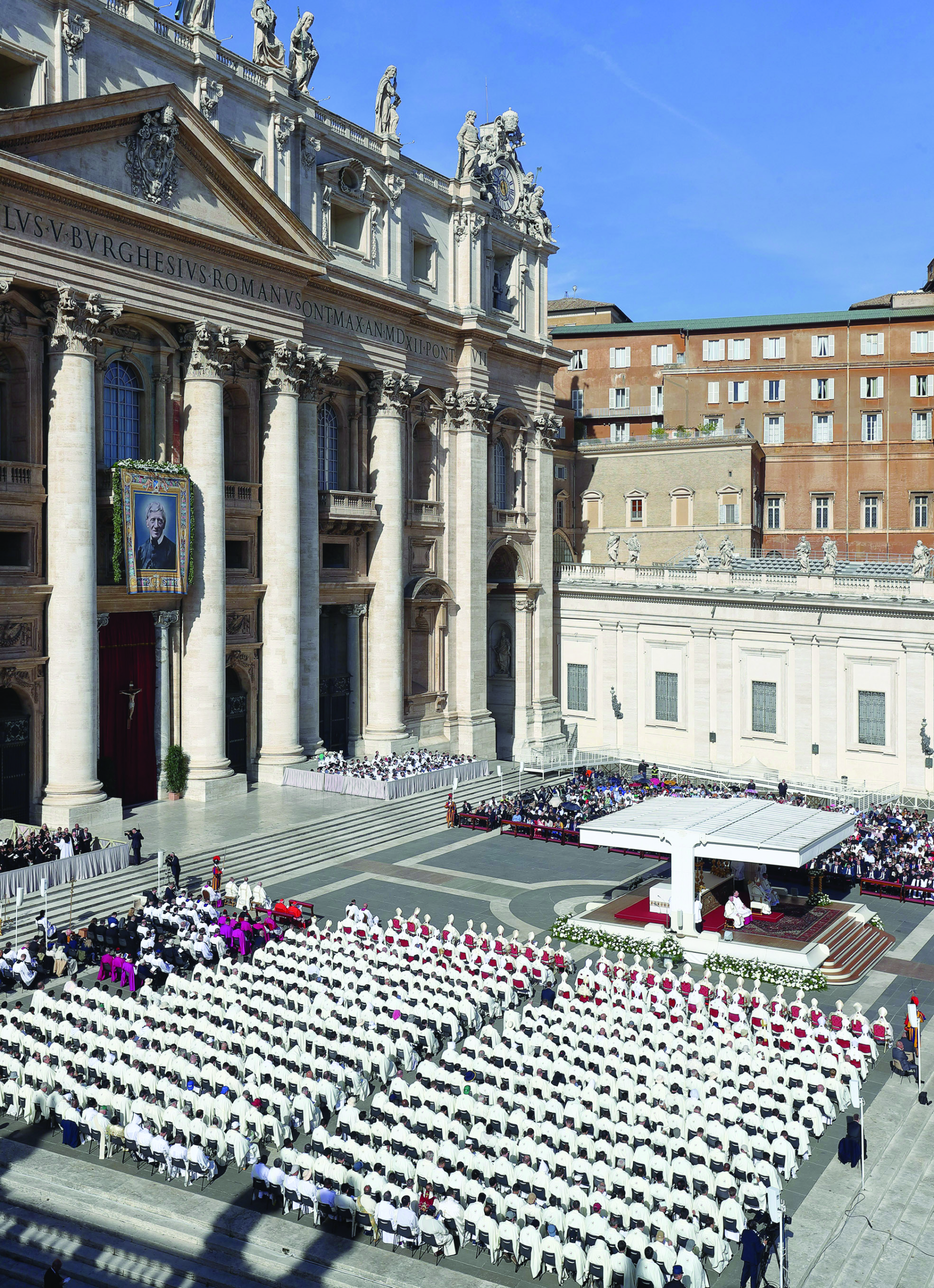
October 27, 2024, St. Peter’s Basilica. After the Holy Mass celebrated on the occasion of the Conclusion of the Synod of Bishops, the Chair of St. Peter was exposed under the newly renovated baldacchino (Photo – G. Galazka).
Another seismic shift that occurred during the Council, which was very apparent throughout the Synod, involves the very definition of the Church and her stance toward non-Catholics. Whereas Pius XII reiterated Catholic dogma that the “true Church of Jesus Christ… is the One, Holy, Catholic, Apostolic and Roman Church” (MCC, 13), Lumen Gentium introduced a novel distinction between “the one Church of Christ” and “the Catholic Church,” stating that the former “subsists in” the latter (LG, 8). This has led many to embrace the claim that the “Church of Christ” is somehow larger and more encompassing than the Catholic Church.
In short, thanks to the “party of innovation,” the Council shifted the emphasis from conversion to dialogue, and the Synod has exclusively promoted dialogue from the beginning.
Take, for example, the official Synod handbook (2021), which insisted that “no one — no matter their religious affiliation — should be excluded from sharing their perspective and experiences [during the consultation phase], insofar as they want to help the Church on her synodal journey of seeking what is good and true.” The Working Document for the Continental Stage (2022) likewise affirmed: “A synodal process is incomplete without meeting brothers and sisters from other confessions, sharing and dialogue with them, and engaging in common actions” (DCS, 22). We find similar language in the final document issued this year: “Be ing in the world and for the world, [the People of God] walk together with all the peoples of the earth, in dialogue with their religions and their cultures, recognising in them the seeds of the Word [a phrase found in the Conciliar decree Ad Gentes], journeying towards the Kingdom.” (FD, 17)
“We reaffirm the commitment of the Catholic Church to continue and intensify the ecumenical journey with other Christians, by virtue of our common Baptism and in response to the call to live together the communion and unity among disciples for whom Christ prayed at the Last Supper (cf. Jn 17:20-26).” (FD, 40)
“The plurality of religions and cultures… are an invitation to each person to confront his or her own unconscious bias, resist the temptation of being at the center, and open oneself to the acceptance of other perspectives.” (FD, 42) The phrase “plurality of religions” is reminiscent of the Document on Human Fraternity (February 4, 2019, abbreviated as DHF) and its claim that “the pluralism and the diversity of religions… are willed by God in His wisdom.”
The Synod’s final document recalls the signing of DHF by Pope Francis and the Grand Imam in 2019 and says, “A synodal Church commits itself to walk this path alongside the believers of other religions and people of other beliefs wherever it lives. It freely shares the joy of the Gospel and gratefully receives their respective gifts” (FD, 123).
All of this stands in stark contrast to the Church’s traditional emphasis on the need for non-Catholics to convert in order to be saved. This is the focus of the traditional Good Friday prayers, the contents of which are radically different in the Missal of Paul VI (1970).
As for “journeying towards the Kingdom,” the Roman Catechism (issued after the Council of Trent) explains that every time we pray the Our Father, we are asking “God that the kingdom of Christ, that is, His Church, may be enlarged; that Jews and infidels may embrace the faith of Christ and the knowledge of the true God; that schismatics and heretics may return to soundness of mind, and to the communion of the Church of God which they have deserted…” (Catechism of the Council of Trent [TAN Books, 2017], p. 565).
There is no such language found in any of the Synod texts produced over the past three years, nor any reminders that “the union of Christians can only be promoted by promoting the return to the one true Church of Christ of those who are separated from it” (Pope Pius XI, Mortalium Animos, 10).
“Permanent Revolution”
The term “revolution” denotes the repudiation and replacement of something old with something new. To a degree, this is what happened during Vatican II. In the words of Fr. Congar, “the Church has peacefully undergone its October Revolution,” referring to the Council.
As with all revolutions, however, there are always some who want to push the envelope further, and the same is true in the Church. Examples of this from the Synod include the call for a female diaconate (which remains on the table — see FD, 60) and the acceptance of “alternative lifestyles” associated with the “LGBT” acronym, both of which obviously go beyond the letter of Vatican II. And yet, they are consistent with the radical spirit that animates “the party of innovation, modernization, liberalization, adaptation, indeed revolution in the Church.”
The answer to this “permanent revolution” in the Church was summed up beautifully by Cardinal Gerhard Müller last year: “God does not need us to give His Word an update or the Church an upgrade.
“Instead of listening to ‘human precepts and doctrines’ (Col. 2:22), we are to adhere to ‘the sound words of our Lord Jesus Christ and the teaching which accords with godliness’ (1 Tim. 6:3).
“Let us forsake the vain project of using our limited human logic to ‘reform’ God’s word in accord with alleged paradigm shifts.
“We are the ones who need to reform and conform to God.”