More than a century ago, Monsignor Robert Hugh Benson foresaw the rise of secular humanism, the contraction of the Catholic Church, and the coming of the Antichrist
By ITV Staff
Editor’s Note: The passage below is from the novel Lord of the World, written by the English Catholic convert Monsignor Robert Hugh Benson (the son of the Anglican Archbishop of Canterbury) in 1907. He attempts a vision of the world more than a century in the future — in the early 21st century… our own time… predicting the rise of Communism, the fall of faith in many places, the advance of technology (he foresees helicopters) and so forth up until… the Second Coming of the Lord, with which his vision ends. For this reason, and also because Pope Benedict and Pope Francis have repeatedly cited the book, saying its clarification of the danger of a type of humanitarianism without God is a true danger that we do face, we print a selection from it in ITV, now and in the months ahead.
LORD OF THE WORLD
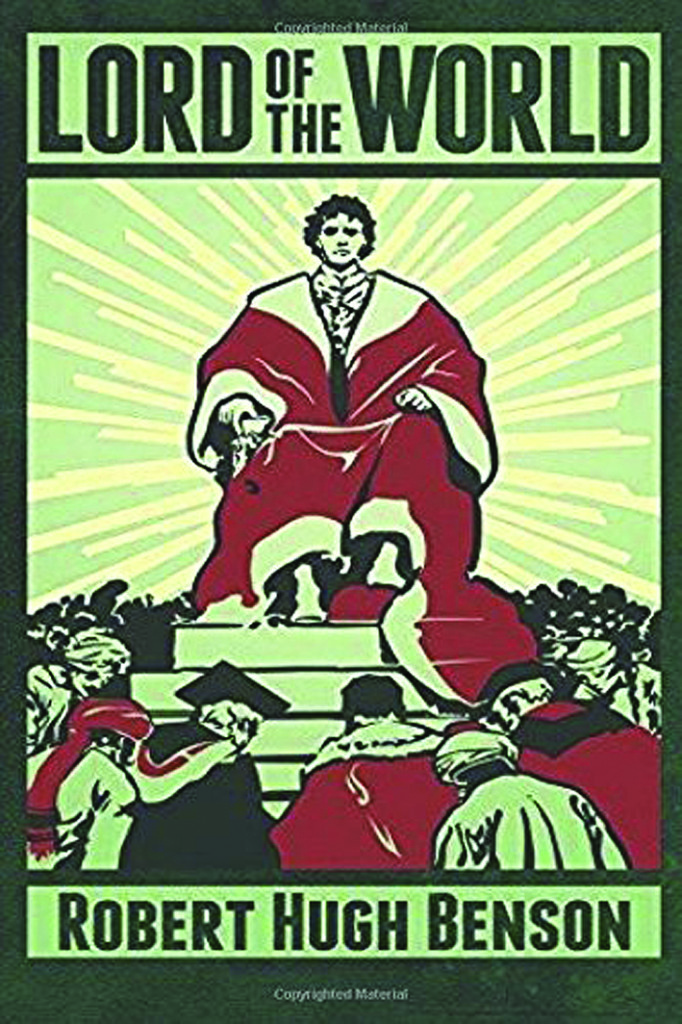
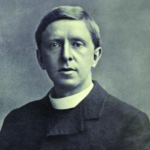 BY ROBERT HUGH BENSON (1907)
Book III, The Victory, Chapter II, Section II
(After Rome falls, Fr. Percy Franklin, secretly elected Pope, lives in exile in Nazareth with a faithful Syrian priest. As word is clandestinely communicated to the leading Catholic prelates around the world, the new Pope Sylvester prepares to make a decision that will affect the entire worldwide Church…)
“Make sure it is the Cardinal,” he said abruptly.
The priest tapped off an enquiry, and, with moving lips, read off the printed message, as like magic it precipitated itself on to the tall white sheet of paper that faced him.
“It is his Eminence, Holiness,” he said softly. “He is alone at the instrument.”
“Very well. Now then; begin.”
“We have received your Eminence’s letter, and have noted the news…. It should have been forwarded by telegraphy—why was that not done?”
The voice paused, and the priest who had snapped off the message, more quickly than a man could write it, read aloud the answer.
“‘I did not understand that it was urgent. I thought it was but one more assault. I had intended to communicate more so soon as I heard more.’”
“Of course it was urgent,” came the voice again in the deliberate intonation that was used between these two in the case of messages for transmission. “Remember that all news of this kind is always urgent.”
“‘I will remember,’” read the priest. “‘I regret my mistake.’”
“You tell us,” went on the Pope, His eyes still downcast on the paper, “that this measure is decided upon; you name only three authorities. Give me, now, all the authorities you have, if you have more.”
There was a moment’s pause. Then the priest began to read off the names.
“‘Besides the three Cardinals whose names I sent, the Archbishops of Thibet, Cairo, Calcutta and Sydney have all asked if the news was true, and for directions if it is true; besides others whose names I can communicate if I may leave the table for a moment.’”
“Do so,” said the Pope.
Again there was a pause. Then once more the names began.
“‘The Bishops of Bukarest, the Marquesas Islands and Newfoundland. The Franciscans in Japan, the Crutched Friars in Morocco, the Archbishops of Manitoba and Portland, and the Cardinal-Archbisbop of Pekin. I have despatched two members of Christ Crucified to England.’”
“Tell us when the news first arrived, and how.”
“‘I was called up to the instrument yesterday evening at about twenty o’clock. The Archbishop of Sydney was asking, through our station at Bombay, whether the news was true. I replied I had heard nothing of it. Within ten minutes four more inquiries had come to the same effect; and three minutes later Cardinal Ruspoli sent the positive news from Turin. This was accompanied by a similar message from Father Petrovski in Moscow. Then—-’”
“Stop. Why did not Cardinal Dolgorovski communicate it?”
“‘He did communicate it three hours later.’”
“Why not at once?”
“‘His Eminence had not heard it.’”
“Find out at what hour the news reached Moscow—not now, but within the day.”
“‘I will.’”
“Go on, then.”
“‘Cardinal Malpas communicated it within five minutes of Cardinal Ruspoli, and the rest of the inquiries arrived before midnight. China reported it at twenty-three.’”
“Then when do you suppose the news was made public?”
“‘It was decided first at the secret London conference, yesterday, at about sixteen o’clock by our time. The Plenipotentiaries appear to have signed it at that hour. After that it was communicated to the world. It was published here half an hour past midnight.’”
“Then Felsenburgh was in London?”
“‘I am not yet sure. Cardinal Malpas tells me that Felsenburgh gave his provisional consent on the previous day.’”
“Very good. That is all you know, then?”
“’I was called up an hour ago by Cardinal Ruspoli again. He tells me that he fears a riot in Florence; it will be the first of many revolutions, he says.’”
“Does he ask for anything?”
“‘Only for directions.’”
“Tell him that we send him the Apostolic Benediction, and will forward directions within the course of two hours. Select twelve members of the Order for immediate service.”
“‘I will.’”
“Communicate that message also, as soon as we have finished, to all the Sacred College, and bid them communicate it with all discretion to all metropolitans and bishops, that priests and people may know that We bear them in our heart.”
“‘I will, Holiness.’”
“Tell them, finally, that We had foreseen this long ago; that We commend them to the Eternal Father without Whose Providence no sparrow falls to the ground. Bid them be quiet and confident; to do nothing, save confess their faith when they are questioned. All other directions shall be issued to their pastors immediately!”
“‘I will, Holiness.’”
* * * * *
There was again a pause.
The Pope had been speaking with the utmost tranquillity as one in a dream. His eyes were downcast upon the paper, His whole body as motionless as an image. Yet to the priest who lis-tened, despatching the Latin messages, and reading aloud the replies, it seemed, although so little intelligible news had reached him, as if something very strange and great was im-pending. There was the sense of a peculiar strain in the air, and although he drew no deductions from the fact that apparently the whole Catholic world was in frantic communication with Damascus, yet he remembered his meditations of the evening before as he had waited for the messenger. It seemed as if the powers of this world were contemplating one more step—with its nature he was not greatly concerned.
The Pope spoke again in His natural voice.
“Father,” he said, “what I am about to say now is as if I told it in confession. You understand?—Very well. Now begin.”
Then again the intonation began.
“Eminence. We shall say mass of the Holy Ghost in one hour from now. At the end of that time, you will cause that all the Sacred College shall be in touch with yourself, and waiting for our commands. This new decision is unlike any that have preceded it. Surely you understand that now. Two or three plans are in our mind, yet We are not sure yet which it is that our Lord intends. After mass We shall communicate to you that which He shall show Us to be according to His Will. We beg of you to say mass also, immediately, for Our intention. Whatever must be done must be done quickly. The matter of Cardinal Dolgorovski you may leave until later. But we wish to hear the result of your inquiries, especially in London, before mid-day. Benedicat te Omnipotens Deus, Pater et Filius et Spiritus Sanctus.”
“‘Amen!’” murmured the priest, reading it from the sheet.
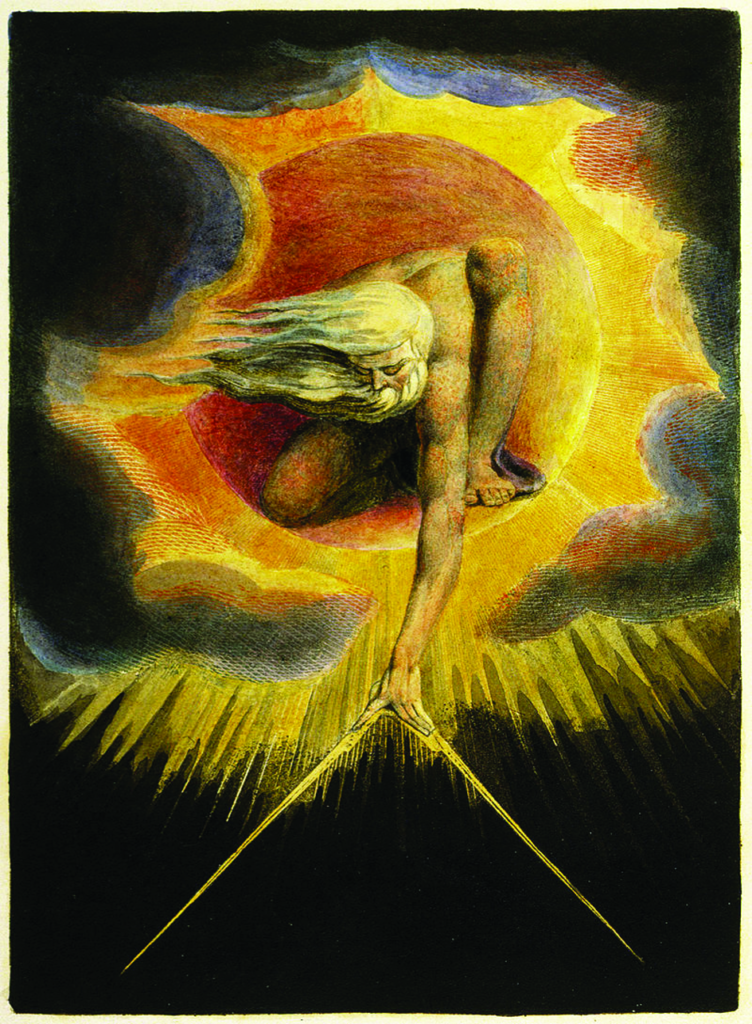
God as depicted by British poet William Blake as the “architect of creation,” the “Ancient of Days,” now in the British Museum, London
III
The little chapel in the house below was scarcely more dignified than the other rooms. Of ornaments, except those absolutely essential to liturgy and devotion, there were none. In the plaster of the walls were indented in slight relief the fourteen stations of the Cross; a small stone image of the Mother of God stood in a corner, with an iron-work candlestick before it, and on the solid uncarved stone altar, raised on a stone step, stood six more iron candlesticks and an iron crucifix. A tabernacle, also of iron, shrouded by linen curtains, stood beneath the cross; a small stone slab projecting from the wall served as a credence. There was but one window, and this looked into the court, so that the eyes of strangers might not penetrate.
It seemed to the Syrian priest as he went about his business—laying out the vestments in the little sacristy that opened out at one side of the altar, preparing the cruets and stripping the covering from the altar-cloth—that even that slight work was wearying. There seemed a certain oppression in the air. As to how far that was the result of his broken rest he did not know, but he feared that it was one more of those scirocco days that threatened. That yellowish tinge of dawn had not passed with the sunrising; even now, as he went noiselessly on his bare feet between the predella and the prie-dieu where the silent white figure was still motionless, he caught now and again, above the roof across the tiny court, a glimpse of that faint sand-tinged sky that was the promise of beat and heaviness.
He finished at last, lighted the candles, genuflected, and stood with bowed head waiting for the Holy Father to rise from His knees. A servant’s footstep sounded in the court, coming across to hear mass, and simultaneously the Pope rose and went towards the sacristy, where the red vestments of God who came by fire were laid ready for the Sacrifice.
* * * * *
Silvester’s bearing at mass was singularly unostentatious. He moved as swiftly as any young priest, His voice was quite even and quite low, and his pace neither rapid nor pompous. According to tradition, He occupied half-an-hour ab amictu ad amictum; and even in the tiny empty chapel He observed to keep His eyes always downcast.
And yet this Syrian never served His mass without a thrill of something resembling fear; it was not only his knowledge of the awful dignity of this simple celebrant; but, although he could not have expressed it so, there was an aroma of an emotion about the vestmented figure that affected him almost physically—an entire absence of self-consciousness, and in its place the consciousness of some other Presence, a perfection of manner even in the smallest details that could only arise from absolute recollection. Even in Rome in the old days it had been one of the sights of Rome to see Father Franklin say mass; seminary students on the eve of ordination were sent to that sight to learn the perfect manner and method. (to be continued)