By Mother Martha
The ancient Romans were the world’s first gourmets. They owe their obsession with food, at least in part, to fellow citizen Marcus Gabius. Better known as Apicius, he was a wealthy decadent epicure who in the first century wrote De Re Coquinaria (Concerning Culinary Matters), the world’s first cookbook. He specialized in spicy sauces and cakes and held extravagant feasts for his friends, in particular the emperor Tiberius’ son, at his seaside villa at Minturnae between Rome and Naples. Alas, when he’d blown most of his fortune, Apicius poisoned himself, afraid to die of hunger. After Apicius’s suicide, De Re Coquinaria was copied and recopied. The oldest two surviving manuscripts are in the Vatican Library and in the New York Academy of Medicine.
Roman cuisine might not be to everyone’s taste. Before the internet, when I wrote about it for Hemispheres, United Airlines’ inflight magazine, the editor sent me a fax saying “Do the Romans really eat those things?” To my answer “yes,” in shock he responded, “And you?”
My “I’ve learned to” left him speechless.
Although many of Rome’s some 5,000 bustling, clattery trattorie serving Roman specialties are family-run, only Checchino dal 1887 has belonged to the same family for so long — six generations so far. The restaurant is carved into the man-made Monte de’ Cocci, a hill of discarded broken amphoras from ancient Rome’s nearby port. Brothers chef Elio and sommelier Francesco Mariani specialize, although not exclusively, in dishes using the quinto quarto or fifth quarter — offal, tripe, intestines, and oxtail — originally discarded or used as part of the workers’ salaries at the slaughterhouse across the street which closed in 1975. In fact, coda alla vaccinara (oxtail braised with tomato and celery), now a classic of cucina romana, was invented here. Also, always on the menu are: rigatoni con pajata (pasta with baby-calf intestines), animelle (sweetbreads), coratella con carciofi (chopped lamb heart, liver, lungs, and windpipe with artichokes), and trippa (tripe) cooked with wild mint and tomato.
Another dynastic eatery of Roman cuisine is Felice, owned by the Trivelloni family since 1936. Like Checchino dal 1887, it’s located in the once working-class turned chic neighborhood called Testaccio named for the Monte de’ Cocchi. Felice’s star dish is tonnarelli cacio pepe, whisked at your table. Present owner Franco, Felice’s son, has posted its recipe on the restaurant’s website. A favorite of the world-famous actor Roberto Begnini, be sure to book (obligatory) at least five days in advance. In addition to the standard menu, Franco and his son Maurizio have an additional separate menu for each day of the week. For the Romans traditionally eat fish on Tuesday and Friday, gnocchi on Thursday, and tripe on Saturday.
Still another dynastic homage to Romanità through its cuisine is Sora Lella, founded in the 1950s by the short, plump, exuberant, comic actress Elena Fabrizi with her much more famous and even shorter and plumper gourmand comic actor older brother Aldo. The children of a widowed fruit vendor in Rome’s historic food market in Campo de’ Fiori, they considered their acting careers a hobby and their true profession restaurateur and gastronome.
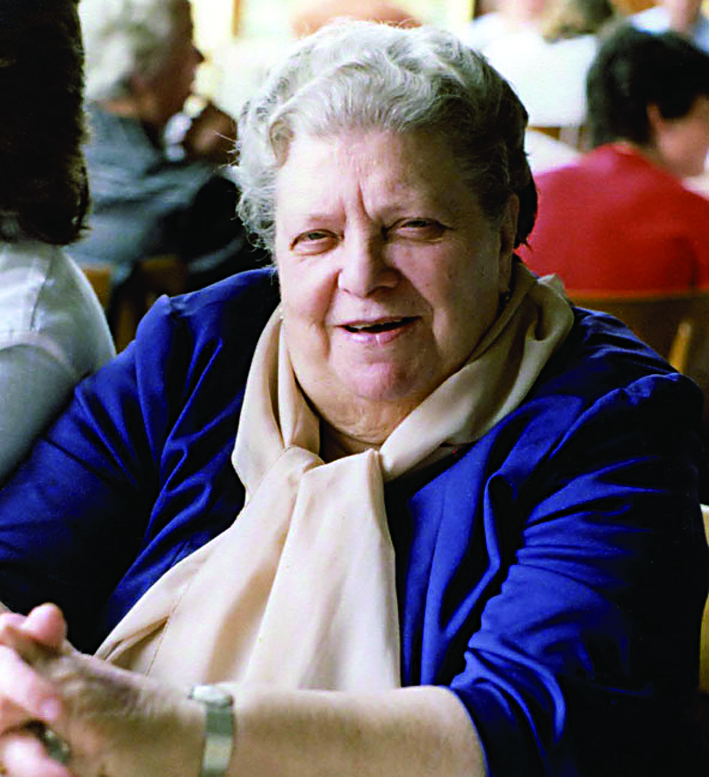
The late Elena Fabrizi, aka Sora Lella, an Italian actress, cook and television presenter
Located on the Tiber Island, the only island in Rome, it’s across from the ancient port. Since 293 BC, when a temple was dedicated here to Aesculapius, the god of healing, there’s always been a hospital here.
After Sora Lella’s death in 1993, her disciple and son Aldo Trabalza took over. Now Aldo’s four children, so the third generation, run the restaurant. His sons Mauro and Renato, who learned Nonna Lella’s recipes hands-on in the 1980s, are the chefs. Her, and now their, mouthwatering starters include supplì, artichokes deep-fried Jewish style, and potato crochets. The menu includes all the classic “Roman” quinto quarto pastas, even some for celiacs. But the house specialty, on the menu since 1961, a homemade tonnarelli alla cuccagna, with 18 ingredients in the sauce, bacon, sausage eggs, and walnuts and more, is a must, as are Renato’s home-made ricotta cake with wild cherry sauce and his gelati.
Like Felice and Sora Lella, Armando al Pantheon, founded in the 1960s, is in its third generation of the Gargioli family ownership. It’s just across the street from the Pantheon, the best preserved of all ancient Rome’s buildings. Reservations are available on line, and only a month ahead of your desired meal. If you’re among the lucky few to find a table, the musts are: spaghetti alla griscia, rigatoni con la pajata, and homemade fettucine con le regaje di pollo (with chicken innards).
To these all-in-the-family classics, don’t overlook the newer entries: Trecca and Osteria Fratelli Mori are also both in Testaccio, and newest of all (opened November 2023), Casa Sceppa, a 10-minute walk from St. Peter’s Basilica.

Aldo, Mauro, Renato, Elena, and Simone Trabalza x
Sora Lella’s son and successor with his four children (Courtesy of Mauro Trabalza).

Coda-alla-vaccinara-tradizionale-830×625 x
Coda alla vaccinara first served at Checchino dal 1887.

Foto di Famiglia di Armando al Pantheon x
Family photo outside “Armando al Pantheon” (Courtesy of Chiara Gargioli)

Apicius_Handschrift_New_York_Academy_of_Medicine x
9th-century manuscript of De Re Coquinaria by Apicius (Wikipedia).