More than a century ago, Monsignor Robert Hugh Benson foresaw the rise of secular humanism, the contraction of the Catholic Church, and the coming of the Antichrist
By ITV Staff
Editor’s Note: The passage below is from the novel Lord of the World, written by the English Catholic convert Monsignor Robert Hugh Benson (the son of the Anglican Archbishop of Canterbury) in 1907. He attempts a vision of the world more than a century in the future — in the early 21st century… our own time… predicting the rise of Communism, the fall of faith in many places, the advance of technology (he foresees helicopters) and so forth up until… the Second Coming of the Lord, with which his vision ends. For this reason, and also because Pope Benedict and Pope Francis have repeatedly cited the book, saying its clarification of the danger of a type of humanitarianism without God is a true danger that we do face, we print a selection from it in ITV, now and in the months ahead.
LORD OF THE WORLD
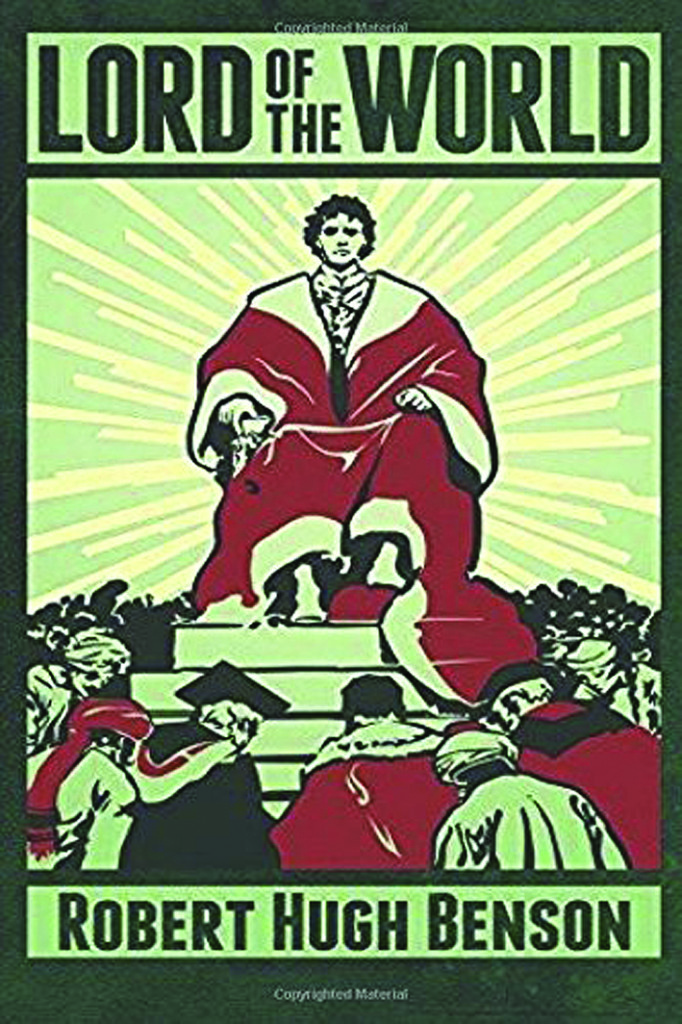
 BY ROBERT HUGH BENSON (1907)
Book III, The Victory, Chapter I, Section III—Chapter II, Section II
(After Rome’s destruction, Fr. Percy Franklin, elected secretly by three remaining cardinals as the new Pope Silvester, lives in exile in Nazareth. A faithful Syrian priest is his chaplain.)
The Pope lifted His hand to His eyes for an instant, then smoothed it down His face.
He nodded across to a dim patch of white walls glimmering through the violet haze of the falling twilight.
“That place, father,” He said, “what is its name?”
The Syrian priest looked across, back once more at the Pope, and across again.
“That among the palms, Holiness?”
“Yes.”
“That is Megiddo,” he said. “Some call it Armageddon.”
CHAPTER II
I
At twenty-three o’clock that night the Syrian priest went out to watch for the coming of the messenger from Tiberias. Nearly two hours previously he had heard the cry of the Russian volor that plied from Damascus to Tiberias, and Tiberias to Jerusalem, and even as it was, the messenger was a little late.
These were very primitive arrangements, but Palestine was out of the world — a slip of useless country — and it was necessary for a man to ride from Tiberias to Nazareth each night with papers from Cardinal Corkran to the Pope, and to return with correspondence. It was a dangerous task, and the members of the New Order who surrounded the Cardinal undertook it by turns.
In this manner all matters for which the Pope’s personal attention was required, and which were too long and not too urgent, could be dealt with at leisure by him, and an answer returned within the twenty-four hours.
It was a brilliant moonlit night. The great golden shield was riding high above Tabor, shedding its strange metallic light down the long slopes and over the moor-like country that rose up from before the house-door—casting too-heavy black shadows that seemed far more concrete and solid than the brilliant pale surfaces of the rock slabs or even than the diamond flashes from the quartz and crystal that here and there sparkled up the stony pathway. Compared with this clear splendor, the yellow light from the shuttered house seemed a hot and tawdry thing; and the priest, leaning against the door-post, his eyes alone alight in his dark face, sank down at last with a kind of Eastern sensuousness to bathe himself in the glory, and to spread his lean, brown hands out to it.
This was a very simple man, in faith as well as in life. For him there were neither the ecstasies nor the desolations of his master. It was an immense and solemn joy to him to live here at the spot of God’s Incarnation and in attendance upon His Vicar. As regarded the movements of the world, he observed them as a man in a ship watches the heaving of the waves far beneath. Of course the world was restless, he half perceived, for, as the Latin Doctor had said, all hearts were restless until they found their rest in God. Quare fremuerunt gentes?… Adversus Dominum, et adversus Christum ejus!
As to the end—he was not greatly concerned. It might well be that the ship would be overwhelmed, but the moment of the catastrophe would be the end of all things earthly. The gates of hell shall not prevail: when Rome falls, the world falls; and when the world falls, Christ is manifest in power. For himself, he imagined that the end was not far away. When he had named Megiddo this afternoon it had been in his mind; to him it seemed natural that at the consummation of all things Christ’s Vicar should dwell at Nazareth where His King had come on earth — and that the Armageddon of the Divine John should be within sight of the scene where Christ had first taken His earthly sceptre and should take it again.
After all, it would not be the first battle that Megiddo had seen. Israel and Amalek had met here; Israel and Assyria; Sesostris had ridden here and Sennacherib. Christian and Turk had contended here, like Michael and Satan, over the place where God’s Body had lain.
As to the exact method of that end, he had no clear views; it would be a battle of some kind, and what field could be found more evidently designed for that than this huge flat circular plain of Esdraelon, twenty miles across, sufficient to hold all the armies of the earth in its embrace? To his view once more, ignorant as he was of present statistics, the world was divided into two large sections, Christians and heathens, and he supposed them very much of a size. Something would happen, troops would land at Khaifa, they would stream southwards from Tiberias, Damascus and remote Asia, northwards from Jerusalem, Egypt and Africa; eastwards from Europe; westwards from Asia again and the far-off Americas. And, surely, the time could not be far away, for here was Christ’s Vicar; and, as He Himself had said in His gospel of the Advent, Ubicumque fuerit corpus, illie congregabuntur et aquilae.
Of more subtle interpretations of prophecy he had no knowledge. For him words were things, not merely labels upon ideas. What Christ and St. Paul and St. John had said—these things were so. He had escaped, owing chiefly to his isolation from the world, that vast expansion of Ritschlian ideas that during the last century had been responsible for the desertion by so many of any intelligible creed. For others this had been the supreme struggle — the difficulty of decision between the facts that words were not things, and yet that the things they represented were in themselves objective.
But to this man, sitting now in the moonlight, listening to the far-off tap of hoofs over the hill as the messenger came up from Cana, faith was as simple as an exact science. Here Gabriel had descended on wide feathered wings from the Throne of God set beyond the stars, the Holy Ghost had breathed in a beam of ineffable light, the Word had become Flesh as Mary folded her arms and bowed her head to the decree of the Eternal. And here once more, he thought, though it was no more than a guess—yet he thought that already the running of chariot-wheels was audible—the tumult of the hosts of God gathering about the camp of the saints—he thought that already beyond the bars of the dark Gabriel set to his lips the trumpet of doom and heaven was astir. He might be wrong at this time, as others had been wrong at other times, but neither he nor they could be wrong for ever; there must some day be an end to the patience of God, even though that patience sprang from the eternity of His nature. He stood up, as down the pale moonlit path a hundred yards away came a pale figure of one who rode, with a leather bag strapped to his girdle.

God as depicted by British poet William Blake as the “architect of creation,” now in the British Museum, London
II
It would be about three o’clock in the morning that the priest awoke in his little mud-walled room next to that of the Holy Father’s, and heard a footstep coming up the stairs. Last evening he had left his master as usual beginning to open the pile of letters arrived from Cardinal Corkran, and himself had gone straight to his bed and slept. He lay now a moment or two, still drowsy, listening to the pad of feet, and an instant later sat up abruptly, for a deliberate tap had sounded on the door. Again it came; he sprang out of bed in his long night-tunic, drew it up hastily in his girdle, went to the door and opened it.
The Pope was standing there, with a little lamp in one hand, for the dawn had scarcely yet begun, and a paper in the other.
“I beg your pardon, Father; but there is a message I must have sent at once to his Eminence.”
Together they went out through the Pope’s room, the priest, still half-blind with sleep, passed up the stairs, and emerged into the clear cold air of the upper roof. The Pope blew out His lamp, and set it on the parapet.
“You will be cold, Father; fetch your cloak.”
“And you, Holiness?”
The other made a little gesture of denial, and went across to the tiny temporary shed where the wireless telegraphic instrument stood.
“Fetch your cloak, Father,” He said again over His shoulder. “I will ring up meanwhile.”
When the priest came back three minutes later, in his slippers and cloak, carrying another cloak also for his master, the Pope was still seated at the table. He did not even move His head as the other came up, but once more pressed on the lever that, communicating with the twelve-foot pole that rose through the pent-house overhead, shot out the quivering energy through the eighty miles of glimmering air that lay between Nazareth and Damascus.
This simple priest had scarcely even by now become accustomed to this extraordinary device invented a century ago and perfected through all those years to this precise exactness — that device by which, with the help of a stick, a bundle of wires, and a box of wheels, something, at last established to be at the root of all matter, if not at the very root of physical life, spoke across the spaces of the world to a tiny receiver tuned by a hair’s breadth to the vibration with which it was set in relations.
The air was surprisingly cold, considering the heat that had preceded and would follow it, and the priest shivered a little as he stood clear of the roof, and stared, now at the motionless figure in the chair before him, now at the vast vault of the sky passing, even as he looked, from a cold colorless luminosity to a tender tint of yellow, as far away beyond Tabor and Moab the dawn began to deepen. From the village half-a-mile away arose the crowing of a cock, thin and brazen as a trumpet; a dog barked once and was silent again; and then, on a sudden, a single stroke upon a bell hung in the roof recalled him in an instant, and told him that his work was to begin.
The Pope pressed the lever again at the sound, twice, and then, after a pause, once more—waited a moment for an answer, and then when it came, rose and signed to the priest to take his place.
The Syrian sat down, handing the extra cloak to his master, and waited until the other had settled Himself in a chair set in such a position at the side of the table that the face of each was visible to the other. Then he waited, with his brown fingers poised above the row of keys, looking at the other’s face as He arranged himself to speak. That face, he thought, looking out from the hood, seemed paler than ever in this cold light of dawn; the black arched eyebrows accentuated this, and even the steady lips, preparing to speak, seemed white and bloodless. He had His paper in His hand, and His eyes were fixed upon this.
(To be continued)