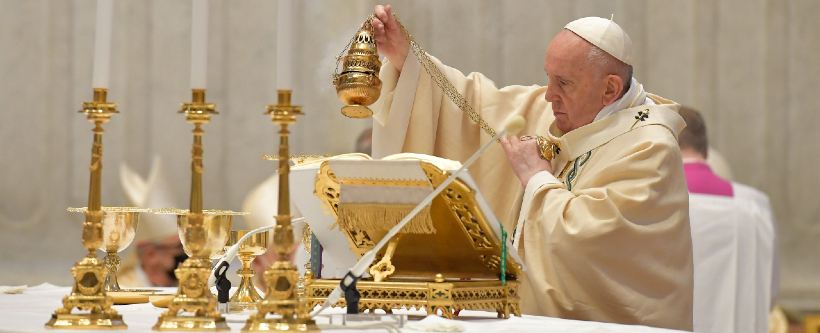
‘One who lives this encounter becomes a witness and makes possible the encounter for others; and makes him also a promoter of the culture of encounter, avoiding self-reference that makes us remain closed in ourselves.’
Today, before our eyes is a simple, humble and great event: Mary and Joseph take Jesus to the Temple of Jerusalem. He is a baby as so many others, as all, but He is unique: He is the Only-Begotten come for all. This Child has brought us the mercy and tenderness of God: Jesus is the face of the Father’s Mercy. This is the icon that the Gospel gives us at the end of the Year of Consecrated Life — a Year lived with so much enthusiasm. Like a river, it now flows in the sea of mercy, in this immense mystery of love that we are experiencing with the Extraordinary Jubilee.
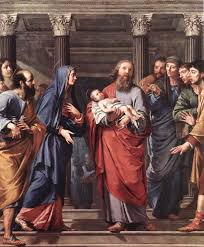 Today’s feast, especially in the East, is called the feast of meeting. In fact, in the Gospel that was proclaimed, we see different meetings (Cf. Luke 2:22-40). In the Temple Jesus comes to meet us and we go to meet Him. We contemplate the meeting with the elderly Simeon, who represents the faithful expectation of Israel and the exultation of the heart for the fulfillment of the ancient promises. We also admire the meeting with the elderly prophetess Anna, who, on seeing the Child, exults with joy and praises God. Simeon and Anna are the expectation and the prophecy; Jesus is the novelty and the fulfillment: He presents Himself to us as the endless surprise of God. In this Child, born for all, the past — made of memory and promise –, and the future — full of hope come together. We can see in this the beginning of Consecrated Life. Consecrated men and women are called first of all to be men and women of encounter. The vocation, in fact, does not take the movements of a plan of ours thought “at table,” but from a grace of the Lord who reaches us through an encounter that changes our life. He is the novelty that makes all things new. One who lives this encounter becomes a witness and makes possible the encounter for others; and makes him also a promoter of the culture of encounter, avoiding self-reference that makes us remain closed in ourselves.
The passage of the Letter to the Hebrews that we heard, reminds us that Jesus Himself, in order to encounter us, did not hesitate to share our human condition: ”Since therefore the children share in flesh and blood, He Himself likewise partook of the same nature” (v. 14). Jesus did not save us “from outside,” He did not remain outside our drama, but willed to share our life. Consecrated men and women are called to be a concrete and prophetic sign of God’s closeness, of the sharing of the condition of fragility, of sin and of wounds of the man of our time. All the forms of Consecrated life, each one in keeping with its characteristics, are called to be in a permanent state of mission, sharing “the joys and hopes, the sorrows and anguishes of the men of today, of the poor especially, and of all those that suffer” (Gaudium et Spes, 1).
The Gospel also tells us “His father and His mother marveled at what was said about Him” (v. 33). Joseph and Mary kept the wonder of this meeting full of light and hope for all peoples. And we also, as Christians and as consecrated persons, are custodians of this wonder. A wonder that calls to be always renewed; woe for habit in the spiritual life; woe to crystalizing our charisms in an abstract doctrine: the Founders’ charisms — as I have said at other times — are not to be sealed in a bottle, they are not museum pieces. Our Founders were moved by the Spirit and were not afraid to soil their hands in daily life, with the people’s problems, going with courage to the geographic and existential fringes. They did not stop in face of obstacles and the incomprehension of others, because they kept in their heart the wonder of the encounter with Christ. They did not domesticate the grace of the Gospel. They always had in their heart a healthy restlessness for the Lord, a consuming desire to take Him to others, as Mary and Joseph did in the Temple. Today we too are called to make prophetic and courageous choices.
In conclusion, from today’s feast we learn to live gratitude for the encounter with Jesus and for the gift of the vocation to Consecrated Life. To give thanks, to render thanks: the Eucharist. How lovely it is when we see the happy face of consecrated persons, perhaps already advanced in age, as Simeon and Anna, happy and full of gratitude for their vocation. This is a word that can summarize the whole of what we lived in this Year of Consecrated Life: gratitude for the gift of the Holy Spirit, who always animates the Church through different charisms.
The Gospel ends with this expression: “And the Child grew and became strong, filled with wisdom; and the favor of God was upon Him” (v. 40). May the Lord Jesus, through the maternal intercession of Mary, be able to grow in us, and increase in each the desire of encounter, the custody of wonder and the joy of gratitude; then others will be attracted by His light, and will be able to encounter the Father’s mercy.