Dignitatis Infinita condemns gender transition, surrogacy and abortion
By Tyler Arnold (CNA)

Presentation in the Holy See Press Office of the Dicastery for the Doctrine of the Faith’s Dignitas Infinita. Panelists: Secretary of the Dicastery for the Doctrine of the Faith, Monsignor Armando Matteo; Dicastery Prefect Cardinal Victor Fernandez; Professor Paola Scarcella, lecturer at the Universities Tor Vergata and Lumsa in Rome; and Vatican Press Office Director Matteo Bruni. Opposite, Cardinal Fernandez (All the photos by Grzegorz Galazka)
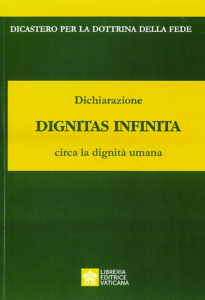 The Vatican’s top doctrinal office issued a declaration on the theme of human dignity on Monday that addresses growing concerns such as gender theory, sex changes, surrogacy, and euthanasia in addition to abortion, poverty, human trafficking, and war.
“In the face of so many violations of human dignity that seriously threaten the future of the human family, the Church encourages the promotion of the dignity of every human person, regardless of their physical, mental, cultural, social, and religious characteristics,” reads the Vatican declaration issued by the Dicastery for the Doctrine of the Faith.
The declaration, titled Dignitas Infinita, which means “infinite dignity,” states that the Church highlights these concerns “with hope, confident of the power that flows from the risen Christ, who has fully revealed the integral dignity of every man and woman.”
Abortion, euthanasia, and surrogacy
In the declaration, the dicastery cautions against threats to human dignity that begin at the moment of conception, that exist in the process of procreation, and that threaten humanity toward the end of life.
According to Pope Francis’ apostolic exhortation Evangelii Gaudium, also cited in the declaration, preborn children are “the most defenseless and innocent among us” and in the present day, “efforts are made to deny them their human dignity and to do with them whatever one pleases, taking their lives and passing laws preventing anyone from standing in the way of this.”
The declaration also warns that euthanasia and physician-assisted suicide are “swiftly gaining ground” in some parts of the world, which it says is “unique in how it utilizes a mistaken understanding of human dignity to turn the concept of dignity against life itself.”
“Even in its sorrowful state, human life carries a dignity that must always be upheld, that can never be lost, and that calls for unconditional respect,” the declaration states.
The practice of surrogacy is another concern noted by the document, noting that “the immensely worthy child becomes a mere object” in the process.
“Because of this unalienable dignity, the child has the right to have a fully human (and not artificially induced) origin and to receive the gift of a life that manifests both the dignity of the giver and that of the receiver,” the declaration says, adding that “…the legitimate desire to have a child cannot be transformed into a ‘right to a child’ that fails to respect the dignity of that child as the recipient of the gift of life.”
Gender theory and sex changes
As many Western nations continue to promote gender ideology and debate whether minors should be able to access transgender drugs and surgeries, the Vatican states that the ideology “intends to deny the greatest possible difference that exists between living beings: sexual difference.”
The declaration emphasizes that “only by acknowledging and accepting this difference in reciprocity can each person fully discover themselves, their dignity, and their identity.”
A human body, the Vatican notes, also shares in the dignity of the image of God, and people are called to accept and respect the body as it was created: “The body participates in that dignity as it is endowed with personal meanings, particularly in its sexed condition.”
“Any sex-change intervention, as a rule, risks threatening the unique dignity the person has received from the moment of conception,” the Vatican adds.
To respect human dignity, the declaration also condemns unjust discrimination, aggression, and violence directed toward individuals based on sexual orientation.
War and poverty
As war rages on in Ukraine, Gaza, Sudan, and elsewhere in the world, the declaration confirms that self defense is permissible but that “war is always a ‘defeat of humanity,’” citing Pope Francis’ address to the United Nations in December.
“No war is worth the tears of a mother who has seen her child mutilated or killed; no war is worth the loss of the life of even one human being, a sacred being created in the image and likeness of the Creator; no war is worth the poisoning of our common home; and no war is worth the despair of those who are forced to leave their homeland and are deprived, from one moment to the next, of their home and all the family, friendship, social, and cultural ties that have been built up, sometimes over generations,” the declaration reads, quoting the current pontiff.
The declaration further discusses the problems of poverty, which it states are linked to the unequal distribution of wealth.
“If some people are born into a country or family where they have fewer opportunities to develop, we should acknowledge that this is contrary to their dignity, which is the same dignity as that of those born into a wealthy family or country,” the declaration adds. “We are all responsible for this stark inequality, albeit to varying degrees.”


Dicastery Prefect Cardinal Victor Fernandez, head of the Vatican’s top doctrinal office after his intervention relieves the tension by opening and eating a package of cookies
Human trafficking, sexual abuse, and violence against women
The declaration states that human trafficking is “among the grave violations of human dignity.” It includes the marketing of human organs and tissues, the sexual exploitation of boys and girls, slave labor, prostitution, the drug and weapons trade, terrorism, and organized crime.
“Confronted with these varied and brutal denials of human dignity, we need to be increasingly aware that human trafficking is a crime against humanity,” the dicastery adds.
Sexual abuse, as explained by the declaration, “leaves deep scars in the hearts of those who suffer it.” It adds that “those who suffer sexual abuse experience real wounds in their human dignity” and that the problem of such abuse plagues society and has also affected the Church.
The dicastery notes that women specifically face threats to their human dignity through inequality and violence. It references unequal pay, a lack of protections for working mothers, the exploitation and sexualization of women, and coercive abortions.
“While the equal dignity of women may be recognized in words, the inequalities between women and men in some countries remain very serious,” the declaration reads. “Even in the most developed and democratic countries, the concrete social reality testifies to the fact that women are often not accorded the same dignity as men.”
Dignity of the marginalized
The dignity of marginalized groups such as migrants and people with disabilities was also addressed in the declaration.
“Migrants are among the first victims of multiple forms of poverty,” the Vatican says. “Not only is their dignity denied in their home countries, but also their lives are put at risk because they no longer have the means to start a family, to work, or to feed themselves.”
The declaration quotes Pope Francis’ encyclical Fratelli Tutti, in which he says: “No one will ever openly deny that [migrants] are human beings; yet in practice, by our decisions and the way we treat them, we can show that we consider them less worthy, less important, less human.” It adds, quoting from Pope Benedict XVI’s encyclical Caritas in Veritate, that “every migrant is a human person who, as such, possesses fundamental, inalienable rights that must be respected by everyone and in every circumstance.”
In the declaration, the dicastery condemns “throwaway culture” and urges society to respect the dignity of other marginalized groups such as those with disabilities.
“Each human being, regardless of their vulnerabilities, receives his or her dignity from the sole fact of being willed and loved by God,” the declaration states.
Human dignity is infinite
In his introduction to the declaration, Dicastery for the Doctrine of the Faith prefect Cardinal Víctor Manuel Fernández emphasizes that the list is not comprehensive, but the subjects were selected to “illuminate different facets of human dignity that might be obscured in many people’s consciousness.”
“The Church sees the condemnation of these grave and current violations of human dignity as a necessary measure,” Fernández writes, “for she sustains the deep conviction that we cannot separate faith from the defense of human dignity, evangelization from the promotion of a dignified life, and spirituality from a commitment to the dignity of every human being.”
Reactions and observations on Dignitatis Infinita: A brief sampling

 Document neither “liberal” nor “conservative”
David Cloutier, the Ordinary Professor of Moral Theology at Catholic University of America told the Crux website:
“The [list of issues] demolishes any kind of attempt to align the Church with liberals or conservatives, or with progressives and traditionalists, because it shows that the Church’s teaching about poverty, and peace, and human trafficking, and migration is completely consistent with its teaching against abortion, against euthanasia, against transgender surgeries, those kinds of things.”
 “Pope has the assistance of the Spirit”
Salvatore Cernuzio noted in a Vatican News article that the Pope’s teaching, according to Cardinal Fernandez in his presentation, requires our assent.
“Some people who used to adore the Pope now say that the Pope should only be listened to when speaking ex cathedra. ‘If it’s not so, we can form our own opinion.’ Listen, the Pope will never speak ex cathedra, will never want to create a dogma of faith or a definitive declaration. I am almost 100% sure. We believe that in addition to the charisma of infallibility, the Pope has the assistance of the Spirit to guide and enlighten the Church,” Fernandez said.
And they betray the oath of obedience to the Holy Father of their ordination, the Cardinals, bishops, and priests “who treat the Pope as a heretic, against the tradition of the Church.”
“Furthermore, if there are those who think that Pope Francis is taking too many steps forward,” the Cardinal said, “it must be remembered that in many cases throughout history, a Pope has said something different from his predecessor.”
 Secular understanding of “dignity” may differ
Commentator John M. Grondelski in an April 22 article in Crisis said:
Why turn to “dignity” as the operative principle to make the Church’s argument? Some have suggested it is in keeping with the “fraternity” focus of Fratelli Tutti. “Dignity” is also a frequently invoked concept in secular human rights discourse, so I assume Rome is attempting to co-opt that language, found in many contemporary human rights declarations (Dignitas mentions approvingly the Universal Declaration on Human Rights)…
But what “dignity” means in those secular documents is often diametrically opposed to what the Church is saying in this Declaration. That’s because much of the secular world calls “dignity” the self-willed preferences of isolated individuals asserted in the name of “autonomy.” That inadequate anthropology is, of course, a flawed basis on which to try to build policy and law which are, in the end, ethical endeavors. Ethics constructed on a false anthropology is a house built on sand.
Outdated theology
Francis DeBarnardo, Executive Director of New Ways Ministry, an advocacy group for LGBTQ Catholics, wrote on the group’s website:
In its approach to gender, the document relies on the outdated theology of gender essentialism which claims that a person’s physical appearance is the central evidence of a person’s natural gender identity. This physicalist perspective shackles the Vatican to the growing consciousness that a person’s gender includes the psychological, social, and spiritual aspects naturally present in their lives.
Criminalization of homosexuality
Loup Besmond de Senneville noted in the French Catholic journal LaCroix on April 9:
For the first time, a magisterial document speaks out against the criminalization of homosexual persons.
Cardinal Fernandez said “it’s painful” that there are Catholics who defend these “unjust” laws. He said he recently read a text from some Church members who applauded the adoption of laws against homosexuals in their country.
“I thought I was going to die when I read that Catholics, who hold such a concept of human dignity, could think such a thing. Obviously, we favor the decriminalization (of homosexuality),” he added.
 The soul “unfolds” itself through the body
Theologian Abigail Favale, in an April 9 post on The Pillar website, wrote:
The sexed body has a “natural order” that is part of the natural ordering of creation, which, as Francis has emphasized, should be received as “gift.”
This natural order of the sexed body, as noted in the earlier paragraphs on gender theory, is oriented toward generativity. That is important, because it contests the claim that a person’s sex can be determined by a cognitive experience, i.e. that a person’s true sex could lie only in the brain or the mind, and not in the reproductive structure of the body as a whole…
One line I find beautiful here is this: “…the body serves as the living context in which the interiority of the soul unfolds and manifests itself…” While not directly cited, this is a rendering of JPII’s principle that the body reveals the person. The language of the soul “unfolding” itself through the body is also highly reminiscent of Edith Stein’s anthropology. Both JPII and Stein help to develop the understanding of the body as a sacramental reality, a visible manifestation of an invisible reality.
 Watering the roots of ideas it opposes
David Deane, Associate Professor of Theology at Atlantic School of Theology, commented in an April 10 analysis in Catholic World Report:
While we should celebrate the things that Dignitas Infinita gets right, if it enshrines a “forgetting” of the reasons for those beliefs, then it is participating in the collapse of those beliefs….
There is a voice within the text that erodes its foundations, a voice whose clearest expression is: “The Church’s Magisterium progressively developed an ever-greater understanding of the meaning of human dignity… until it arrived at the recognition that the dignity of every human being prevails beyond all circumstances” (16). This expresses an idea— far from unique within recent Vatican documents—that Catholicism is only recently waking up to many essential moral truths. It is a principle based on an unnuanced reading of the tradition of Catholic moral theology and soaked through with a “presentism” that can’t see beyond the categories of the modern West.
In Dignitas Infinita, the claim is especially incoherent, not least because the text also states that it is “fully recognizable even by reason alone” that “[e]very human person possesses an infinite dignity… which prevails in and beyond every circumstance” (1). Therefore, not only did Augustine, Aquinas (and the Magisterium which drew on them) fail to recognize a fundamental truth of Christian theology (that is, the intrinsic dignity of every human life) but it was a truth fully recognizable by reason alone.
Shame on them if this were true, but, of course, it’s not true. Why, then, does Dignitas Infinita claim that it is? […]
Whatever their reasons for this mistake, the mistake does damage. It encourages the idea that we have moved from seeing through a glass darkly in the patristic and medieval period to the clarity of the modern age. I do not deny that doctrine can develop and greater clarity can be arrived at. But the universal dignity (as dignity functions in Dignitas Infinita) of human beings is a core tenet of Christian thought from the beginning. To suggest that the Church was wrong about this until quite recently (the UN Declaration on Human Rights is referred to far more than the Fathers and Doctors of the Church) is both erroneous and undermines the authority of Christian tradition as a source for moral reasoning…
Dignitas Infinita thus reinforces the narrative that fuels “progressive” positions on abortion, gender, euthanasia, surrogacy and more, while seeking to oppose them. It waters the roots of the ideas it opposes, while hacking at the roots of the ideas that it seeks to support.